Thought-Factory.net Philosophical Conversations Public Opinion philosophy.com Junk for code

Mandy Martin, Puritjarra 2, 2005. For further information on MANDY MARTIN, refer here: http://www.mandy-martin.com/
If there are diverse kinds of knowledge and ways of knowing place, then we need to learn to value the different ways each of us sees a single place that is significant, but differently so, for each perspective.
RECENT ENTRIES
SEARCH
ARCHIVES
Library
Thinkers/Critics/etc
WEBLOGS
Australian Weblogs
Critical commentary
Visual blogs
CULTURE
ART
PHOTOGRAPHY
DESIGN/STREET ART
ARCHITECTURE/CITY
Film
MUSIC
Sexuality
FOOD & WiNE
Other
www.thought-factory.net
looking for something firm in a world of chaotic flux

beyond a single point perspective? « Previous | |Next »
February 2, 2008

If we reject photography as a window onto the world and as a form of personal expression, then what do we have left? Where do we go? Well, it means that we have left, or are in the process of leaving the cultural formation of positivism and romanticism---the dualist and conflicting twins of modernity as it were ---behind. But what have stepped into? A vacuum? A black hole? Possibly not.

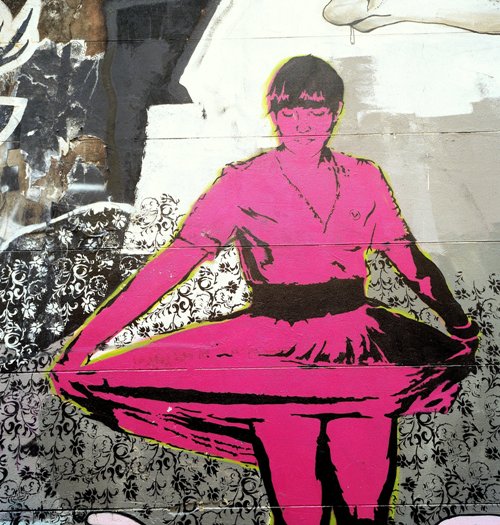
We could interpret this photo as multiple spaces coexist and overlapping like a computer screen--as if it were a customized igoogle desktop-- rather than as a picture:
HosierLane4.jpg
Gary Sauer-Thompson, Hosier Lane, Melbourne, 2007

What if windows were actually translucent and not transparent? One that lends itself to imaginative narrative mappings rather than to the production of a “window on the world? This excellent image----Once Upon Time --- on Myla Kent's blog is a better example of a translucent window. It is different to this kind of historical image making. It is possible to read/interpret Kent's image as if it were a computer screen, rather than the single point perspective that reaches back to Leon Battista Alberti De pictura (1435).

I'm not sure where this leads----to the flows of multiple perspectives within a single computer frame? To virtual windows, as understood in Anne Friedberg's interesting The Virtual Window: From Alberti to Microsoft. That text charts a pathway.

Update
Some of my photography takes its bearings from pop artists such as Robert Rauschenberg and James Rosenquist.
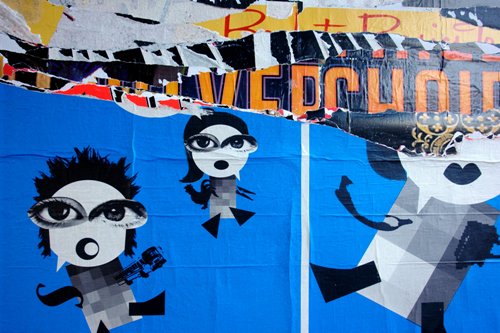
dancersMelbourrneCBD.jpg Gary Sauer-Thompson, street art, King Street, Melbourne CBD

The way we produce and interpret both the moving and still image seems to be undergoing a series of profound shifts. We have come to inhabit a pervasive screen-scape in which our “position is no longer fixed in relation to the virtual elsewheres and elsewhens seen on a screen… the virtual window is mobile and pervasive.

What does seem to have gone--in contemporary work such as this ---is the strong linkage of the linear or single-point perspective with the “Cartesian subject: centered and stable, anonymous and thinking, standing outside the world. The computer-based virtualities do not adhere to a fixed, perspectival positioning, as we have multiple-screen display or multiple-screen composition within the single frame.

| Posted by Gary Sauer-Thompson at 5:25 PM | | Comments (31)
Comments

Comments

Gary,

It is a rare occurrence when an artist unifies diverse and seemingly contradictory images with any degree of elegance or plausibility. When it happens, it brings to mind Lautreamont's oft-quoted line, "as beautiful as the chance meeting on a dissecting-table of a sewing-machine and an umbrella."

That poetic circumstance, as desirable and beguiling as it may be, only succeeds in a visionary and highly skilled artist's hands. Typically, it is a less appealing encounter--a messy collision of conflicting forms and ideas that rarely congeals into an understandable or persuasive whole

Duchamp, Joseph Cornell, James Rosenquist and Jerry Uelsmann (to name a few) were extraordinary synthesists who tackled and perfected this approach in the 20th century. And many artists who have combined imagery abandoned one point perspective quite a ways back.

What are you seeing in Kent's image that would possibly make you conclude that this is representative of some significant evolutionary departure in the trajectory of Western art?

Finally, what do you mean when you ask:

"If we reject photography as a window onto the world and as a form of personal expression, then what do we have left? Where do we go?"

Countless photographers from the very beginning of photographic history have preferred personal expression to the "window on to the world approach." There's nothing novel here except your observations--an assessment, I suggest, that has little or nothing to do with the historical record.

Rocco Sole

Rocco,
I'm not claiming to be saying anything novel or new. Far from it. Cubism explored this multiple perspectives angle long ago in a pre-digital world and pop painters, such as Kurt Schwitters, Robert Rauschenberg and James Rosenquist, had flat images with multiple perspectives. I do not know the work of James Cornell but I will have a look.

All I'm pointing to is the possibility of a shift beyond the modernist cultural formation of both the positivist window of the world and personal expression due to the new digital visual technologies of perspective. I'm not saying that the intent of Myla Kent's image was to do this; or that it is designed to make this shift. Far from it. I'm just saying that it can be interpreted as if it were akin to a computer screen with an personalized igoogle desktop.That desktop commonly consists of multiple images, nested windows, data flows, letters and writing.

I interpret Uelsmann's work, in which the final image is a composite of many images in terms of a photographer exploring the unconscious in a surrealist mode.This allegorical surrealist imagery of the unconscious is either an expression of unconscious forces, a window onto the unconscious. Photoshop and an Apple computer allows photographers to do something similar now.

What I am interested in is the effect that living and working as a photographer in a digital technological world is having on our sensory of perception, perspective or visuality. This is more akin to what I had in mind

Gary
Rocco is quite right to introduce Joseph Cornell in to the discussion, as he is very relevant, given your remarks in the James Rosenquist post about collectors cabinets of curiosity as portals within a single frame.

The Wikipedia entry says:

Cornell's most characteristic art works were boxed assemblages created from found objects. These are simple boxes, usually glass-fronted, in which he arranged surprising collections of photographs or Victorian bric-à-brac, in a way that combines the formal austerity of Constructivism with the lively fantasy of Surrealism.

Have a look at the images here It's weird work (mushy and spooky) but really interesting.

Gary,

Theory and art criticism often obscure the purely retinal or pictorial and, more often than not, are used as a smokescreen to divert the viewer's attention from the artist's lack of competency.

But we've touched upon that subject before, Gary, and I imagine we're on very opposite ends of the spectrum. What strikes you as revelatory and trenchant in the world of theory strikes me as just so much specious academic twaddle. This "virtual window" business, to my mind, seems like another attempt to over-intellectualize the utterly obvious. It reminds me of the hilarious website:

http://www.elsewhere.org/pomo/

which randomly generates dazzling, pseudo-intellectual essays on the most absurdly fatuous topics imaginable.

Which brings me to this. Are you more interested in an object of art as a visual experience or as a catalyst for intellectual speculation? In simpler terms, is the discussion, in the end, more stimulating to you than the thing itself?

Furthermore, what is your considered stance on the virtue of the inexplicable--that music and art are the aesthetic endeavors best suited for communicating the evanescent, ineffable, emotional and spiritual experiences in life? The ones that can't be nailed down?

When asked about spirituality, Aldous Huxley replied that he was "entirely on the side of the mystery...any attempts to explain away the mystery is ridiculous...I believe in the profound and unfathomable mystery of life which has sort of a divine quality to it."

Isn't there any place for that sort of thing in art anymore? Wouldn't that be a radical notion in an art world awash with parsing and theory--an approach, I hasten to add, that adores itself as being ultra-contemporary but in reality has, through its persistent tedium, become just another wing of the academy?

Rocco Sole

Rocco,
Junk for code is a mixture of text and image that is based on the everyday experiences individual person.The heavy theory is to be found on philosophical conversations.

I'm in the process of setting up a photoblog, I did link to the work of Myra Kent whose photography is very poetic, and I post a lot of indigenous imagery with just some context and little critical commentary.

Gary,

Yes, Kent's work is poetic. And the indigenous art you post is consistently extraordinary. However, I think they need less explanation and theoretical speculation and a more visceral, and intuitive response--a surrender to the mystery--that inexplicable emotional reaction that still lives somewhere between the intellectual gymnastics of the artistic theories that dominate the world of art and make the creative product subservient to its interpretation.

Or as the Italian designer and photographer, Carlo Mollino, once put it:

"...the best explanation of one's work is its silent exhibition."

One more thing, Gary. I would imagine, considering your affinity for theory, that you must take great exception to Tom Wolfe's book, "The Painted Word," and its merciless thumping of the pretensions of criticism. True?

And an aside to Pam--I think Cornell's work is anything but "mushy." His method of working, and the very specific elements he incorporated into his pieces are best explained by Deborah Solomon in her excellent biography, "Utopia Parkway: the Life and Work of Joseph Cornell."

Yes, some of Cornell's pieces are "spooky'" but, more often than not, his boxes and collages represent a yearning for the romantic, the poetic and the sublime.

Rocco Sole

Rocco,
but there is little explanation and theoretical speculation for the indigenous art that I post on junk for code. It is mostly just presented with a bit of historical context about the community the artist belongs to.

Gary,

You're right. The second sentence in my last missive should have been more specific. In truth, your approach to the indigenous material is significantly different.

Which brings to mind this question---why the double standard? Why does the non-indigenous material require the imposition of theory when the aboriginal material does not?

Rocco Sole

Rocco,
Gary sometimes posts images of western art with minimal commentary--eg., James Rosenquist. Most of the commentary is associated with his own photographs and his commentary recognizes that as a photographer he works within a particular culture and aesthetic which he is trying to make sense of.

Your talk about the virtue of the inexplicable--that music and art are the aesthetic endeavors best suited for communicating the evanescent, ineffable, emotional and spiritual experiences in life--- is a particular aesthetic and is an expression of romanticism. Gary talks about this in terms of the sublime.

Not everyone holds to your aesthetic, and it is certainly not the most influential aesthetic amongst photographers on Flickr.

The strength of junk for code is the mixture of text and image and the way it is located within our visual culture. The talk is often about the visual culture not just art.

Rocco
you imply that I downgrade the object of art as a visual experience in favour of the image as a catalyst for intellectual speculation.

I operate on junk for code as both a photographer and as someone interested in theory. I've been trained in both. The images stand on their own as does the theory, and both are juxtaposed against one other.

There are no claims being made on junk for code that the visual object is and should be replaced by theory.

Gary

I have also been trained in photography, design, the history of art and photography and theory and have taught at three universities both here in the States and in Oz. I assure you, I am more than familiar with the subjects being discussed.

Furthermore, I have read enough of junk for code to understand that it appears to be, at the very least, as fascinated by theoretical trends, speculation and suppositions as it is by the objects themselves.

By the way, I never suggested that jfc claimed that "the visual object is and should be replaced by theory"--only that there seemed to be an inordinate amount of emphasis on the theoretical basis and interpretation of music and art.

I did, however, ask three questions that were deftly and shrewdly sidestepped:

1. "Are you more interested in an object of art as a visual experience or as a catalyst for intellectual speculation? In simpler terms, is the discussion, in the end, more stimulating to you than the thing itself?"

2. "I would imagine, considering your affinity for theory, that you must take great exception to Tom Wolfe's book, 'The Painted Word,' and its merciless thumping of the pretensions of criticism. True?"

3. "Why does the non-indigenous material require the imposition of theory when the aboriginal material does not?"

One other observation. Pam's assertion that "not everyone holds to" my "aesthetic, and it is certainly not the most influential aesthetic amongst photographers on Flickr," reveals a deliciously unembarrassed sophistry.

I would remind Pam of two things:

1. The democratic nature or lack of standards (take your pick) on Flickr hardly certifies it as an authority on photographic quality or theoretical credibility. It's wildly varying levels of competency, in both it's imagery and commentary, qualify it, at best, as indiscriminate vanity publishing on an unprecedented scale.

2. The majority of "reasonable" people have, throughout history, consistently believed in the most preposterous things--whether its UFOs, phrenology, estian training or the medical "humourism" of the Ancient Greeks. Consensus, in itself, means nothing and, on so many occasions, it merely rubber stamps the gullibility of received opinion.

Rocco Sole

Rocco,
it's not a question of creditionals--its issues.What do you want junk for code to be---to be a series of visual art images without comment? If so, why?

On your first point. I've said that I'm in the process of setting up a proper photoblog without comment. Doesn't that address your first point? That is hardly sidestepping.

On the second point, though I am critical of cultural conservatism in general, I haven't read Tom Wolfe's The Painted Word. I take it to be a trenchant critique of the modernist artworld of the 1950s and 60s--in particular, of abstract painting.

I know Wolfe's general argument-- that art has become wholly dependent on theory; or that modern art has become completely literary, and that paintings and other works only exist to illustrate the text. Junk for code is premised on the distinction between art criticism and aesthetics; and on visual culture becoming dominant in postmodernity and a literary culture being pushed into the background.

The third point---the non-indigenous material require the imposition of theory when the aboriginal material does not--is not being side stepped. I reject your claim that theory is being imposed on the image in junk for code. The mixture of image and text is designed so that their juxtaposition brings them into dialogue with one another; a dialogue grounded on me as a part time amateur photographer. My photos are not taken to illustrate theory by any means.

Academic theory has its own place just as much as art works. Each deserves to be treated on its own terms.


Rocco,
Wolfe derides the theories successively advanced in the artworld--beginning with those of Clement Greenberg and Harold Rosenberg, the influential early advocates of Abstract Expressionism. In the process he endeavours to puncture the inflated reputations of the painters and painter-theorists whom one or the other of them had championed.

No major movement of the modernist-postmodernist movements --from Cubism Op, and Pop to Earth Art and Conceptual Art--is spared. Wolfe also critiques what he takes to be postmodernism's absurdities.

Running through the text is a derision of the whole abstract movement in painting and all the critical and theoretical texts supporting it.

Are you supporting this kind of criticism of modernist art--early and late?

((1. "Are you more interested in an object of art as a visual experience or as a catalyst for intellectual speculation? In simpler terms, is the discussion, in the end, more stimulating to you than the thing itself?"))

Gary,
I would think that the statement above about you by Rocco is fair comment.
You seem to have taken it as an insult though. Why?
Art is like music. Some hear the drum and some hear the words.

Gary,

"What do you want junk for code to be--to be a series of visual art images without comment? If so, why?"

No, I think junk for code should be exactly what you desire it to be. It would be absurd for me to suggest anything else.

Nevertheless, it does feature a comments section which leads me to assume that you welcome contrarian points of view as well as cheerleading for the accepted wisdom.

"...I am critical of cultural conservatism in general, I haven't read Tom Wolfe's The Painted Word. I take it to be a trenchant critique it is of the modernist artworld of the 1950s and 60s--in particular, of abstract painting."

I wouldn't consider myself an advocate of "cultural conservatism," either. For example, I once worked for the the Sex Pistols and my enthusiasm for the outre and the oppositional has not diminished one iota in the intervening thirty years.

One does not have to be a reactionary to conclude that the wild speculation and often fatuous word-play of semiotics, post-modernism and the con-artistry of deconstructionism is, in fact, just so much bunk--that, worse yet, it has become the NEW "cultural conservatism,"--as stodgy and uncompromising as anything that preceded it.

"Academic theory has its own place just as much as art works. Each deserves to be treated on its own terms."

A rather dictatorial and somewhat inflexible directive, isn't it? Especially from someone who is critical of "cultural conservatism."

Look, what I'm suggesting here, across-the-board, (and this will address Pam's inquiry as well) is something with more viscera and less intellectual posturing. Something more intuitive and less speculative than theoretical mental gymnastics. Something more akin to Jerry Salz's excellent commentary with a dollop of Tom Wolfe's skepticism and sense of humor.

Something that makes the discussion of art fiery again and liberates it from the exclusive domain of the joyless wordsmiths that beat it to death with verbosity and grimly dissect its corpse.

Rocco Sole

Les,
Rocco ties his question

"Are you more interested in an object of art as a visual experience or as a catalyst for intellectual speculation? In simpler terms, is the discussion, in the end, more stimulating to you than the thing itself?"
with an attack on theory(meaning poststructuralism) as bad and Tom Wolfe's condemnation of modern abstract art because it has become literary.

Gary answered the first question---indigenous art is posted on junk for code with little to no theoretical comment.

Answering Rocco's question re modern western art means dealing with the derision about poststructuralism and Tom Wolfe's Painted Word argument.

Rocco,
your cultural conservatism is appearing as if your remarks are part of the culture wars. Is this what you are doing?

My linking your spiritual aesthetic to photography on Flickr was to show the limits of your aesthetic, in the sense that there are other aesthetics. This is meet with a condemnation of Flickr.You say Flickr is indiscriminate vanity publishing on an unprecedented scale.

Yet Flickr on junk for code appears in a selective manner---Myra Kent and the work of Feininger and Vachon from the Library of Congress pilot project.

These works embody two aesthetics:--- photography as a form of personal expression and photography as a window onto the world. They are different to your spiritual aesthetic. So we need to recognize that there are different aesthetics embodied in contemporary photography.Gary added another ---the digital photo constructed in terms of a computer screen. You scorned this ---"This "virtual window" business, to my mind, seems like another attempt to over-intellectualize the utterly obvious."

Your other response to using Flockr is this:

The majority of "reasonable" people have, throughout history, consistently believed in the most preposterous things......Consensus, in itself, means nothing and, on so many occasions, it merely rubber stamps the gullibility of received opinion.

All this scorn and derision makes it appear that you are trolling not engaging.

Pam,
Yes I can see Rocco's point about the indigenous art having little theoretical comment. I wonder if that has something to do with Gary's perception of the intelligence of the aboriginal artists as opposed to others.

I am a painter myself and if somebody stood in front of one of my paintings and started waxing on theoretically about it I would most likely kick them hard in the leg. And most indigenous artists would say yeah but do you like it brother.

Pam,

"My linking your spiritual aesthetic to photography on Flickr was to show the limits of your aesthetic, in the sense that there are other aesthetics. This is meet with a condemnation of Flickr.You say Flickr is indiscriminate vanity publishing on an unprecedented scale."

Thank you for your concern, Pam. The limitations of my aesthetic troubles me deeply. I will give serious thought to correcting course by diligently combing through Flickr searching for enlightenment.

After looking at several thousand pointless and uninspiring photographs, I'm absolutely certain I will have my Damascene moment. When that instant comes, I'll be sure to take a hundred or so pictures of my beatific countenance and post them on the site. Furthermore, I will ask you or some other person with modish and philosophically correct theoretical leanings to tell me what they actually mean.

"All this scorn and derision makes it appear that you are trolling not engaging."

C'mon, Pam. What's a little "scorn and derision," anyway?

If, as your deconstructionist buddy, Derrida, argued, language is a flexible concept with contradictory definitions and multiple interpretations, how would you even KNOW if I was being scornful or derisive? Maybe, after careful analysis, you could divine my true meaning--that I was actually talking about the migratory patterns of the California banana slug.

Weird huh? But, as you well know, this theoretical musing can lead you into some unexpected and vexing cul-de-sacs, right?

In conclusion, let me doff my fedora to Brother Les. I inferred the same thing as he--that the aboriginal art is posted without comment due to some sort of cultural bias that diminishes its philosophical or theoretical sophistication.

And to further express my solidarity with Les, let me say this. Like him, I would take great exception to a bunch of academic smarty-pants explaining the "significance of my gesture" or semiotically parsing the "post-structuralism" in my work.

The only difference is, unlike the more humane Les, I wouldn't kick the theoreticians in the leg. I'd drop a firecracker down their briefs.

Rocco Sole

Rocco,
your hostility to academia and poststructuralism is pretty clear and obvious. Why do use this weblog to vent your spleen rather than engage with what is being said. We have considered the points you have made and answered the questions you have put to us , but you are more interested in having a go at your dislikes and hates.

I'll be taking you all into the rectory for a good paddling soon.

Pam,

You're absolutely correct. It's extraordinarily impolite to disagree. One should always strive, as you so repeatedly and eloquently phrased it, to "engage with what is being said."

Goose-stepping to the fashionable orthodoxy is, after all, so much more decorous and less discomfiting than provoking a lively debate. Better to drone on and on with shopworn and hackneyed assumptions handed down to us, ex cathedra, by unimpeachable sources. Polite discussion never, ever upsets the apple-cart of received opinion.

In all seriousness, Pam, I believe that fundamentalism of any sort--whether its religious, philosophical or artistic should be poked in the eye occasionally with a pointed stick. That's one of my self-assigned tasks and, regardless of how you feel about its propriety, I think that endeavor has merit and utility.

At the risk of being perceived as pointlessly snotty, I must add one observation. With the exception of Brother Les and myself, has anyone noticed how humorless and grave this exchange has been? To my mind, therein lies the inherent problem with the brittle and austere nature of academia and post-structuralism--like any form of fanaticism, it can't abide anyone making fun of it.

Rocco Sole

Les,
Yes I do take offence at what Rocco is doing. He's just throwing brickbats at what he sees as post structuralism and art theory, when all the post was doing was raising the possibility of constructing and interpreting photographs of graffiti as if they were a computer screen with multiple perspectives.

No comment is made on how plausible this was or whether the images of the post ---plus the ones of flat images with multiple perspectives within a frame by James Rosenquist and James Cornell in the latter posts---could be read this way. He just blasts away at the theory, which was very minimal.

He accuses me of all sorts of things--

that the "virtual window" business is another attempt to over-intellectualize the utterly obvious;

that I downgrade the object of art as a visual experience in favour of the image as a catalyst for intellectual speculation;

that the discussion, in the end, is more stimulating to me than the thing itself;

that paintings and other works (photographs) only exist to illustrate the text;

that the non-indigenous material (ie., images) require the imposition of theory when the aboriginal material does not?

my totalitarianism --- dictatorial and somewhat inflexible directive.

He does on and on about theory strangling the image and so he gives us streams of words about theory---and very little of that is actually about the images themselves. Why so? Because we must not talk about images. We must stand silent before them. But we can talk about bad theory--the joyless wordsmiths that beat good art to death with verbosity and grimly dissect its corpse as he puts it.

Rocco goes on and on we go about it, using Tom Wolfe scorn and contempt for theory . On top of that he distorts what I say in response to his points or completely ignores what I say. All that matters is smashing up bad theory. As Pam says he's a troll pretending to play the role of a jester, whilst running an aesthetic theory of his own.

Rocco,
Yes your right JFC has never had humor. Music,Dance,Poetry,Cooking are other art forms that are ignored.
It is an academic view of art with no input from artists.
JFC seems a little pointless and unevolved to me but its Gary's project so it is what it is. I come by to watch the tumble weeds and floss. Good dental hygiene is very important Rocco.

Gary,

Let's see if I've got this straight.

1.) I read jfc regularly, largely for the contemporary aboriginal work which I first saw in exhibition in Oz and found utterly captivating.

2.) I find something on the blog with which I disagree--this "framing""window" and perspective business that, to my mind, was an attempt to overly-intellectualize the obvious and deflected attention from the poesy of Kent's work and, most importantly, was a dead issue in contemporary art 80 years ago.

3.) I express a heretical opinion and receive, in return, obfuscating sentence fragments that somewhat resemble English, self-righteous indignation, and artful dodging from the obedient true believers. Most humorously, the reflexive "trolling" cliche is repeated ad nauseum in an attempt to discredit my credibility. How priggish.

4.) And, for some unfathomable reason best left to a battery of psychologists working overtime, I'M the bad guy and YOU'RE offended?

I shouldn't be surprised. When someone advocates the non-specificity of post-stucturalism and deconstructionist orthodoxy, one can't expect a linear, rational discussion from the opposing camp, can one? You're too busy objecting to my tone, interpreting my language, and telling me what I REALLY mean, right?

If your so thin-skinned as to be offended by contrary opinion expressed muscularly, then I offer this suggestion--change the title of your "comments" section to "agreements."

This simple alteration will ensure that everyone's plumage remains unruffled and no one's delicate sensibilities will be affronted. Everyone can nod their head in raptured harmony and bask in the reassuring repetition of unexamined doctrine.

As for your self-congratulatory cultural leftism as compared to my alleged "cultural conservatism," I will leave you with the words of that notorious "conservative," the LSD-dropping, mescaline popping Aldous Huxley, who once observed:

"I find this new criticism unspeakably BORING. It seems to me so barren--and this hideous jargon they've invented--I don't know what it's all about--it BORES me absolutely stiff, this whole thing. It seems so trivial."

Poor Aldous, what a square, what an unashamed reactionary, what a pathetic, second-rate mind. He just didn't "get it."

Too bad he's still not around--you and Pam could set the the moldy old fig straight!

An aside to Brother Les--in the midst of all this sturm und drang your indigenous artist still says it best:

"Do you like it, brother?"

Rocco Sole

Rocco,
so the tirade continues on your theme---the awful poststructuralist lefties who strngle art with their theory.

This post suggested a movement beyond the personal expression and window on the world aesthetic in photography towards a translucent or virtual window exemplified by the computer screen in a digital world. A number of examples were given as offering possibilities for this interpretastion including my own photos.

In response I am charged by you as overly-intellectualize the obvious and deflecting attention from the poesy of Kent's work and, most importantly, raising a dead issue in contemporary art from 80 years ago.Dumb silly me.

But that is only to be expected from a thinskinned, self-congratulatory, cultural Leftie whose style is one of obfuscating sentence fragments that somewhat resemble English, self-righteous indignation, and artful dodging from an obedient true believer of the post-stucturalism and deconstructionist orthodoxy.

If that is not trolling I don't know what is. As Pam pointed out you do not engage with the points I make in response to your criticsm or the way this post has sbeen developed in subsequent posts that pick up on your reference to the way James Rosenquist and James Cornell worked in terms of flat images with multiple perspectives.

Gary,
the point of the post about an aethetic based on translucent windows and virtual windows has been lost. Les and Rocco have no interest in this. Their interest is using junk for code to bash the academic cultural left.

Pam,
I am not engaged in bashing anyone.
The academics and the artists have a marvelous symbiotic relationship and that must stand. Lets face it without the academics how does an artist sell a painting that sometimes equates to little more than 3 squares,a circle and a squiggly line. And without the artists the academics would stare into space wondering what to think about.
Further more I realized from Rocco's first comment that he was an artist here to engage in some harmless nipple twisting.
I think he made a marvelous entrance and should be applauded similarly to Kramer's backless shirt entrance.
Gary,
I think you should invite Rocco to do a post on his working experience with the Sex Pistols. That sounds very interesting.

Les,

"Lets face it without the academics how does an artist sell a painting that sometimes equates to little more than 3 squares,a circle and a squiggly line. And without the artists the academics would stare into space wondering what to think about."

Brilliant and well stated. I wish I possessed such humorous, spot-on brevity. Once again, I humbly doff my beret in recognition of a fellow disanointer. And I further congratulate you for your even-handedness in lampooning both sides!

And you're right. It was, as you so colorfully described it, just a little "harmless nipple twisting"--a gadfly's attempt to liven up the dead-seriousness that permeates so much theoretical discourse.

And, at the risk of being too self-congratulatory, I think it worked. Of course, no one's minds were changed but people were energized enough to passionately defend their turf which is, to my mind, always stimulating and, in addition, marvelous fun.

Just one thing needs clarification. And I think you're just the guy to to shed light on it.

Do you think the juxtaposition of the signifier in the analytical exposition of your subtext defies and interpolates, within post-deconstructivist parameters, the catalytic presuppositions of the visual dialogue? Does the nuanced reflection of the displacement of longing and desire within the dynamic opposition of the evolved and the primitive, create a dense mosaic of networked but oppositional confluences or does it eradicate the post-structural thesis of the role of individualism in the authorship?

I must know.

Sincerely,

Rocco Sole

http://www.fugly.com/pictures/16626/cow_gets_stuck.html

Les,

Thanks for the illuminating link.

One could interpret the image as just a poor cow caught in an unfortunate but humorous dilemma.

Then again...

Rocco