June 29, 2007
June 28, 2007
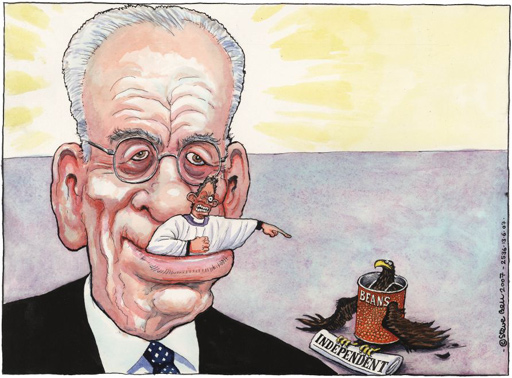
the man from the government
The background is here and here
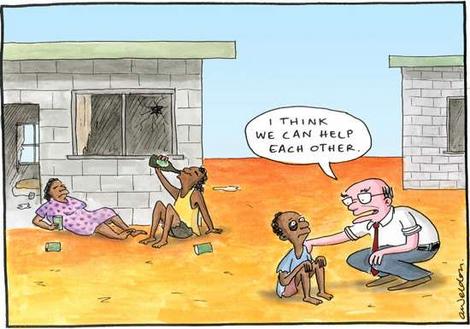
Weldon
The clips I saw on television showed the government representatives being confronted by the history of race relations in the form of the children being taken away by the assimilationists. The policies of paternalistic assimilation and integration in which the Commonwealthn had control of the reserves and settlements, left a legacy of misery.
June 26, 2007
graffiti as art
I'll be travelling to and from Sydney tomorrow so I will not be able to blog. From memory there is little graffiti in Sydney's subway or trains. I'll catch the train from the airport to the CBD to have a look.
Although tags and throw-ups can be well executed and have great style, it is the piece work that allows a graffitist to really show everyone what he/she is about.
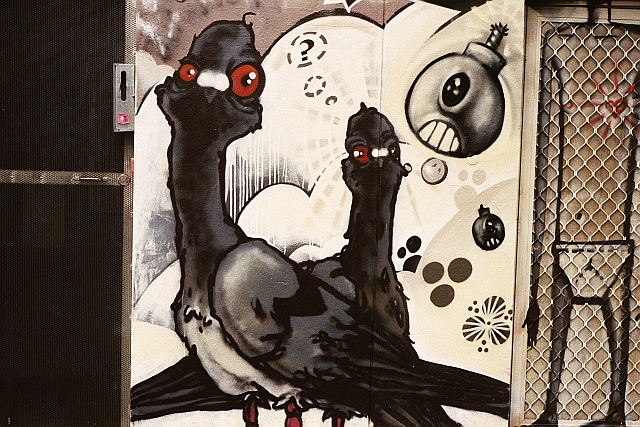
Gary Sauer-Thompson, graffiti figures, Adelaide, 2007
If graffiti is words or drawings scratched or scribbled on a wall, then this is an example of street art. It is hard to see art like this as a crime. If the building has no architectural beauty and is a perfect place to display a mural, why not put one up?
Some say that Ii's tricky to call graffiti `art' because it was born to operate outside the system, and art has a system. But we are not talking about putting graffiti in a gallery we are talking about art in the street. One that makes the city a brighter and more attractive place to be,
Adelaide Graffiti--witty
There's tagging, then there's throwups, then there are stencils. The graffiti that catches my eye is the witty art:
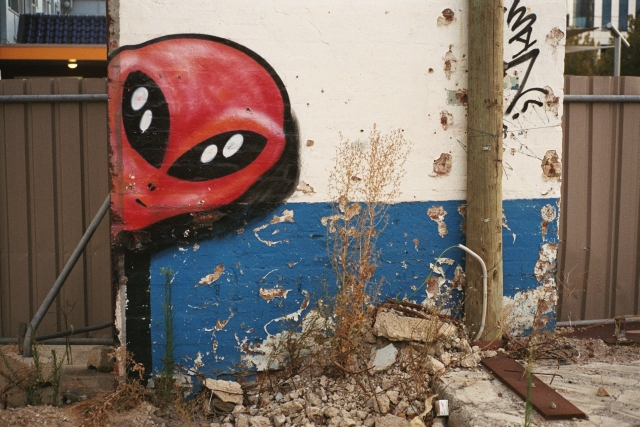
Gary Sauer-Thompson, urban humour, Adelaide, 2007
Clever.
There are grand plans to develop all the empty sites with shops and apartments. But little seems to happen. Some of the sites around the Central Market and King William Street have stood empty for years, holes in the ground that remain that way for decades--since the last boom in the 1980s. Sp why not create some sort of mural?
The empty sites undercut the talk of the real estate industry that things are really booming in Adelaide. Sure there are lots of plans approved by Council ,but many are never implemented. They remain just plans. And the sites remain empty apart from the rubble and the weeds. So it is good to see them enhanced by this kind of graffiti. The social context is what gives the work meaning.
June 25, 2007
Because Sometimes, Rythym in Isolation is Cool
I am no dancer but I can appreciate art (awesomeness of expression) when I see it. At the 4.23 mark Daft Punk kicks in and the whole thing heats up. Very cool. Originally via MeFi, but I have watched it so many times that it needs repeating.
June 24, 2007
a question
Is this what is happening? A military style occupation?
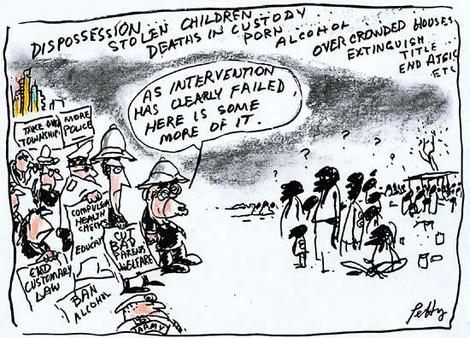
Bruce Petty
More here and here. Deep down its about poverty and character and the attribution of individual responsibility for poverty
Update
What comes through on the surface are the cultural conservatives going on about the naive arrogance of judicial activists and the disaster wrought by well-intentioned progressives on a generation of Aborigines. And they would add the central planners and social engineers liivn gin the Marxist-dominated Labor states will usually do more harm than good.
These activists, the conservatives add, are the fantasists of the arcadian aboriginal lifestyle who have some romantic notion of Rousseau's “noble savage” living in some kind of idyllic bush utopia. The right approach is assimilation of aboriginal people into mainstream Anglo Saxon Australia. It's as simple as that. Well, the rot set in when Keating and other ‘Canberra Cocktail Set’ do gooders took away any opportunity for aborigines to work on cattle stations when the pastoralists were forced to pay equal wages.
So we practical conservatives need a big plan so the centralist Howard Goverment can deal with the national emergency created by the socially engineering, bleeding hearts pushing the p.c. line down our throats.
So say the conservatives. But more is going on than that. What causes the poverty in indigenous communities?
June 23, 2007
hauntology in Adelaide
The ghosts of Adelaide's dead hopes and dreams can be seen in the torn posters on the back walls of the old buildings --there is a presence in what is missing:
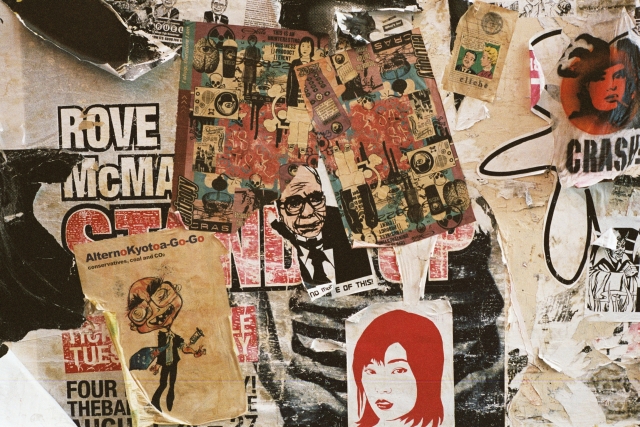
Gary Sauer-Thompson, torn poster, Adelaide, 2007
A romantic melancholist would says that if all the city's 'positive life' had crumbled away, what is left in Adelaide must be either a negative life or a negation of life. Many who live in Sydney would agree without a second thought. 'Positive' life happens in Sydney not Adelaide. It's not even worthy of second thought. Not for those living in Adelaide though-their desires are haunted by what might have been.
Adelaide is yet to be haunted by global warming to accelerate the process of change and there is little sense that that the seaside on which they walk may well be consumed by the sea. Adelaide has yet to fight the war against the sea, even though the groynes and the stones on the beaches providing makeshift coastal defences that will only retard the process of erosion, not end it.
June 22, 2007
Indigenous Art: a note
Australian Indigenous art is a story of the flowering of one of the world’s great contemporary movements in art. It is a story of cultural reinvigoration and communication within, between and beyond Indigenous communities. It is a story of successful links being forged across areas of Indigenous policy and need, particularly between culture and health.
And it is a story of economic growth and prosperity amidst severe poverty and economic disadvantage as well as image innovation.
Friday dog blogging # 2
I flew back from a chilly Canberra to Adelaide and to some urban grit:
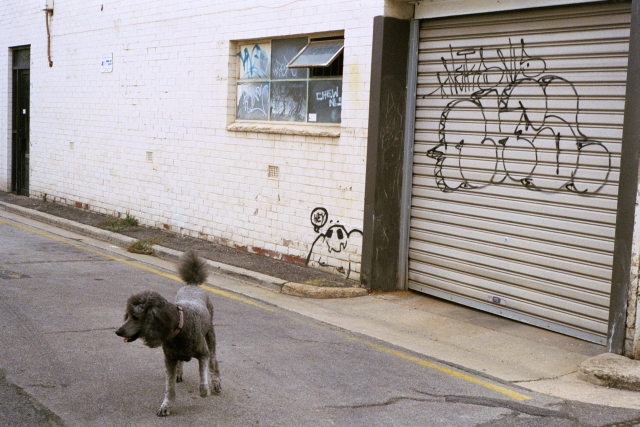
Gary Sauer-Thompson, Agtet + graffiti, Adelaide, 2007
It is no Silicon valley. It's just empty warehouses, old factories and workshops, intermingled with rundown working class cottages. An area ripe for urban renewal and becoming post-industrial. An area that awaits the developers who are elsewhere.
What has happened to the uprisings, protests, civil disobedience — the stuff in the street in the spirit of Seattle? Is our hope for a more human world now expressed by the graffiti artists?
Community has gone. We tend now to exist alongside one another, never striving to understand what it must be like to be somebody else. We experience the world through our own set of lenses and through nobody else's. Contact with others is fleeting and fragmentary.
Best to join the pack and hang out together.
June 21, 2007
exploring urban badlands
These badlands in Adelaide are the effects of de-industrialization that resulted from the economic reforms of the 1980s that opened the Australian economy up to the global one. The devastation was most marked in Adelaide and it quickly became a rustbelt.
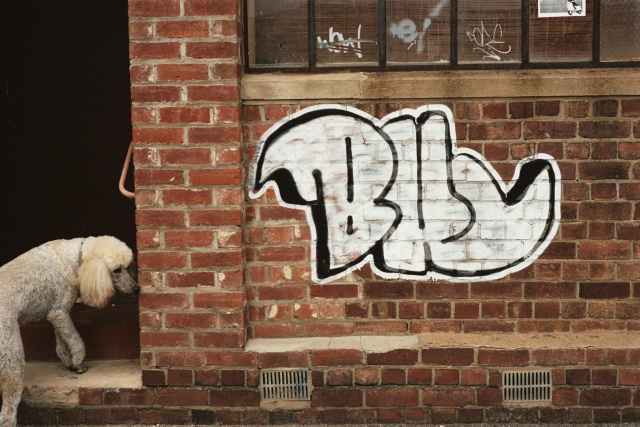
Gary Sauer-Thompson, Ari + graffiti, Adelaide, 2007
The effects of corporate power in the global economy is written on these decaying walls. It's enough to make one an antiglobalization activist trying to nail down the sources of that power. The urban decay sure rubbed the Keating shine off globalization.
It is difficult to find the magic hidden in our urban blight. Is it the dogs barking at the gates of paradise?
June 20, 2007
landscapes for politics
'Storming the Gates of Paradise' by Rebecca Solnit is a collection of of reportage and essays on the post-millennial American political landscape by the celebrated anti-globalization activist. However Solnit began her career as an art critic and so photography, hope, environmental degradation, the landscape of the American West, and beauty are woven though the essays.
Solnit covers familiar ground—the California earth blasted away by the devastating hydraulic mining of the gold rush, and Nevada’s dry, alkaline lake beds, home to Burning Man and the US military.
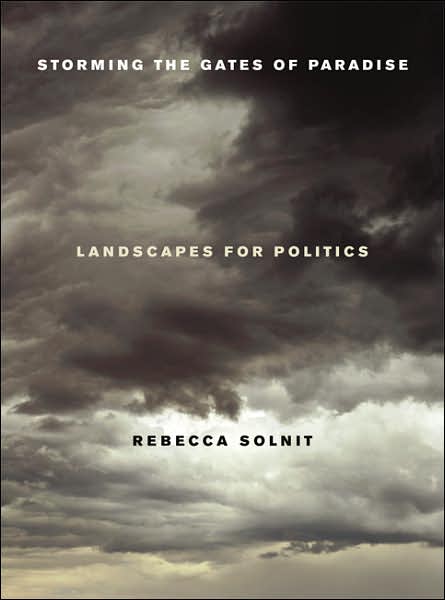
Her art-world credentials are put to good use in an arch and acid fantasia called "The Wal-Mart Biennale," in which she imagines what new pieces Wal-Mart heiress Alice Walton might add to the museum she's assembling with her billions (and some taxpayer cash) in Bentonville, Ark. Perhaps some sweatshop workers could be included amid the Hudson River School scenery. ("Imagine paintings of Edward Hopper's old downtowns, boarded up because all the sad and lonely people are shopping at Wal-Mart.")
An example of the landscapes for politics is the way that Solnit perceives the U.S.-Mexican border as a state of mind imposed on the landscape, “not so much a line drawn in the sand of the desert but in the imagination, a line across which memory may not travel, empathy may be confiscated, truth held up indefinitely, meaning lost in translation.” Physical space, real places, she sees as inevitable starting points, “the arena in which people think about politics and public life and and feel a sense of embeddedness in it as both beneficiaries and caretakers” – hence her visceral revulsion of suburbia.
Another example is her review of a Sandow Birk-illustrated edition of “Dante's Inferno,” which begins with impressions of museum-going in Los Angeles: “ ... when I came home,” she writes, “I would find that the hours I'd spent negotiating freeway merge lanes and entrances and exits and parking garages were, in some mysterious way, more memorable than the museums. I was supposed to have my head full of paintings or installations. Instead, I had a head full of the anonymously ugly spaces that are not on the official register of what any place is supposed to be, the infrastructure of what for me in those days of my youth was despair.”
June 19, 2007
Bye bye Johnny?
The fraternity culture of the faux-tough young Liberals?
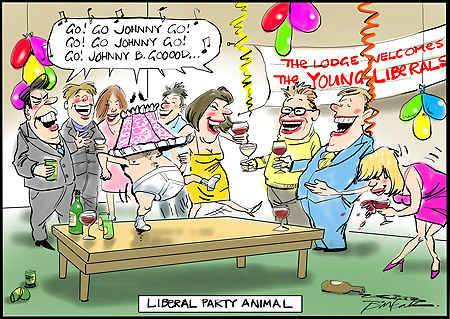
Bil Leak
They've shifted very much to the right in the last decade firmly deepening the cultural divide with the Left. So we have a party crowd cheering their charismatic Daddy-figure, calling for torture and detention camps celebrating war, urging still more surveillance and limitless government power to defend us from the Muslim terrorist. A arnival crowd that still thinks highly of Howard as their standard bearer of Australian conservatism, and who has led them to epic success and bought glory to them.
They have yet to disown him in an act of self-preservation--so unlike what has happened to George Bush, whose Presidency has collapsed and lays in ruins, and who has is now seen to have been an epic failure. The faux-tough young Liberals are misnamed--they are conservatives not liberals. Those who are not true conservatives are deemed to be liberals.
Canberra: graffiti
It's very discreet, but its there:
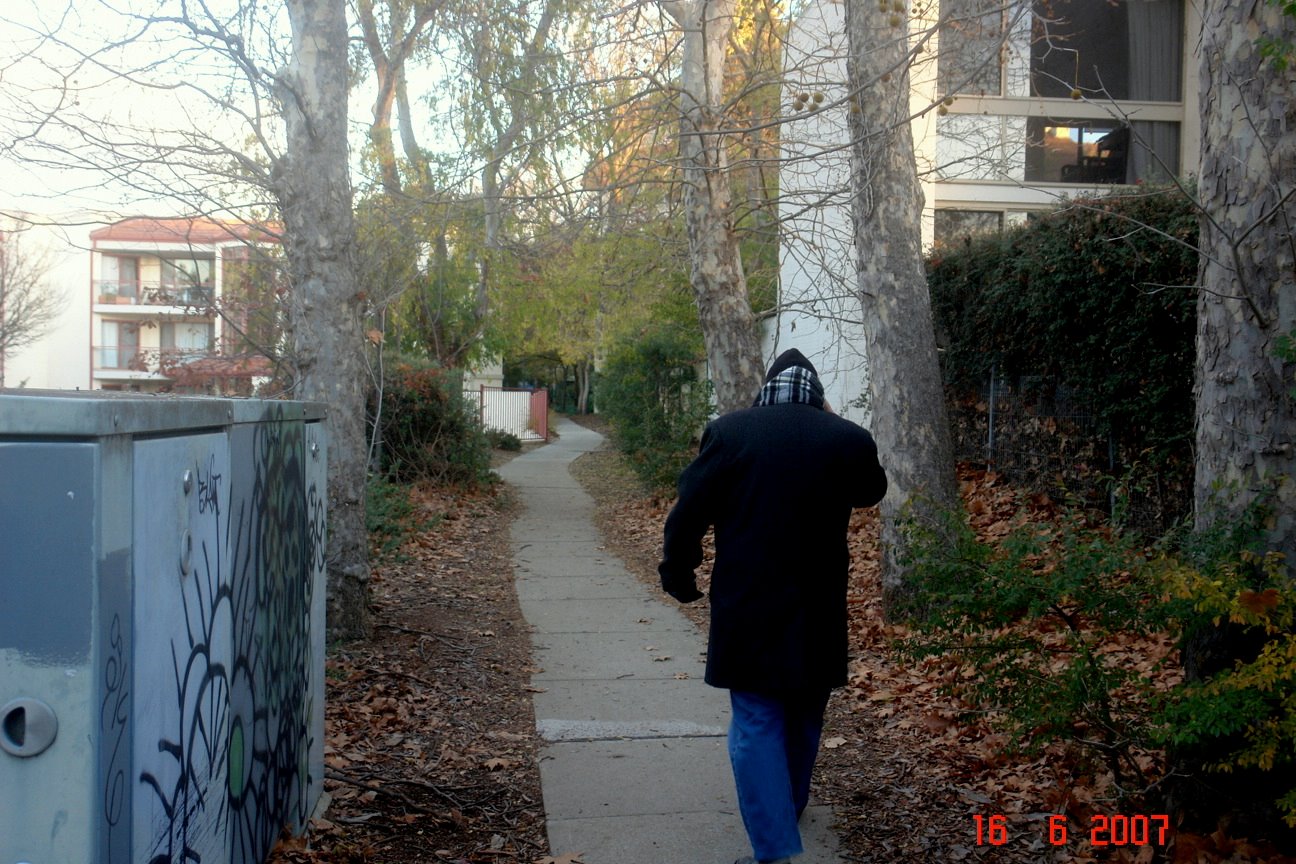
Gary Sauer-Thompson, Graffiti, Canberra. 2006
The graffiti I mean, in the form of tagging.
June 18, 2007
Canberra snaps
Jenny Stewart, an associate professor of public policy in The Centre for Research in Public Sector Management (CRPSM) at the University of Canberra, often writes an op-ed in in the Canberra Times. In today's op-ed she highlights why the city state of Canberra is different from the other capital cities. She says:
Canberra is different, not so much because it was created artificially, but because it has a divided soul. On the one hand it is a creature of the federal government, a place of commanding vistas and national monuments, a company town that rises and falls on the tides of the federal government's spending priorities. On the other, it is a city much like any other, a place of workplaces, shops and clubs, a city in which people live, work, grow old and die.
I concur. I work in the world of the former and live in the world of the latter. We have a schizoid Canberra, or rather two the existence two Canberras. A good proportion of the workforce have their heads in "Canberra" (the source of national policy and practice) rather than Canberra, the actual city in which we live.
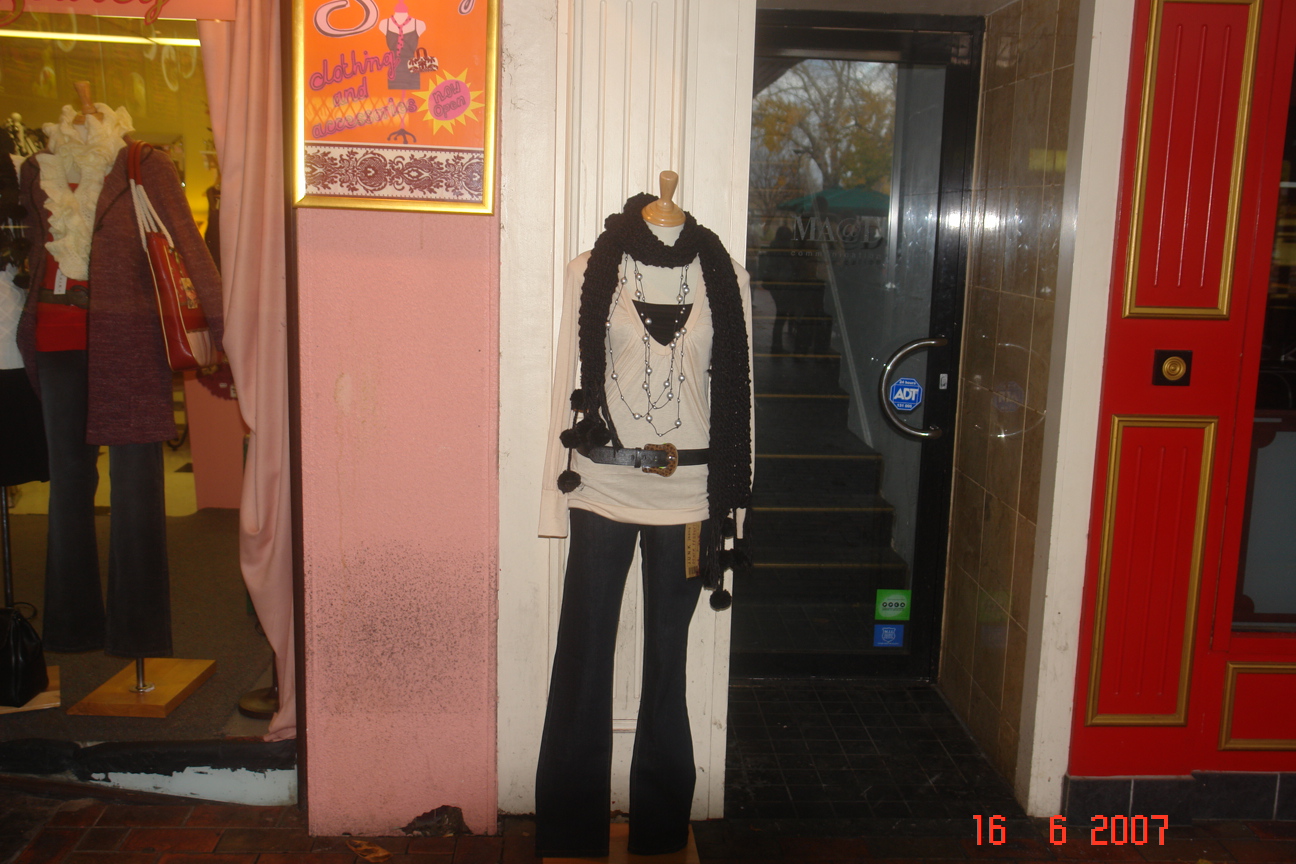
Gary Sauer-Thompson, model Kingston shops, Canberra, 2007
Canberra is a more a country town than a city, but one with an alternate or oppositional edge to the culture of federal government and bureaucracy.
Stewart is concerned with the implications of the anomaly a city-state whose most interested and able citizens--15,000 ACT government public servants and the academics-- who do live and breathe the life of the city but who are cut off from directly shaping its political life.
My photographic concerns are with exploring the actual city in which we live from the perspective of a nomad.
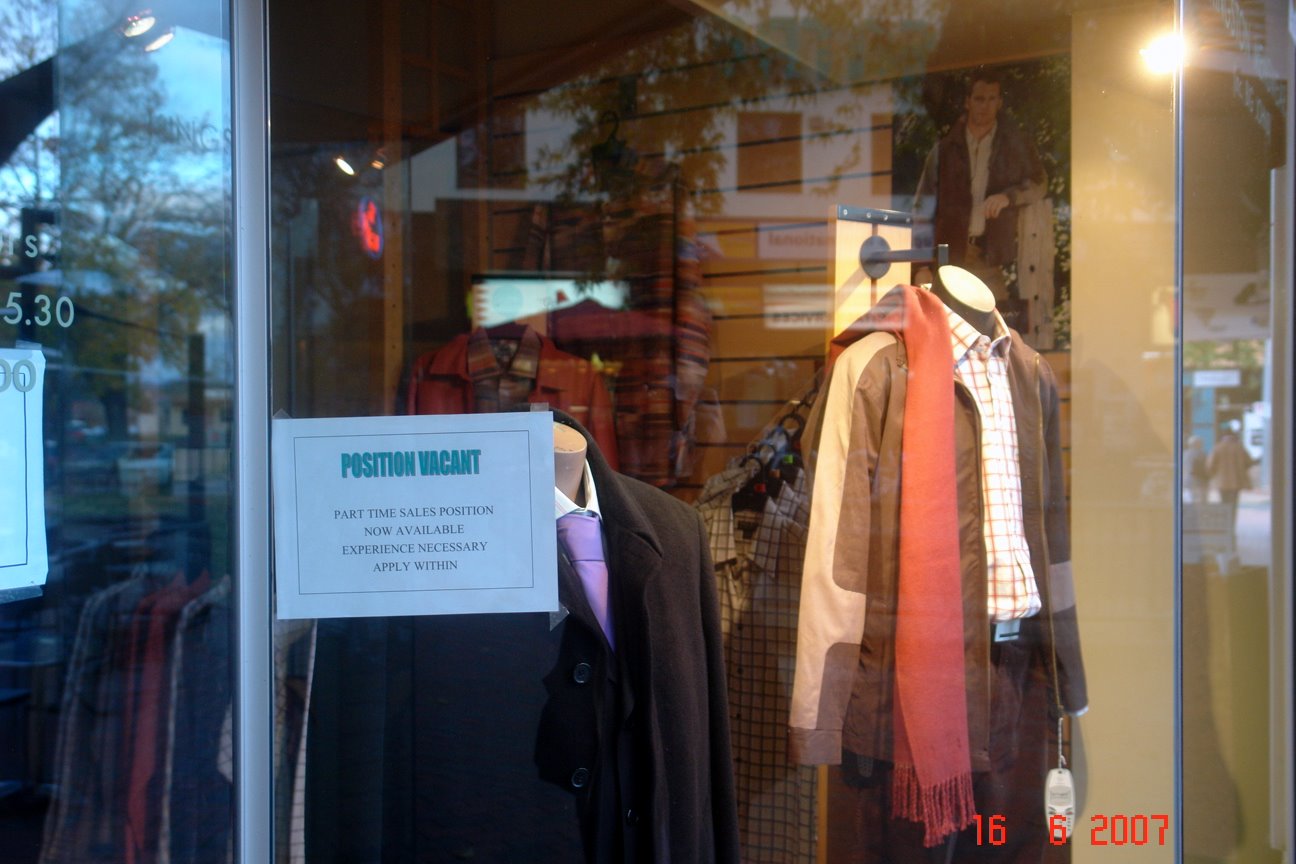
Gary Sauer-Thompson, Kingston shopwindow, Canberra, 2007
June 17, 2007
Sunday evening music
The Grateful Dead kinda fell apart in the 1980s--the spark had gone as Garcia's drug habit took its toll and he fell into and out of a diabetic coma in 1986. The spark returned in the 1989 tour and in the early 1990s when Bruce Hornsby (piano) and Vince Wellnick (organ) were on keyboards, replacing the Brent Mydland, who had died of a drug overdose .
The magic of the musical improvisation returned in this example--- 'Eyes of the World' 17 6 91 at Giants Stadium.This is Part I
The unbridled, jazz-fusion-driven exploration---what Ornette Coleman dubbed "harmolodics", in which the mussical flow derives from the unique interaction between the players ---come to an end with band’s departing soiree in October 1974; the "farewell" concerts at the Winterland Arena in San Francisco. The sonic architecture of its later concerts reflected a different, more tightly-knit perspective.
The improvisation here is not devoid of form or structure, nor is it a free-form ad hoc rambling.
This is Part 2
Sunday morning cartoon + animation
It's a sunny morning in Canberra. 'Tis a light laugh over an issue that is causing a bit of political heat and angst around the nation as it is part of the culture wars:
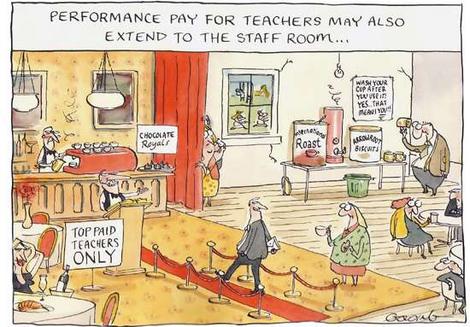
Matt Golding
It's Sunday morning and I'm reminded of the Velvet Underground and, in a particular a song from their "banana album" Velvet Underground and Nico, the lush and professionally produced Sunday Morning:
I only know the CD. The banana does not peel slowly. Warhol's Factory and the Exploding Plastic Inevitable media happenings may have faded, but not the music on this album.
Even though the Velvets were experimental (John Cage) and wrote interesting songs (Lou Leed) this first album died still born. It was critically acclaimed a couple of decades latter but it took longer for the Velvets music to be professionally repackaged and properly restored. Finally this music, which fuses avant-garde with rock & roll, can be critically evaluated outside the 'influence upon the punk and new wave' frame. They blended the energy of rock with the sonic adventurism of the avant-garde, and introduced a new degree of social realism and sexual awareness into rock lyrics.
Something else of interest that I came across on YouTube-- the Beginning cartoon that opens the Grateful Dead "Movie.
I am suprised that a lot of credit goes to the UK visual Yellow Submarine-style animation work around the Beatles whilst that around the Grateful Dead is ignored. This work is not hippy stuff, nor do you have to be a deadhead to appreciate Gary Gutierrez's innovation circa 1974-76 around the iconography of the Grateful Dead --the Uncle Sam skeleton, skulls, roses etc. It is pre-Bush America.
Update
The Grateful Dead Movie was Garcia's labour of love, and it captures performances from the Grateful Dead's October 1974 five-night stand at the Winterland Ballroom in San Francisco. This end-of-tour run marked the beginning of an extended hiatus for the band as no shows were planned for 1975.
There was no director in the beginning. After the shows, Garcia sat down with 125 hours of raw footage, which he matched to the soundtrack and catalogued. Garcia, by late '76 he was purchasing books of airline commuter tickets and flying daily to Burbank Studios to mix the soundtrack, inventing new technologies like 'phase panning' so that the sound of the film would subtly follow the camera. The film was edited by Susan Crutcher.
Ironically, the film that followed them into Burbank Studios was Star Wars.
June 16, 2007
In Canberra
I'm spending the weekend in Canberra. It's wintry and cold despite the sunshine. I'm lonely, and tired of sitting at the computer living a virtual life hugged to a heater. To head off the feeling of depression taking hold I decided to put on my coat, get out of the apartment, and walk around Kingston with my camera as a nomad. After all I have an arial but no roots in Canberra.
Nearby the apartment, close to the Lake was Canberra's old Kingston Powerhouse. It has been remodelled by Tanner Architect into the Canberra Glassworks. This building is Australia's only cultural centre wholly dedicated to contemporary glass art; a working glassworks that provides access to glassmaking facilities for glass artists.
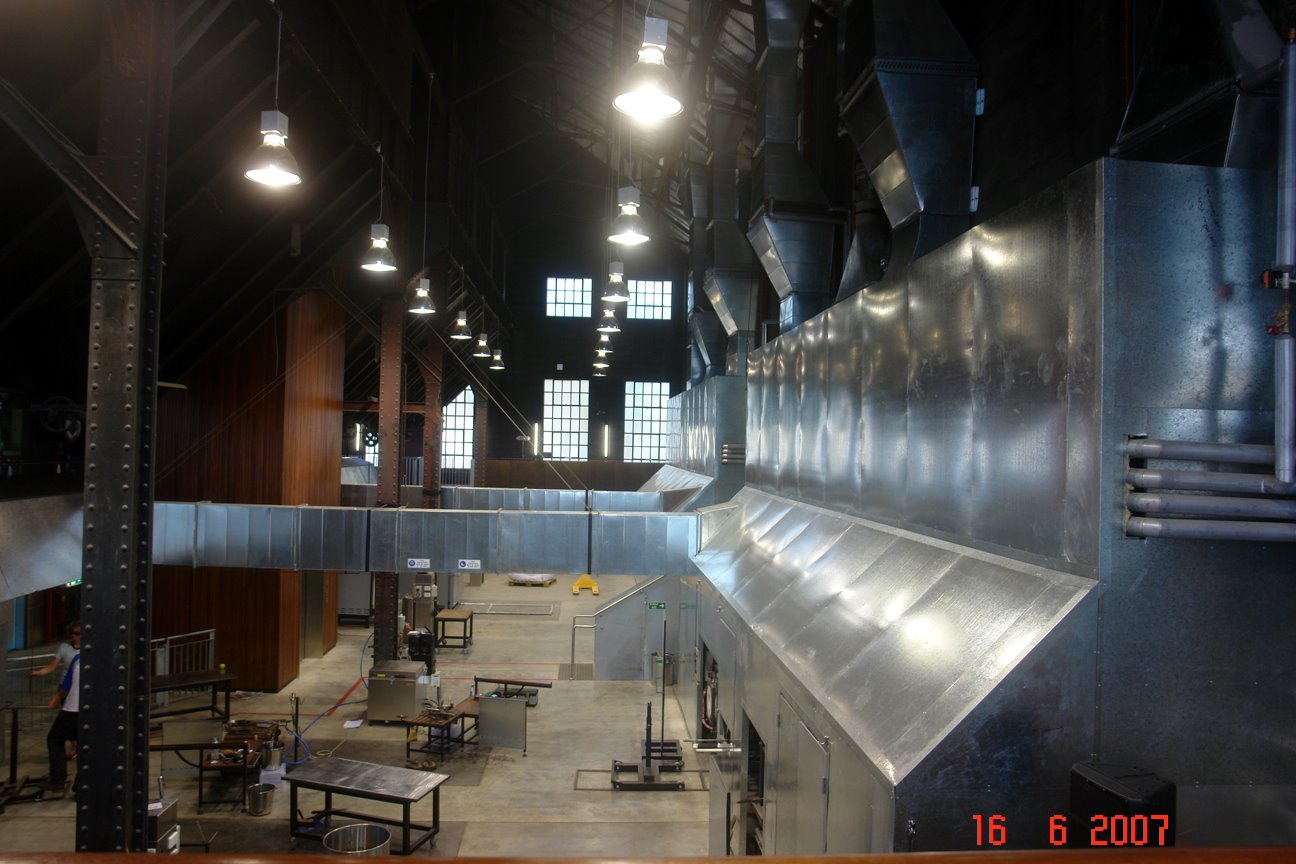
Gary Sauer-Thompson, Hotshop, Canberra Glassworks, 2007
The exhibition was by Richard Whiteley, the current Head of Glass at the ANU School of Art.
Whilst on my way to the Kingston shops, where people often gather after a day in Parliament working on dirty tricks, this colour in the winter shade caught my tourist eye:
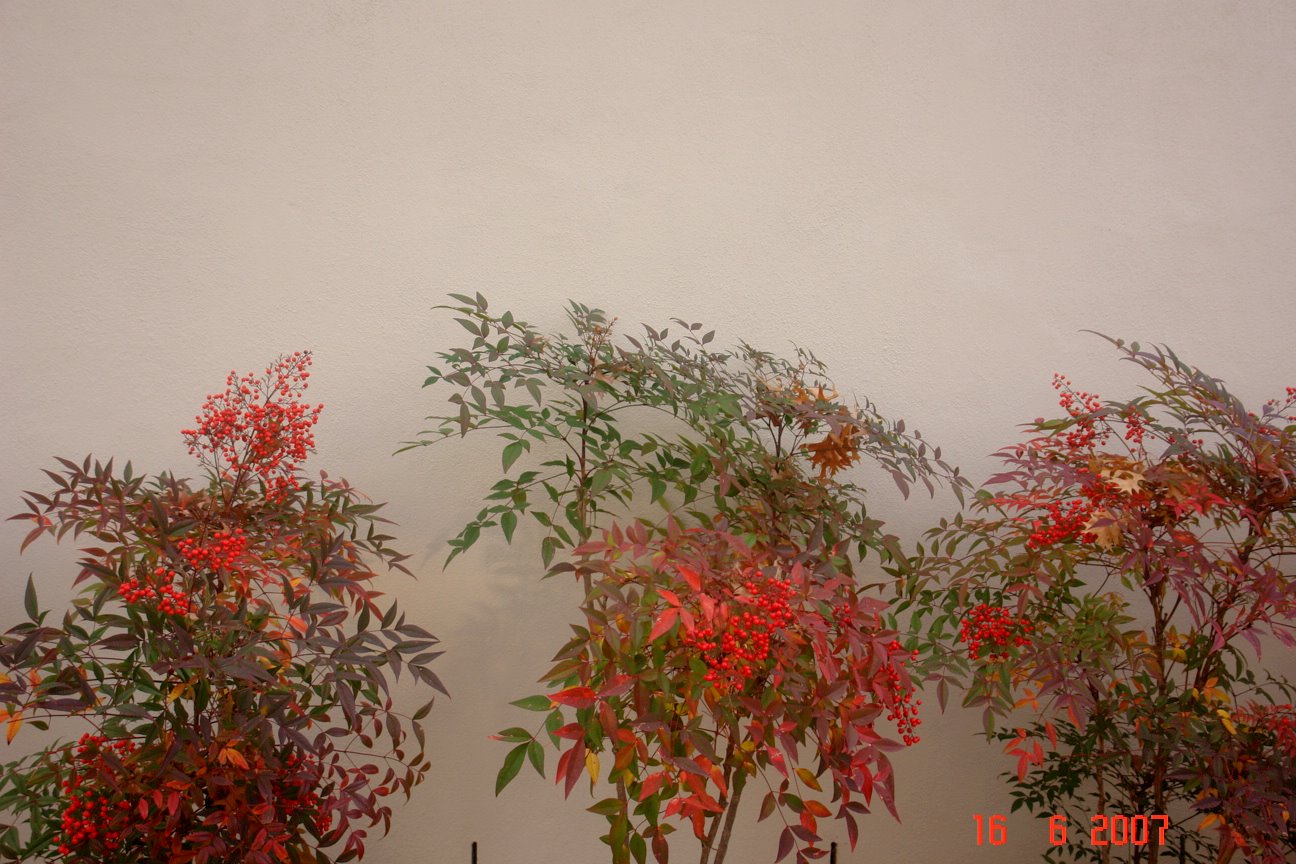
Gary Sauer-Thompson, shrubs, Kingston, 2007
I hung around the back alley of the shops as a contrast to the cultured middle class world at the Canberra Glassworks. I was looking for signs of graffiti and urban decay, but I found little, as Canberra is too new. No doubt it would have an a underground or alternate culture that comes out of the Art School or the Canberra Contemporary Art Space. A raunch culture perhaps?
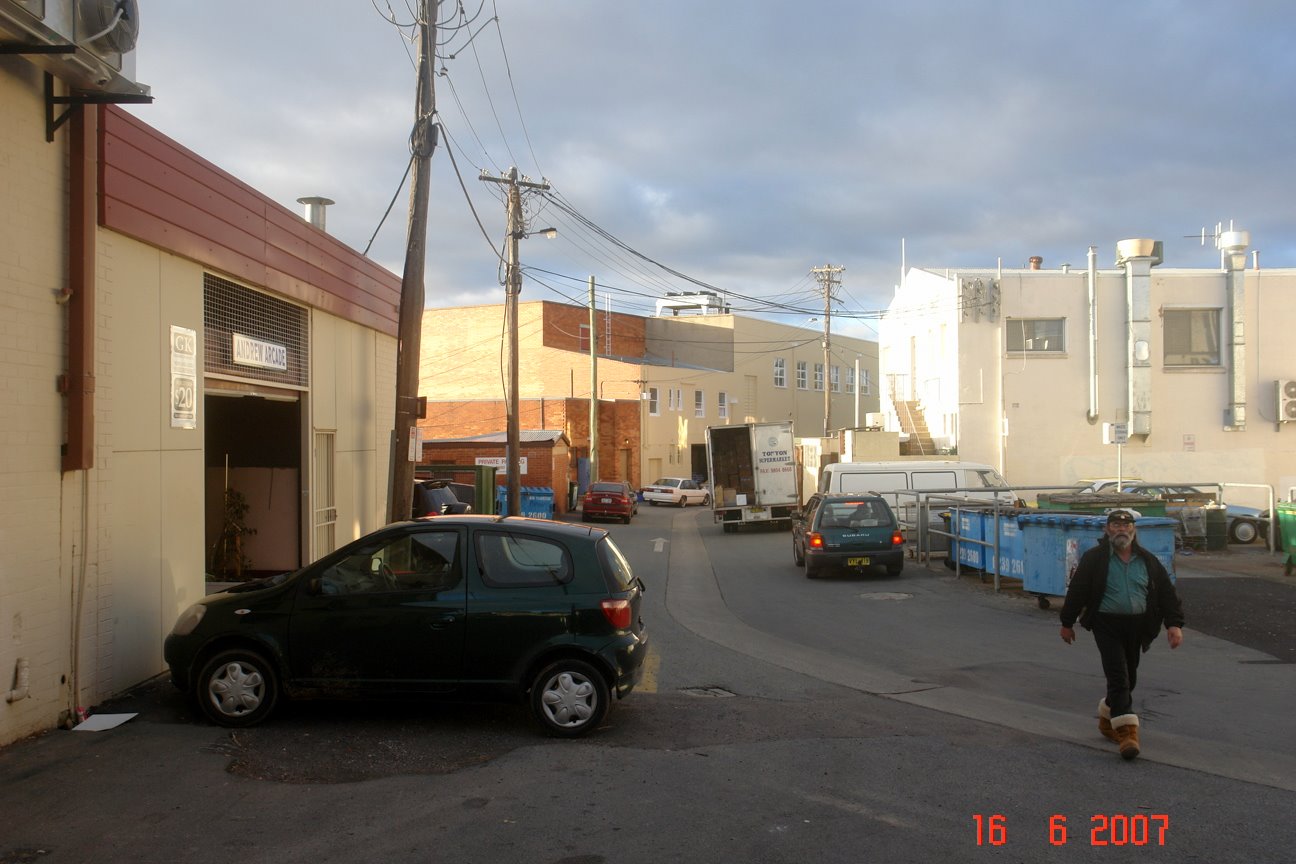
Gary Sauer-Thompson, Backlane Kingston Shops, 2007
I no longer felt lonely or so isolated. Nor hemmed in by winter being battered by the 24 hours news TV. I was quite happy to return to the apartment when the lovely soft light went, the cold came in, and the darkness descended. It was back to the computer, the heater and to look at the online work of Martin Jolley and Helen Ennis at the photomedia studio in the ANU School of Art and the exhibitions at the Canberra Contemporary Art Space.
a picture is...?
A question addressed to W.J.T. Mitchell. ' How would you define picture? Is it a sign?' Mitchell's answer:
I would rather explain the relation between the image and the picture. If you think of the sign as constitutive in de Saussure`s model by the convention then the image might be even non-sign. The image violates the law of the sign. My thinking of the image is that it could be situated at the border of linguistics. The question I would rather want to answer is the relation between the image and the picture. You can hang the picture on the wall but you can not hang an image on the wall. An image is what comes off the picture.
Okay, so this is equivalent to the picture on the wall.
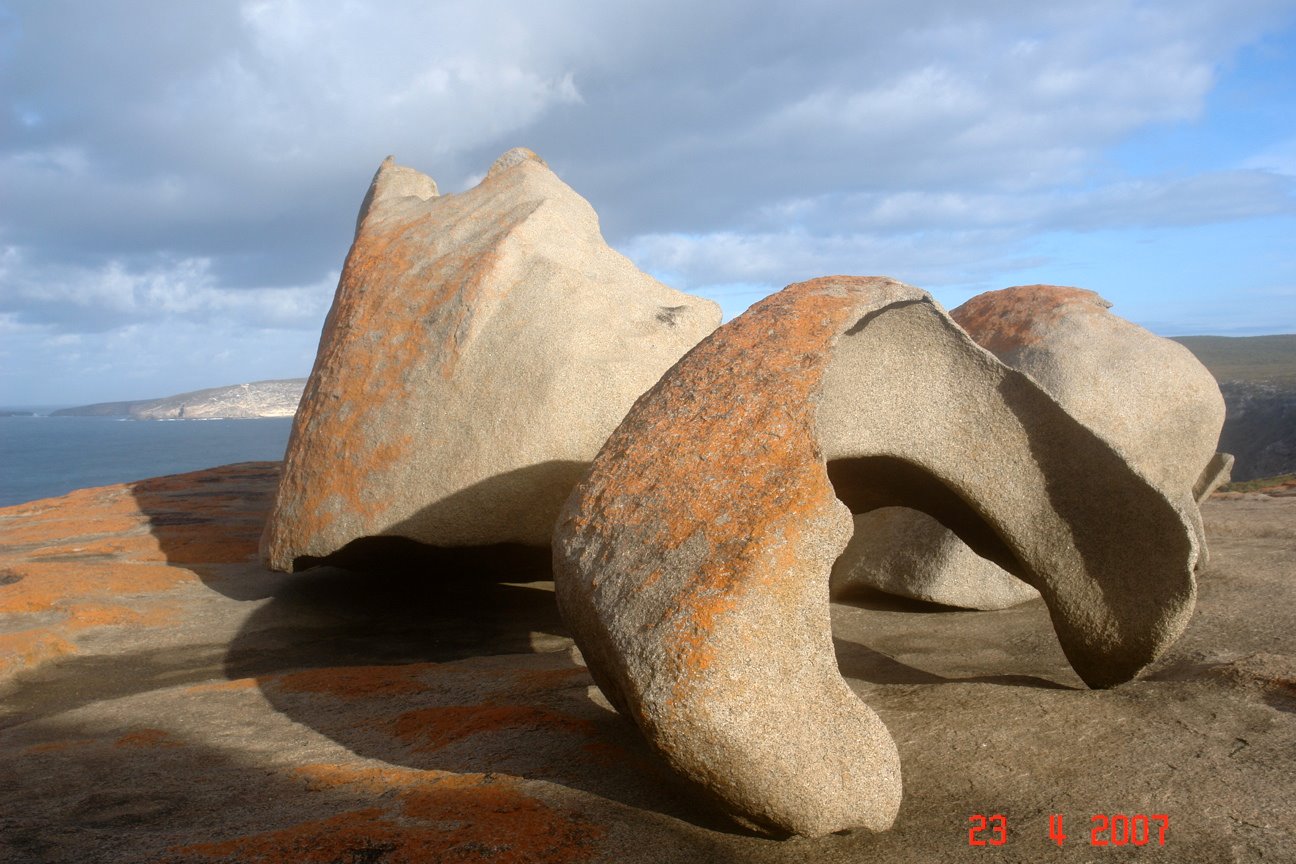
Gary Sauer-Thompson, Remarkable Rocks, 2007
What is the image? What is it that comes off the picture? The effect of the picture on me?
Is it a mental phenomenon? Mitchell responds:
It is a percept with the illusion. It is what appears in the picture. I think it is very helpful for lots of thinking about the strange relation between images and their materiality to make this fundamental section. The picture is an image in a medium, or an image that is mixed into some picture of an object. Even if the object is shaped as an image or the object has reflected on an image. I think this is an extremely useful distinction.
Sadly, I don't get it.
Wikipedia says that a percept is a philosophical term which roughly means an individual's observation/perception of something external to one's self; more specifically, the resultant of perceiving. It is the representation of an external event that affected the senses and which - by perceptual processing - caused the activation of a certain category in the mind, i.e., the percept.
And the illusion bit? Well one picture can create two entirely separate and distinct percepts.
June 15, 2007
convergence
The public policy background on the roll out of highspeed broadband in Australia is here at public opinion. We do need high speed broadband to workonline-- to search for, and access, and distribute online material.
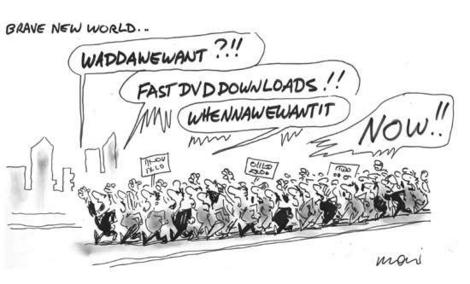
Allan Moir
Some argue that the core of broadband is to download DVD' s in a converged home entertainment environment where the PC, TV, stereo and portable entertainment devices are coming together. So we are being asked to hook the Media Center PC into your home network, attach the outputs to the TV and stereo, the inputs to the cable TV and make sure it's Internet enabled. Of course the flaw of a Media Center PC is that it must be close to your TV to wire them together.
So we are talking about the storage of pictures, music, television shows, videos, and other multimedia on the PC and then downloaded to the tv:

Tamara Voninski
So where is all the online content going to come from? I realize that though there are thousands of broadband TV channels available for live streaming or downloading, broadband television has not taken off in Australia as they have in Europe and Asia because unlimited data broadband internet plans here are very expensive, and video quickly blows any limit.
So are stuck with free to air and the very expensive Foxtel. Channel Nine has blocked the shift to digital to protect its income but with Packer gone things could begin to change.
thinking about pictures
This sure is thinking about pictures differently:
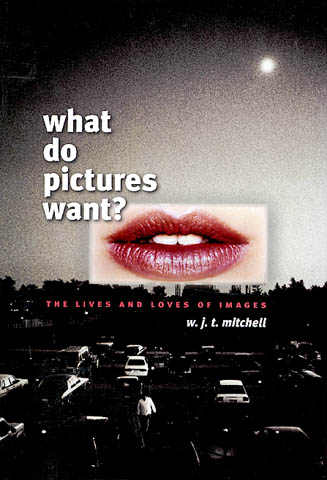
Mitchell says that they just want to be kissed. Aaah---what's a kiss. A gesture of affection and a desire to incorporate. Incorporate means to be eaten. So pictures want to be taken in by us.
It's a different way of looking at pictures to the dominant approach which has been, 'What do pictures mean?'--- ie., what overt or hidden messages do they convey, what set of values do they promote or denigrate? This approach places the emphasis on the picture as something that requires interpretation--a visual "text" there to be read, decoded or interpreted.
Pictures are more than just structures of information or ideas. Pictures also work affectively: They fascinate and move us, they work on our emotions and fantasies. So we shift the question of images into a different register, from meaning to desire. If pictures work on our emotions then power exists also in the "inside" of the image, as an energy it mobilizes from its own resources, its independent capacity to persuade or enthrall or overwhelm its beholders.
Norman Bryson says that this kind of power of images raises anxiety about the seductive power of images. The image of the book refers to David Cronenberg's Videodrome (1983), which envisioned a world where television directly impacted the viewer, even changing the viewer physically so that interaction could be made easier yet. The image of desire (female lips and mouth) breaks out of the television screen and invades the real world, literally devouring the male spectator.
A widespread topos in postmodernism is that mediated images--in cinema and television--have come to function in new ways, no longer representing the real world but replacing or supplanting it. In the "society of the spectacle," the image dictates to its viewers the terms of their reality (Debord, Baudrillard). For Mitchell, what is interesting in this kind of account is not whether it offers an accurate description of the contemporary world but rather the way it expresses contemporary anxieties concerning the power of the image to go its own way, to "walk by itself"--anxieties that, he suggests, suffuse the whole cultural climate.
June 14, 2007
Whiteley
A semi-surreal figurative work from someone who was once seen as a visionary genius and viewed as being in the forefront of Australia's avant-garde art movement:
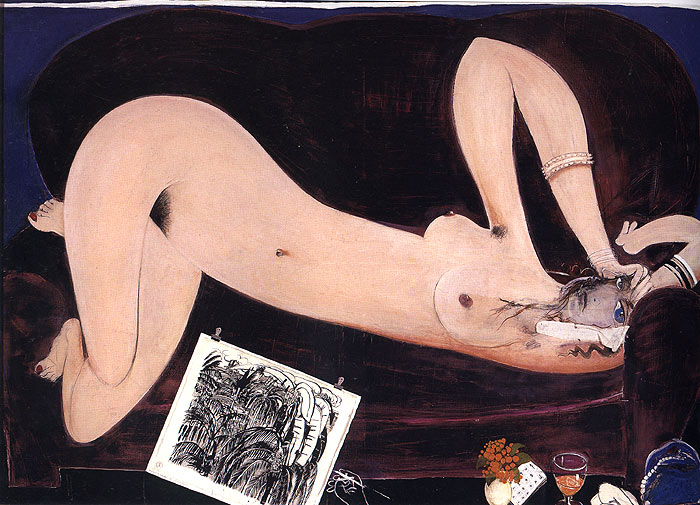
Brett Whiteley, Portrait of Wendy, 1984
Others understand Whiteley in terms of figurative expressionism. What is significant is that Whiteley turned his back on the dominant mode of 20th century art, abstraction, which he did whilst in London in 1963. It is the line and the colour that catches the eye.
June 13, 2007
selling heritage
It looks natural doesn't it? But it is carefully landscaped for tourists.
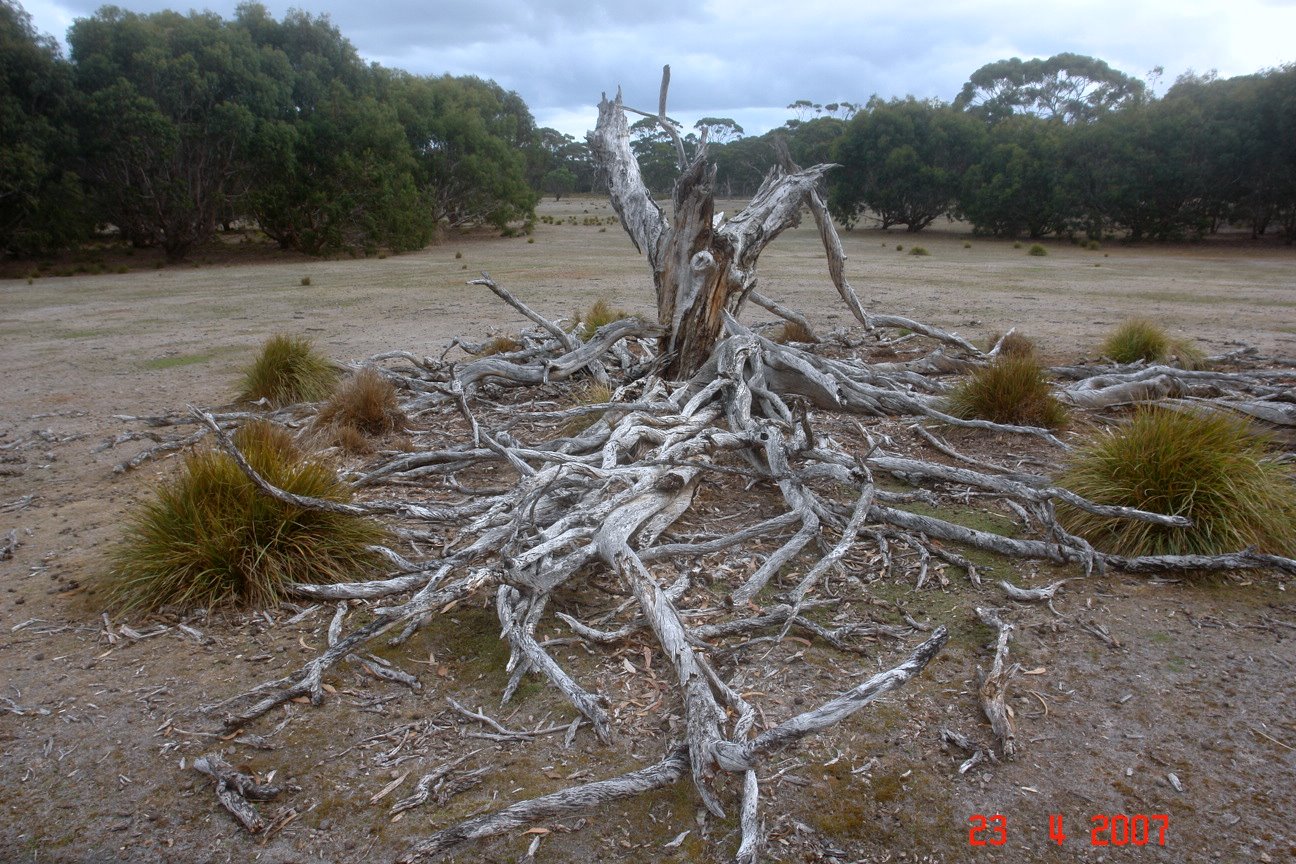
Gary Sauer-Thompson, heritage, 2007
It's an example of how Flinders Chase National Park constructs nature for tourists.
June 12, 2007
inside looking out
Photography is sometimes described as "the art of seeing" - by which is often meant impressions created by light. Is this modernist account plausible?
Now we often view the landscape from inside cars:
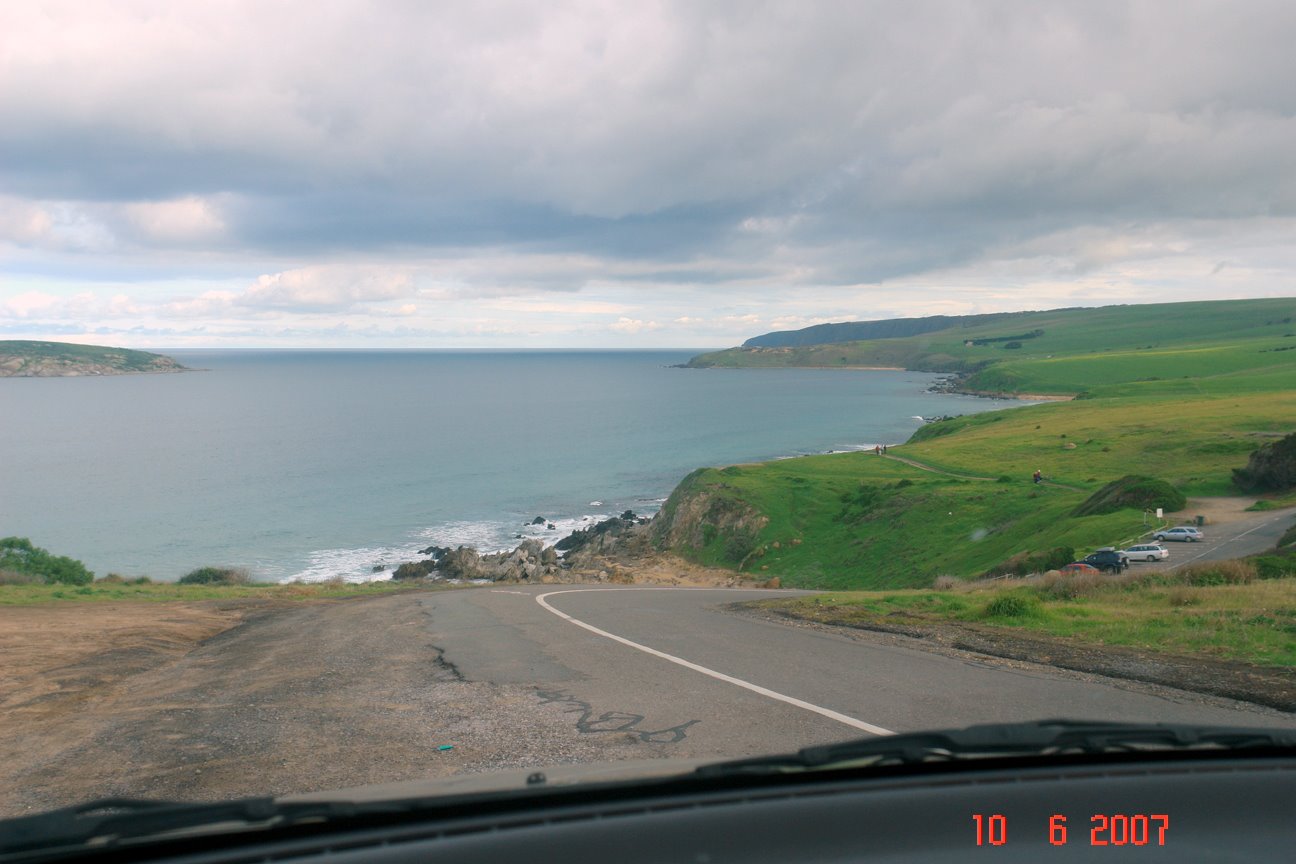
Gary Sauer-Thompson, looking towards Petrel Cove, Victor Habor, 2007
And so we "see as tourists". Sometimes we see "the landscape" from airplanes:
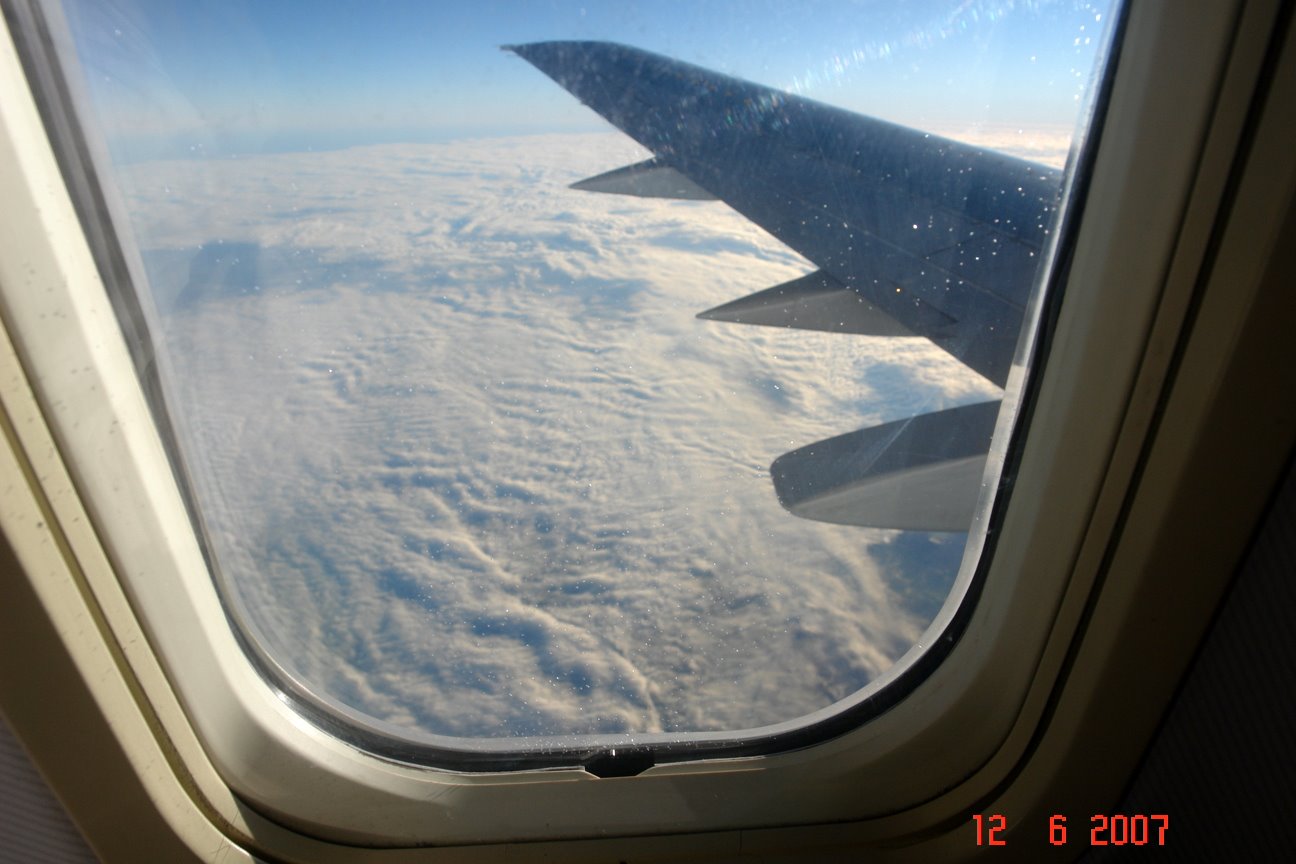
Gary Sauer-Thompson, between Adelaide and Canberra, 2007
This is a very fragmented mode of seeing and any given instance is more or less meaningless. To understand what we are seeing requires a context to be contributed from the viewer. They are interpreting the image.
'We' does not just mean humans and so what we "see" is quite different:
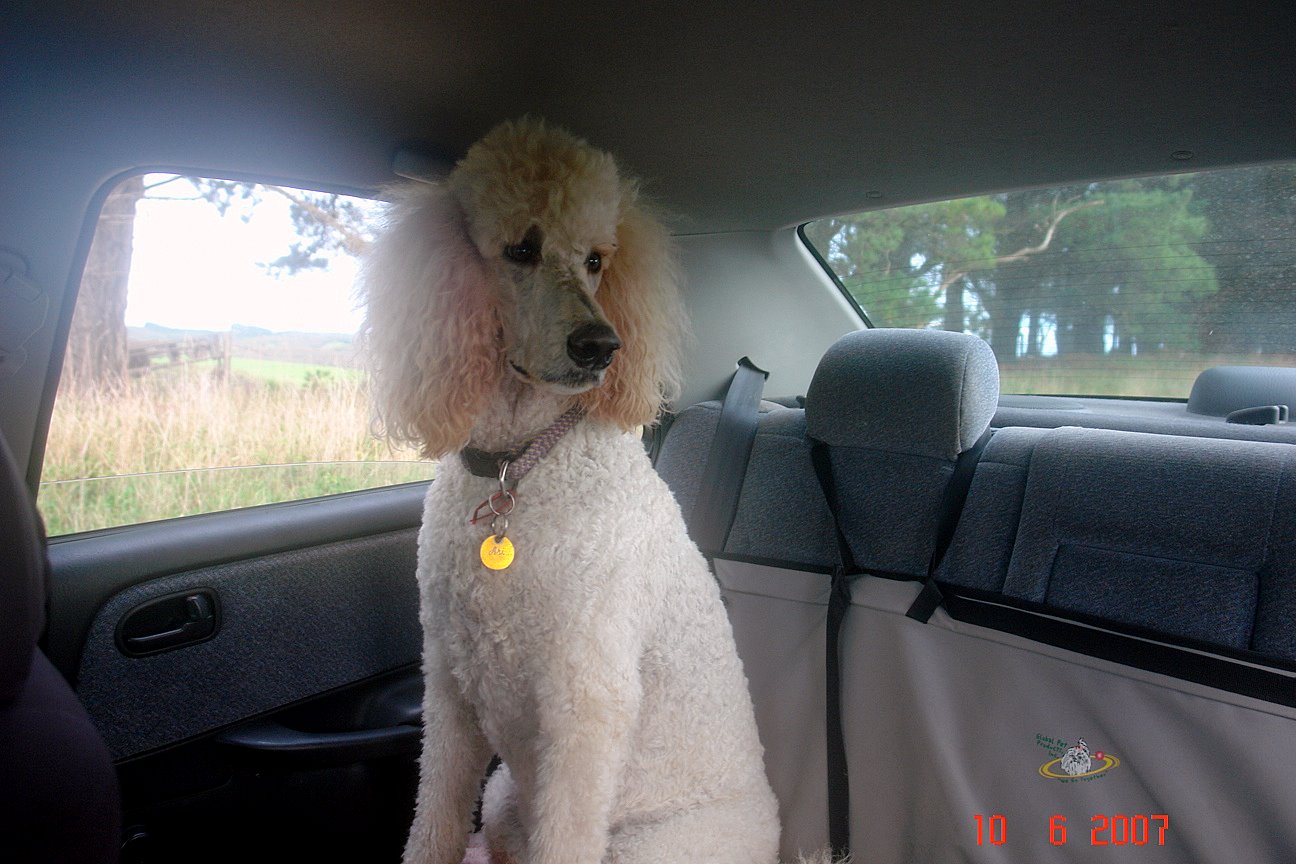
Gary Sauer-Thompson, Ari, 2007
Photography is about creating meaning from a continuous stream of visual information is it not? We are just using images rather than words. 'Creating meaning' refers to interpreting the world.
Now some talk in terms of photographic 'messages.' So what would be the photographic message a of a tree on hill. Some would say that, well , a hill is a hill, a tree is a tree. No cultural code is needed, since everyone, pretty much regardless of culture, can see and recognise hill and tree.
Or they simply understand the message of the Abu Ghraib photos.
Dear Internet, You Rock

Australian meat pies are a scarce resource in the United States. We can order them from the Australian bakery in Georgia, and we normally do for ANZAC Day or Christmas. But my wife, a talented cook, decided to have a go at making home-made hand-sized meat pies. They were awesome. They looked so good out of the oven that I happy-snapped them, and posted the picture up to flickr for my friends to see.
I got an email today asking if the image could be used in an Australian Recipe book. I asked my wife, and she said sure.
This isn't the first time this has happened, I publish fairly widely at different internet sites, and have done since 1997. For instance my Australian Flying Corps website has been around since 97 in one form or another and gets a lot of queries. One article from it on Arthur Cobby ended up in the RAAF's Fundamentals of Australian Aerospace Power which was published a few years ago. That site has also led me to have a copyright run-in with the Australian War Memorial where I ended up quoting the 1968 copyright act to the AWM.
Because of publishing on the internet I have had requests to have articles published in books, manuals, magazines, even a request to be interviewed on a Perth radio station on the 1804 Rebellion (which fell through). It is all unpaid of course, but then, I publish on the internet unpaid too.
It is fun and I get a great deal of enjoyment from it.
June 11, 2007
remembering
In this review of Marc Augé 's Oblivion (trans. Marjolijn de Jager, Minneapolis, 2004) in Culture Machine Les Roberts says:
In order to remember it is necessary at the same time to forget. The process of remembrance – the ‘flowering’ of the past in the present – is thus as much a process of negation as it is that of retrieval or selection. What is lost in oblivion is not the past (which is already absent) but the traces of its remembrance (its rendering as present), leaving other traces – other remembrances – to flourish and take root in their wake.
Roberts says that tending time and memory in this way is literally manifested in actual ‘gardens of remembrance’, landscaped monuments to personal and collective memory in which oblivion is ritualised in the symbolic and performative context of everyday practice.

Gary Sauer-Thompson, Rosetta Head, Victor Harbor, 2007
If oblivion is a loss of remembrance then it needs to be connected to place.
Roberts says that the relationship between life and death, memory and oblivion can to some degree be observed or ‘staged’ in the flat, empty seascapes of coastal resorts frequented by the elderly. The practice of ‘taking in the view’, in effect a gazing at nothingness sprawled out towards the horizon,

Gary Sauer-Thompson, Rosetta Head #1 Victor Harbor, 2007
We don't gaze at nothingness. We are immersed in a natural time that is quite different from the clocktime of industrial and postindustrial capitalism that defines our work life.
June 10, 2007
a personal note
I arrived back in Adelaide late last night, had a drink, watched a bit of free -to air TV (Channel Seven) ---the BBC drama Inspector Lynley Mysteries---and then fell asleep with the flu. I was tired from working all day whilst feeling feverish.
All I remember from the tv is that I just couldn't figure out why it was necessary to have the character of the cold hard senior woman police inspector who was sp full of angst, resentment and bitterness. The interpersonal relationships were mysterious--- nice upper class man, bitch middle class woman. I didn't really understand the gender stereotypes nor the morality of the ethical life.
Adelaide was very quiet when I walked the streets to the Franklin bus station to catch a bus down to Victor Harbor early this morning. Bus travel is so different from air travel--- the passengers at the bus station are teenagers, older Australian's, or those with little money. The public phones didn't work and there are signs that say this phone costs 60c a call, and don't bash the phone if things don't work.
I remembered that I spend a substantial portion of my life in the transit spaces called highways, airports, supermarkets and shopping malls. So I started to take some 'on-the-road photographs' whilst I travelled on the bus. We could be anywhere really. I remembered other times years ago. I'd forgotten them.
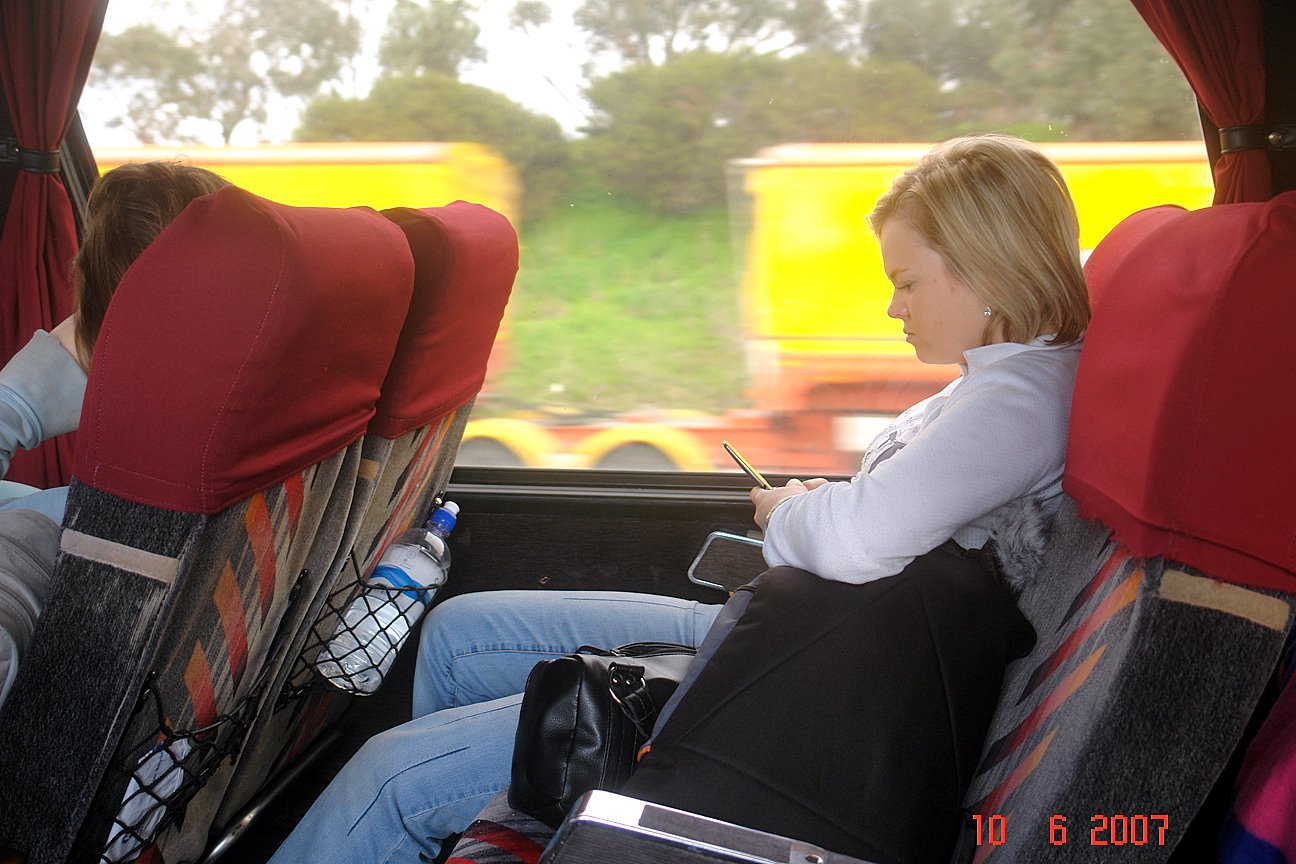
Gary Sauer-Thompson, Victor Harbor bus, 2007
I remembered how photography gave me my sense of identity. The images I took weren't very good, as it was difficult to catch the mood of isolation, with each individual keeping to themselves and each being unknown to the others. My eye wasn't in, and I was not fast enough to snap the image amidst all the movement. The magic moment stuff is not my style.
But I kept plugging away to try and get get my eye in:
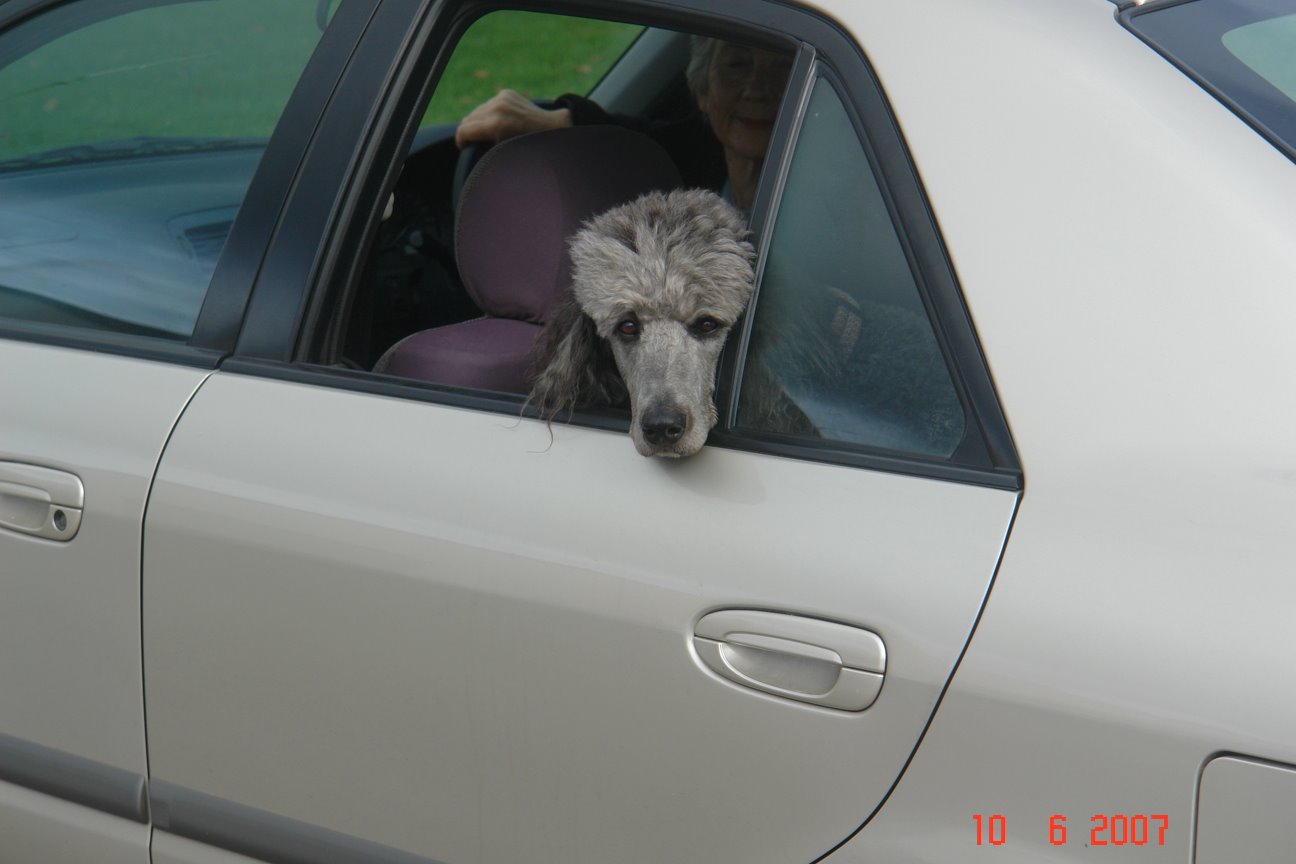
Gary Sauer-Thompson, Victor Habor, 2007
As I drove around Victor Harbor in the late afternoon amidst all the holiday crowds looking at the road and scenes from car interiors I was reminded of times past:
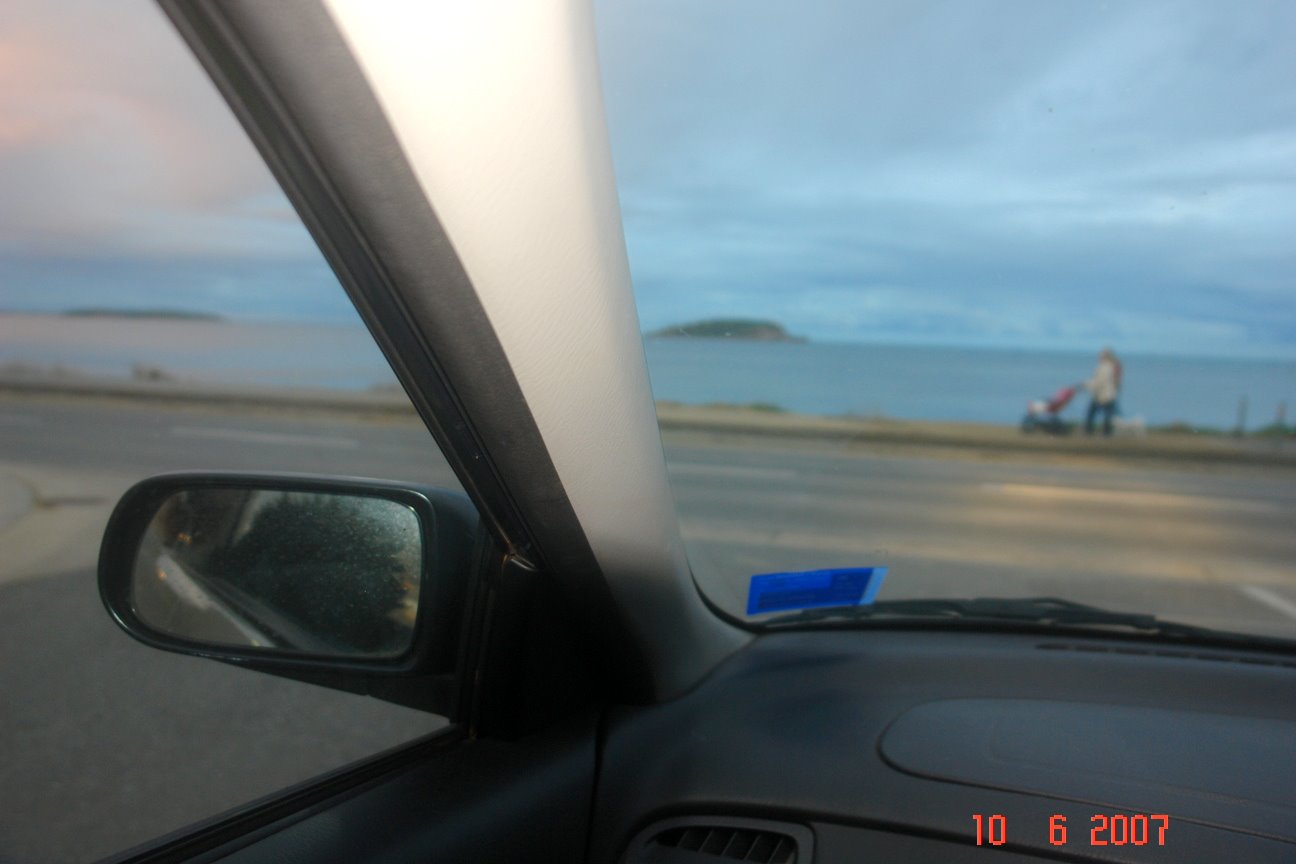
Gary Sauer-Thompson, Remembering Victor Habor, 2007
Somehow my life seems to be an excess of travel. The travel in the air and on the road is a non-place compared to Victor Harbor as a place with an identity and history. My experience of time, which involves an efforts to construct meaningful life-story and a narrative of both an individual and collective sort, is premised on a constitutive dialectic between remembrance and forgetting. Remembrance is like a screen on which memory traces are projected. And our personal narratives are bound up with, and shaped by the process of forgetting.
June 8, 2007
Friday snap: Remarkable Rocks
I'm due to catch a flight to Sydney tonight for an all day working meeting on health and research. This sure cuts into the long weekend at Victor Harbor. It's the last flight out and thankfully I have no late meetings when I arrive at the airport hotel.
I'm currently working in the Qantas Club with a hundred or so other travellers. I'm able to grab a bite to eat (a bit of meat and salad) and a glass of wine and blog whilst I wait for the plane. The business rush has finished so it is fairly easy going. Just the stragglers as it were. Hell, they've got the airconditioner going even though its winter.The Perth flight has been called.
The taxi driver played John Coltrane 'A Love Supreme' live in Paris --it was delightful. It took the edge off the urban rush. I hadn't heard it for years.
So we have a friday snap:
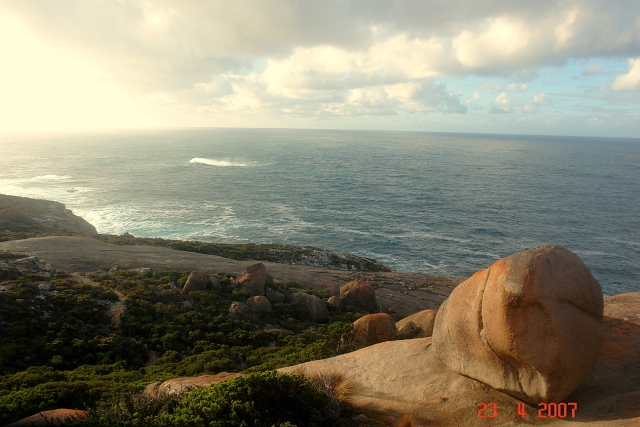
Gary Sauer-Thompson, Remarkable Rocks, Kangaroo Island, 2007
'Tis early morning on the rocks. I'd driven down and was the first tourist there. Then a serious photographer turned up, with a six pack of lenses attached to his belt. He strolled aroudn with purposeful strides and took no photos. I snapped away aware of his scorn for a tourist.
I must start taking photos of airports and cities from taxis as I go to and fro, I spend so much time on the road going from here to there and back again that I'm a frequent flyer. Airports are hubs, spaces where people gather for an hour or so before they move on. I could do a project--observations of a frequent flyer or something. It's all about displacement, fragmentation, isolation.
Flight has been called.
June 7, 2007
Meanjin: troubles ahead
There's a bit of fuss around Meanjin, the Melbourne literary/cultural journal published out of the University of Melbourne. Melbourne University Press (MUP) and Meanjin are wholly-owned subsidiary companies of the University of Melbourne. Meanjin is going to come under the control of and it is feared that it will lose its independence.
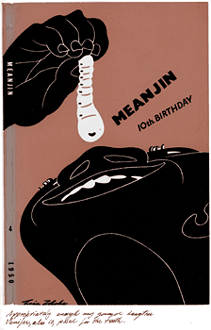 Meanjin's historical role in Australian cultural life is second to none but it does not have an online presence.
It is generally agreed that quality of the magazine has been consistently outstanding under Ian Britain its current editor, whilst transforming the journal into one that common readers are interested in.
The cause for concern is that Melbourne University will not give Meanjin the same level of financial support it gives the Australian Literary Review ALR) run out of Murdoch's Australian newspaper.
The University of Melbourne has decided to apply financial tests to a non-profit-making publication that is in practice subsidised by generations of editors who have edited it.
The University of Melbourne could make a substantial investment in Australian public culture by both defending the magazine's in-print editorial independence, and by digitalizing Meanjin's extraordinary archives and putting them online.
June 6, 2007
Martha Rosler + an aesthetics of decay
I only know 'The Bowery in Two Inadequate Descriptive Systems ' (1974-75) work of Martha Rosler plus the essay, "In, around, and afterthoughts (on documentary photography)." From memory both of these broke with modernism in the exhibition system and modernist criticism (ie., Greenbergian formalism).
These works recognized the art gallery as container and frame, and they aimed at breaking the modernist myth that art was a domain apart from society and immune to politics and power employing strategies planned from positions once on the margins of the art world. Thus 'The Bowery' work deliberately engaged with the traditions of documentary photography”.
The black and white photographs of Bowery storefronts hang adjacent to clusters of typewritten words that are synonyms for the word "drunk." The piece, which avoids depictions of homeless people, subverts documentary photography's assertion of objectivity and accuracy and its traditionally humanist ethos.
 \
\
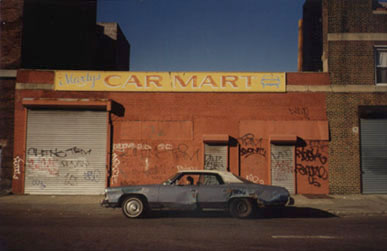
Martha Rosler, Rights of Passage, 1995-1998
The Rights of Passage work is a suite of panoramic photographs of the road, the car, the street, which as the locus of daily experience in the US, shapes our lives and creates dreamscapes that accord with nothing previously imagined. They documens a driver's-eye view of featureless highways and focus on the "no-place" quality of so many modern "public spaces."
The photographs are of the roads she travels to and from her home in Brooklyn. These photographs, taken from inside her car, focus mostly on billboards, to show the urban landscape as largely a site for advertising. The steering wheel, windshield wipers and rearview mirror are cut into and frame the image, as if to circumscribe the mythical freedom of the American road.
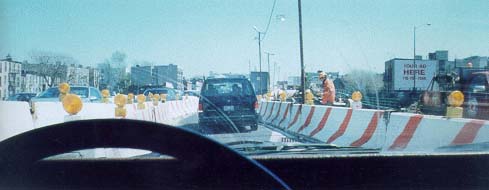
Since these series of color photographs of highways, road signage, vehicles transporting goods, and highway construction sites point to the erosion of geography, history, community, and liberty that have result from American -style urbanization, they can be seen as an aesthetics of decay.
June 5, 2007
Remarkable Rocks +Aboriginal presence
From a distance, looking across the water from Cape De Couedic, they look like Australia's version of Stonehenge. These rocks sit atop a remnant granite outcrop that juts out to sea.
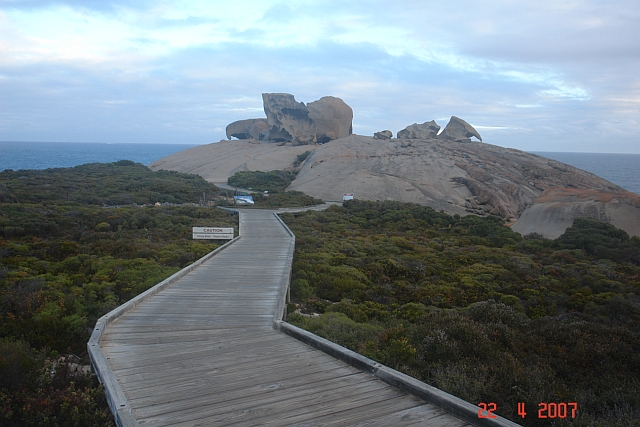
Gary Sauer-Thompson, Remarkable Rocks, Kangaroo Island, 2007
Upclose it is very different. It's the dramatic forms not the mystical or spiritual presence that is striking:

Gary Sauer-Thompson, Remarkable Rocks, Kangaroo Island, 2007
The weathering actions of water seeping into the cracks of the rocks weathered by the sandy wind which form unusual shapes.
Aboriginality is marked by its absence. In the early nineteenth century sealers kidnapped Tasmanian Aboriginal women to work and live with them on Kangaroo Island. During the past times of lower sea levels Kangaroo Island was connected to the mainland. Its most recent separation was probably at the end of the last ice age about 10,000 years ago.Aborigines had lived on the island until at least 4,000 years ago - long after the island was isolated from the mainland by rising sea levels. Stone tools have been found widely on the island and Aboriginal occupation may have persisted until about 2000 years ago.
The place was unoccupied when Matthew Flinders landed there in 1802 - he noticed there were no fires, and extraordinarily tame kangaroos.Rebe Taylor, author of Unearthed: The Aboriginal Tasmanians of Kangaroo Island, says:
As the two histories met, Kangaroo Island fell out of both of them. It is only a footnote to the narrative of the Aboriginal Tasmanian community of Bass Strait ... It was cordoned off, roped into the colonial narrative of South Australia. But it is only a footnote in that story as well.
Marc Riboud
Marc Riboud worked in the tradition of Magnum crew as initally defined by Henri Cartier-Bresson, Robert Capa, and Chim (David Seymour)----travelling the travel the globe with a Leica shooting in black and white.
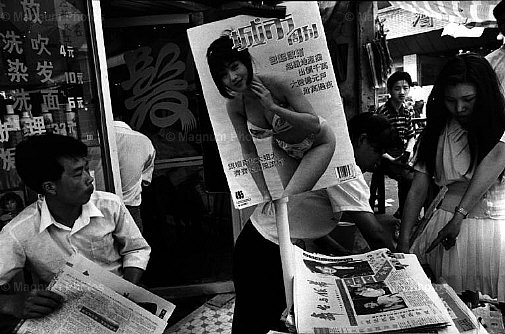
Marc Riboud, China, 1993
It is the photojournalist as a witness to the atrocities of war in the 20th century. Or wandering the globe photographing all walks of life, especially those in Asia.

Marc Riboud, Windows, Beijing, 1957
June 4, 2007
Alison Krauss, photos
After taking some photos in the late afternoon at Remarkable Rocks I came back to the lighthouse cottage at Cape de Couedic and listened to Alison Krauss recent A Hundred Miles Or More: A Collection whilst drinking a big SA red.

Gary Sauer-Thompson, Remarkable Rocks, Tasmania, 2007
It was the first time I heard Alison Krauss apart from the Cohen Brothers O Brother, Where Art Thou?" soundtrack:
The 'A Hundred Miles Or More' album is a long way from the earthy, rollicking bluegrass roots of her Union Station band and you wouldn't know that she and Union Station were bluegrass' leading light in the '90s. It's a collection of solo Alison Krauss songs from various artist's albums or movie soundtracks. I was lukewarm as some of the material lurches towards the middle of the road and lacks the depth of a Gillian Welch.
June 3, 2007
'Curtin': a new Australian national identity
I was reminded of this cartoon after watching the ABC docudrama on John Curtin and the ALP governing the nation in WW2-circa 1941-42:

Matt Golding
The nationalism of the ALP was embodied in resisting the British Empire and bringing the troops home from the Middle East to defend an independent Australia from the Japanese.Australia's independence from being its history of being a colonial outpost was inseparable from the commitment to the White Australia Policy.This was not mentioned by the docudrama. If that action forged a new Australian identity, as the ALP claims, then that identity of nationhood remained that of white Australians who were no longer Britons.
Australians were defending a white Australia. White Australia remained entrenched as the foundation stone of the Australian state. White Australia had been developed within the framework of the British empire. But after 1942 the security umbrella it had provided was no longer there. After 1945 the British Empire was shattered by an eruption from below—the anti-colonial upsurge—as well as by pressure from a the United States, which saw the dismantling of the empire as a key post-war objective. Accordingly, Australia was no longer surrounded by empire and it had to deal with decolonised nations to its north.
The nationalism of the ALP was not seriously questioned, and challenged, until Whitlam and the embrace of multiculturalism in the early 1970s. What was suprising was that the white nationalism that was an integral part of the culture of the ALP was not mentioned by the ABC 'Curtin' docudrama.
June 2, 2007
The Police retuned
I never listened to the Police, even though they were they were one of the most popular rock & roll bands in the world in the early 1980s, and so don't know their 1980 classic Zenyatta Mondatta album. So I know nothing about the personal and creative tensions between the band members and I don't know what the fuss is all about in their reunion tour.
They seem to be a pop band to me, despite the jazz backgrounds of the three members and the band being part of the late-'70s English punk/new wave artist movement. I haven't even followed Sting's solo career.
Still, it's an unfortunate name for a pop/rock band.
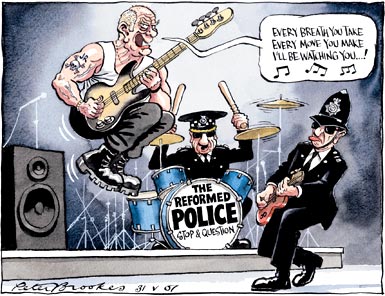
Peter Brookes
Pop melodies based around a jazz arrangement---is that The Police? Or is it the punk-reggae-whatever combination?