|
June 20, 2007
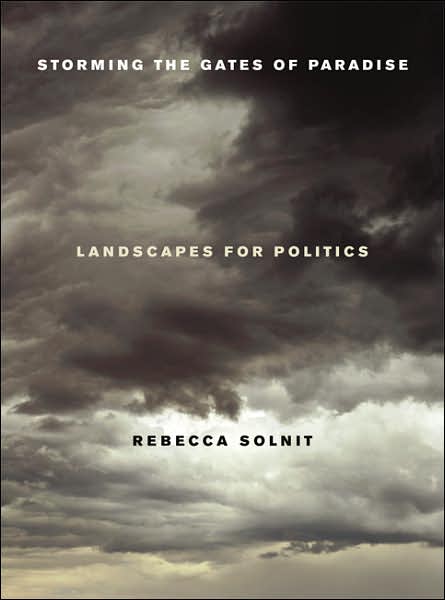
'Storming the Gates of Paradise' by Rebecca Solnit is a collection of of reportage and essays on the post-millennial American political landscape by the celebrated anti-globalization activist. However Solnit began her career as an art critic and so photography, hope, environmental degradation, the landscape of the American West, and beauty are woven though the essays.
Solnit covers familiar ground—the California earth blasted away by the devastating hydraulic mining of the gold rush, and Nevada’s dry, alkaline lake beds, home to Burning Man and the US military.
Her art-world credentials are put to good use in an arch and acid fantasia called "The Wal-Mart Biennale," in which she imagines what new pieces Wal-Mart heiress Alice Walton might add to the museum she's assembling with her billions (and some taxpayer cash) in Bentonville, Ark. Perhaps some sweatshop workers could be included amid the Hudson River School scenery. ("Imagine paintings of Edward Hopper's old downtowns, boarded up because all the sad and lonely people are shopping at Wal-Mart.")
An example of the landscapes for politics is the way that Solnit perceives the U.S.-Mexican border as a state of mind imposed on the landscape, “not so much a line drawn in the sand of the desert but in the imagination, a line across which memory may not travel, empathy may be confiscated, truth held up indefinitely, meaning lost in translation.” Physical space, real places, she sees as inevitable starting points, “the arena in which people think about politics and public life and and feel a sense of embeddedness in it as both beneficiaries and caretakers” – hence her visceral revulsion of suburbia.
Another example is her review of a Sandow Birk-illustrated edition of “Dante's Inferno,” which begins with impressions of museum-going in Los Angeles: “ ... when I came home,” she writes, “I would find that the hours I'd spent negotiating freeway merge lanes and entrances and exits and parking garages were, in some mysterious way, more memorable than the museums. I was supposed to have my head full of paintings or installations. Instead, I had a head full of the anonymously ugly spaces that are not on the official register of what any place is supposed to be, the infrastructure of what for me in those days of my youth was despair.”
|


http://youtube.com/watch?v=7Y7u_NXTQGc