|
February 8, 2008
"The baroque" is a term traditionally associated with the seventeenth century, though it was not a label used by individuals of the period itself to describe the art, economics, or culture of the period. During the eighteenth century "baroque" implied an art or music of extravagance, impetuousness, and virtuosity, all of which were concerned with stirring the affections and senses of the individual. The baroque was believed to lack the reason and discipline that came to be associated with neoclassicism and the era of the Enlightenment.
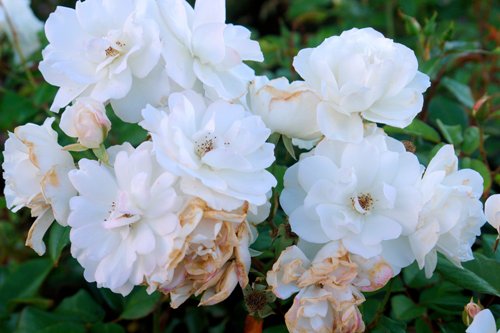 Gary Sauer-Thompson, my desktop, (decaying rose), 2008
For the eighteenth and the nineteenth century, the baroque was increasingly understood as possessing traits that were unusual, vulgar, exuberant, and beyond the norm. Indeed, even into the nineteenth century, critics and historians perceived the baroque as a degeneration or decline of the classical and harmonious ideal epitomized by the Renaissance era. The baroque was generally considered a chaotic and exuberant form that lacked the order and reason of neoclassicism, the transcendent wonder of romanticism, or the social awareness of realism.
It is within the context of the postmodern that the neo-baroque has regained an aesthetic presence.
In her Introduction to her Neo-Baroque Aesthetics and Contemporary Entertainment Angela Ndalianis says:
As was the case with the seventeenth-century baroque, the current expression of the neo-baroque has literally emerged as a result of systemic and cultural transformations, which are the result of the rise of conglomeration, multimedia interests, and new digital technology. Cultural transformation has given birth to neo-baroque form. The neo-baroque articulates the spatial, the visual, and the sensorial in ways that parallel the dynamism of seventeenth-century baroque form, but that dynamism is expressed in guises that are technologically different from those of the seventeenth-century form. In the last three decades in particular, our culture has been seduced by visual forms that are, reliant on baroque perceptual systems: systems that sensorially engage the spectator in ways that suggest a more complete and complex parallel between our own era and the seventeenth-century baroque.
The argument is that the neo-baroque offers a productive formal model with which to characterize the transformations of cultural objects of our epoch; that many of the important cultural phenomena of our time are distinguished by a specific internal `form' that recalls the baroque" in the shape of rhythmic, dynamic structures that have no respect for rigid, closed, or static boundaries; and that neo-baroque forms display a loss of entirety, totality, and system in favour of instability, polydimensionality, and change.
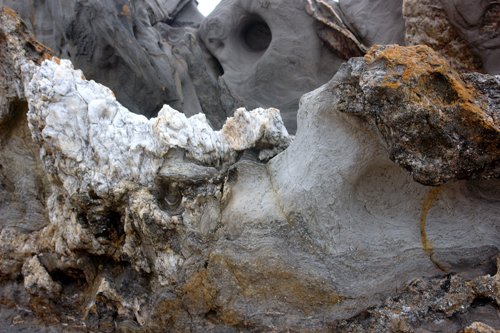 Gary Sauer-Thompson, folding rocks, Victor Harbor, 2007
In The Fold Gilles Deleuze argues that Leibniz's writings constitute the grounding elements of a Baroque philosophy and of theories for analyzing contemporary arts and science. A model for expression in contemporary aesthetics, the concept of the monad is viewed in terms of folds of space, movement, and time. Similarly, the world is interpreted as a body of infinite folds and surfaces that twist and weave through compressed time and space.
|


