|
February 27, 2008
When I was in Brisbane I returned to Harry Seidler's heritage listed Riverside Centre (1987), which I'd explored on an earlier visit, and interpreted in terms of developing a critical regionalism. This is the building that gave Brisbane a sense of growing up, a sense of confidence. Just like Australia Square in Sydney, it was a symbol of an emerging new Australia, a clever country unfettered by colonial restraints.
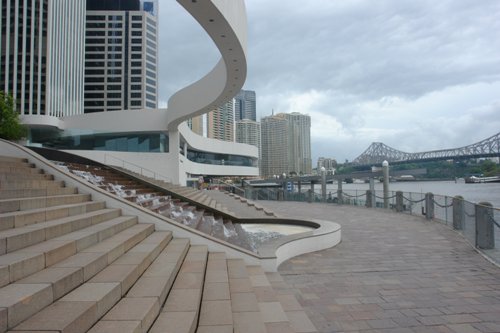 Gary Sauer-Thompson, Riverside Centre, 2008
This time I was more interested in the Riverside Centre's public space, and the link of the plaza to the river and the walkway of Brisbane's first flagship CBD building. It is held that Seidler was
constantly engaged in three interrelated operations: first, in an effort to render the tall office building as an integrated urban landmark; second, in a parallel endeavour to treat the landscape at grade in such a way as to create a civic arena ... without those public institutions that are essential to the public realm; and finally, Seidler continually tries to create enclaves within the chaos of the modern city and to augment those enclaves where possible
This is certainly the case with the Riverside Centre. It provides the space for the urban outdoor lifestyle that gained momentum in the late 1980s, and so enabled people to sit outside and display themselves. It's Brtisbane's equivalent of the Roman promenade.
|


Gary,
Did you explore Seidler's Riparian Plaza in Brisbane?