|
February 18, 2008
Under a post WW2 modernism in the 20th century the public culture, which had characterised an earlier modernism, had been displaced by a pervasive withdrawal into a private sphere. In architectural or urban planning terms terms, the rise of the (good) garden suburbs was positioned as the nemesis to the (bad) public space of the modern city.
So there was the displacement of traditional public spaces such as city squares, plazas, streets and boulevards into the background and the rise of public spaces that were hostile to a gathering and mixing of people as moving subjects.
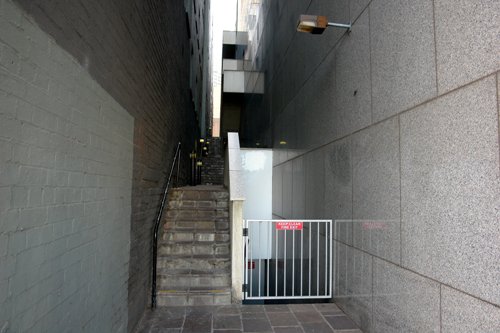 Gary Sauer-Thompson, walkway, Flinders Street/Spring Street cnr, Melbourne, 2008
Such brutalist spaces are not conducive to public civility amongst diverse people who are strangers. They foster fear and apprehension amongst strangers rather than facilitating strangers engaging with each other in public. So we are left with the assumption that Australians feel uncomfortable sitting in a square, and that they are comfortable working at the office, home with the family looking at television, or the productive’ practice of shopping in the department store or arcade.
This decline of the public space--- a turning away from the street and towards controllable domesticity---gave rise to a culture in which strangers had no right to speak to each other, that each mobile subject possessed as a public right an invisible shield, a right to be left alone:
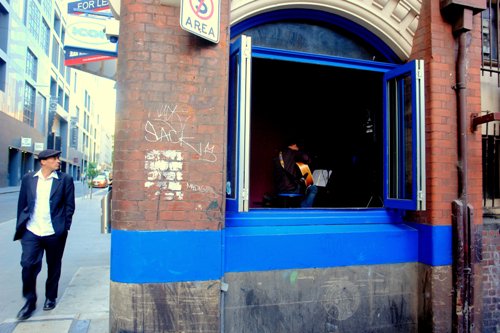 Gary Sauer-Thompson, Flinders Lane, Melbourne, 2008
So we have a modernist public culture that privileged looking over talking, detachment over engagement.
|


