Thought-Factory.net Philosophical Conversations Public Opinion philosophy.com Junk for code

Mandy Martin, Puritjarra 2, 2005. For further information on MANDY MARTIN, refer here: http://www.mandy-martin.com/
If there are diverse kinds of knowledge and ways of knowing place, then we need to learn to value the different ways each of us sees a single place that is significant, but differently so, for each perspective.
RECENT ENTRIES
SEARCH
ARCHIVES
Library
Thinkers/Critics/etc
WEBLOGS
Australian Weblogs
Critical commentary
Visual blogs
CULTURE
ART
PHOTOGRAPHY
DESIGN/STREET ART
ARCHITECTURE/CITY
Film
MUSIC
Sexuality
FOOD & WiNE
Other
www.thought-factory.net
looking for something firm in a world of chaotic flux

AC/DC Lane, Melbourne: revisiting « Previous | |Next »
February 17, 2008

I had been disappointed in the lack of visual culture in AC/DC Lane when I explored it last year. Afterwards, I realized that I had only seen one part of it. The lane curves in a semi-circle off and then back to Flinders Lane. In my hurry I had failed to walk the curve. I was still caught in the mentality of the Hoddle grid.

I walked through the Fitzroy Gardens and worked my way down the corporate looking Flinders Lane to the AC/DC Laneway.
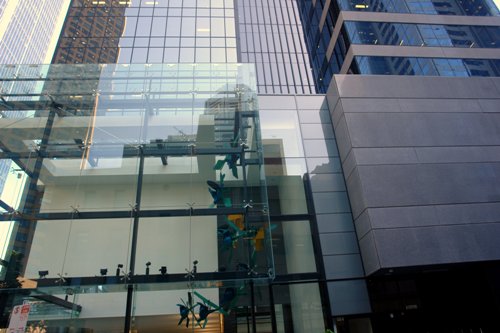
MelbourneFlinderslane1.jpg Garry Sauer-Thompson, Flinders Lane/Exhibition Street cnr, Melbourne CBD, 2008

The back doors of the Flinders Lane restaurants opened onto the laneway, whilst other doorways opened up into clubs or upstairs restaurants. There were a few people around in the laneway, mainly restaurant staff. The visual musical culture of the laneway was mainly based on posters, and it expressed, 1970's punk:
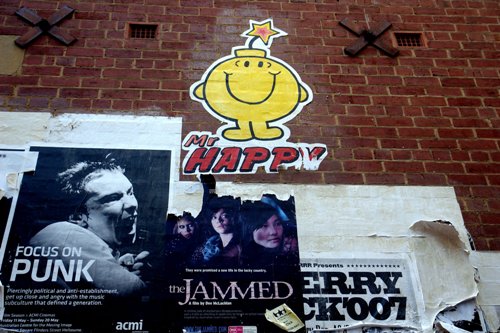
MelbourneACDClane.jpg Gary Sauer-Thompson, AC/DC Lane, Melbourne, CBD, 2008

This stood in stark contrast to the rapid renovation of the 19th century warehouses and rag trade buildings happening all along Flinders Lane. Two worlds. But they weren't colliding.

What was surprising was the lack of music being played. It was in the afternoon, but I thought that music would be coming from some of the clubs/venues/ bars as the doors were open. I'd been listening to David Bowie's best music from the 80's period on the plane to Melbourne, and I 'd found it disappointing after the innovative work of the Berlin trilogy period in the 1970s. The 1980s work did not sound fresh, hip, or contemporary. Classic Bowie is both tuneful and adventurous and this was the hallmarks of his '70s work.
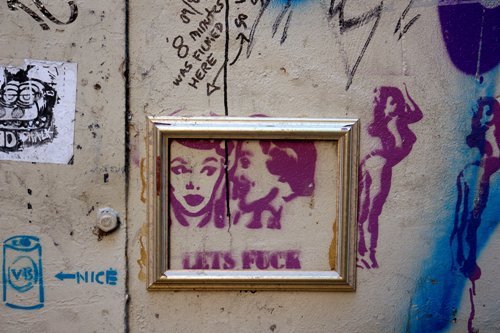
melbournelesbian.jpg Gary Sauer-Thompson, AC/DC Lane, Melbourne CBD, 2008

Presumably, it is all very different at night. The place comes alive. That's when the music photographers turn up to do their work.
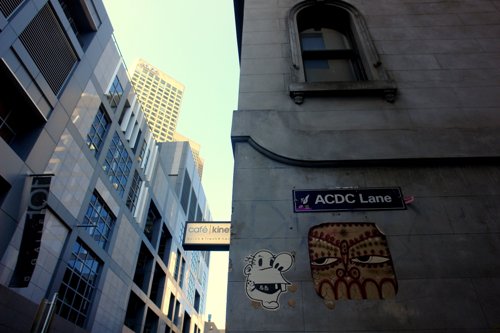
MelbourneACDClane1.jpg Gary Sauer-Thompson, AC/DC Lane,/Flinders Lane cnr, Melbourne CBD, 2008

I was thinking of Bowie as he seems to be a kitschmeister, and habitue, of a prematurely abandoned modernist space; post-punk minimalist, ironic, electronic pop-as-sound.

| Posted by Gary Sauer-Thompson at 8:55 AM | | Comments (11)
Comments

Comments

What about John Coltrane. Did he not influence Iggy Pop. Any signs of Coltrane in AC/DC Lane?

Ah, David Bowie. He dominated the soundtrack of my youth. Music to live by up to and including Young Americans. He didn't do the shift to the digital terribly well, although there were a couple of great tracks.

Brian Eno was the place to be come the more overtly digital. Roxy Music made the transition more successfully and took the camp, glam thing with them. But they would be out of place in AC/DC Lane.

Lyn,
Bowie left LA after making Station to Station (the album after Young Americans) to settle in Berlin, where he lived and worked with Brian Eno. There he developed a fascination with German electronic music, which Eno helped him fulfill on their first album together, Low. Released early in 1977, Low was a startling mixture of electronics, pop, and avant-garde technique.

What do you mean by the shift to the digital?


Gary,
I was thinking about that after I posted the comment. Low is one of my favourites, but not for anything like the reasons the earlier albums were. It's as if Bowie forgot to take his Bowieness with him when he made the transition.

Pam,
no Coltrane anyway. Pity.

Lyn,
what is Bowieness? Ziggy? Aladdin Sane? Diamond Dogs? Hunky Dory? Pinups? On the surface he is a musical chameleon, adapting himself according to fashion and trends.

I was trying to imagine Bowie's as a soundtrack to the colliding worlds of the working class back lanes with their dirty rubbish and heroin needles with their rock and roll, and the classy middle class world of restaurants and fashion shops and the suits.

It ain't 'All the Young Dudes' that bridges the two worlds--it's a tough live version of Diamond Dogs.

Wrong musician. And it sure ain't the Grateful Dead, no matter what Gary holds about these cocaine hippies picking up on Coltrane's improvisation around Sarlet Begonias and Fire on the Mountain.

The two worlds have something in common: coke and sympathy and needing someone to bleed on---so it's the Rolling Stones 'Let it Bleed.'

It's nostalgic pop culture for sure. But isn't that the case with Melbourne's back lanes? Nostalgic for yesterday--the 1970s--- before the impact of globalization on Melbourne?

Pam
I disgree. The 1977 Barton Hall Cornell University concert by the Grateful Dead is a classic. This show is considered by many to be one of, if not the Grateful Dead’s finest shows, after the raw rocking improvisation of the distorted 1968 shows show cased on Live Dead.

Cornell’s most significant contribution to contemporary American culture may well have occurred on May 8th, 1977, when the Grateful Dead played Barton Hall. The show is a legend among dead heads and is one of the most popular shows available for downloading or trading over the Internet.

I can imagine myself sitting amongst the dirt and filth of AC/DC Lane looking the graffiti as a photographer whilst listening to the reworking of Coltrane's A Love Supreme style improvisations on Scarlet Begonias on my Ipod. Bowie sounds pedestrian on Diamond Dogs. It's just not Coltrane. I could also listen to this free form music in in the cosmopolitan bars.

Gary,
It goes without saying that this is all subjective, but for me, my parents already owned the Grateful Dead by the time I started developing my own musical tastes. I think it's true that Bowie is not the stuff for dirty laneways, except maybe Aladdin Sane.

I don't know what I mean by Bowieness. Camp? Glam? I was too young at the time to understand camp.

Lyn,
It's the young t shirt and jeans at home in dirty laneways who are rooted in historical Melbourne + upmarketed bars peopled by young free market "punks" living in the global market place Or rather they are fashionably post punk. Doesn't Bowie straddle the two?

Maybe I should have been thinking of the White Stripes?

Coltrane and the Grateful Dead, as you point out, are too way back in the dim past of popular culture.

Gary,
Yes, the White Stripes could do it. They can do pretty much anything. Maybe Hilltop Hoods? Their lyrics do the dirty bits and the production(?) does the swanky bars and nightclubs.

They could carry the last two scenes, and could probably get away with the punk posters in the second one if you connect the class roots of their style. Corporatism is one of their favourite topics, so that's the first shot covered as well.