|
February 7, 2008
Brutalism in modernist architecture has a presence in Australia, though it is often softened with a slab of colour as distinct from the singular, iconic concrete monoliths that are favoured by Telstra to signify its dominant gorilla like presence in Australia's telecommunications industry.
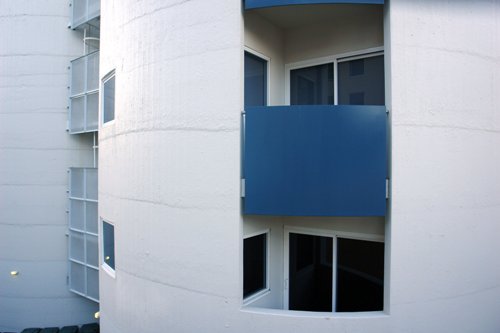 Gary Sauer-Thompson, flats (back detail), Salamanca Place, Hobart, 2007
This building, as self-contained monolithic form, is probably better seen as an updated Brutalist style. It still continues the tradition of architects thinking of cities as collections of buildings with spaces in between them.
It belongs to the modernist tradition, as it both utilizes advances in technology to produce a better quality of life for all, and repudiates the 19th century tradition and heritage. In doing so modernism radically changed,. and is changing, the urbanscape in Australia.
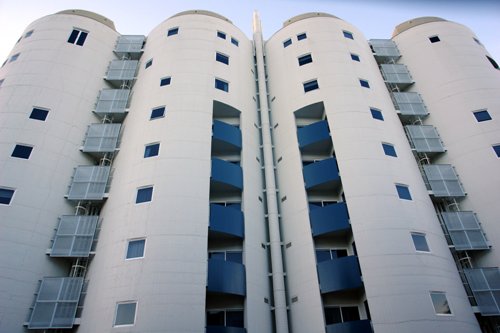 Gary Sauer-Thompson, Modernist flats (back facade), Salamanca Place, Hobart, 2007
I do not have a working knowledge of the history of modernist architecture in Australia with its concept of architecture as a monumental, autonomous, constructed space, in Australia, its fierce opposition to historicism and taste for superfluous ornamentation, and its dream of a rationalized machine world where life would approach the perfection of an assembly line.
Mauro F. Guillén in his The Taylorized Beauty of the Mechanical: Scientific Management and the Rise of Modernist Architecture says the modernists architects:
They yearned to create houses, public buildings, factories, artifacts, and durable consumer goods combining beauty with technical, economic, and social efficiency. They became technicians organizers, and social reformers as well as artists, adding the stopwatch, the motion picture camera, the slide rule, and the psycho-physiological test to their toolkit. Architecture and our experience of the built environment changed in ways still discernible today. Technology merged with style, science with history, efficiency with creativity, and functionality with aesthetics.
I don't know the effect of the Bauhaus or Le Corbusier's concepts of the “machine for living,” the standardized “dwelling unit,” and the “mass produced house” in Australia after WW2. Modernism includes several “discontinuous movements” not always fully compatible with each other; but there is an overall unity in the aesthetic qualities of the institutionalized modernist architecture, such as classical trinity of “unity, order, purity”.
|
|


Gary
Brutalism was one of the last architectural styles that pre-dated globalism. It was a time when society thought the future of science-fiction novelists was upon us.
Le Corbusier and the new modernist movement sought to eradicate the past, and its irrelevant urban lifestyle. The streets would become highways moving mass numbers of automobiles, the street-life would be moved indoors or elevated above the street.
Our lifestyle would be filled with modern inventions, and a totally new evolved society would require a re-fabricated neo-urban environment. There was a rampage during the '60s and '70s to eradicate Victorian architecture. Victorian buildings were regarded as dirty, old, and of little use in a society that would be jet-packing around by the 21st century.