|
February 6, 2008
As the old building sites from the days of rustbelt Adelaide slowly gives rise to new modernist glass towers the urban trees are cut down. Despite the city sweltering during the long months of summer heat there are little moves to plant trees to provide shade for people as they walk the city. So we have images like this in the south west corner of the city:
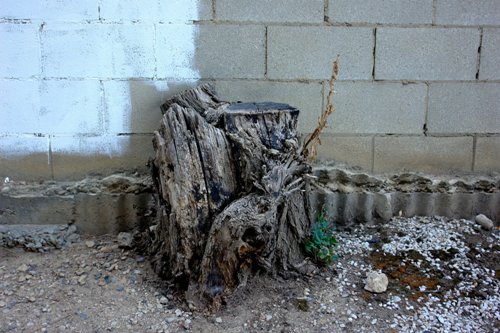 Gary Sauer-Thompson, tree stump, Adelaide CBD, 2008
Urban design is still modernist--how to pack lots of people in a small ordered space with little thought being given to the quality of the public spaces in a warming world. Trees represent disorder, mess, uncleanness. Only decorative street trees and trees in parks are allowed. Le Corbusier’s key text, The City of Tomorrow and its Planning, is central to understanding our urban life.
It is premised on “the exodus of city dwellers” from the centers of the city and the “replacement by business.” Le Corbusier take this as evidence that people prefer to live in suburbs rather than in cities, and therefore bases his theory of urban planning on the idea that the center should be for commerce (and some public services), and that it should be surrounded by two belts of residential areas – one with “blocks of dwellings on the ‘cellular’ system”, and one outer garden city. The center of a great city should consist mainly of skyscrapers – exclusively for commercial use.
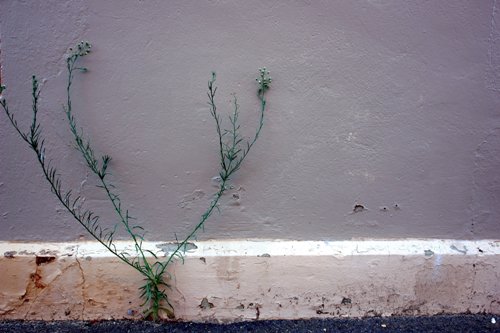 Gary Sauer-Thompson, green weed, Adelaide CBD, 2008
That's how urban planning in Adelaide traditionally understand itself, with on modification---trying to bring people back to the live in the CBD to create some life,diversity and creativity in a CBD that was dead and empty after working hours. The New Urbanism of Jane Jacobs, with its stress on the importance of diversity in neighborhoods in the inner city is not embraced.
Like Le Corbusier it is assumed that order = peace and happiness. Adelaide as an ordered garden city is of a purely geometrical kind; its rectilinear is clear and well-arranged, easy to police and to clean, a place in which you could find your way about and stroll with comfort.
What was rejected is what Le Corbusier calls the Pack-Donkey’s Way--or the curvilinear type of city that allows the meandering along, meditate a little, becoming lost, and ending up is strange and different spaces.
|


Gary,
Though Le Corbusier’s theories suggest that the center of a great city should consist mainly of skyscrapers – exclusively for commercial use – he did say that the area occupied by these should be no greater than 5 percent. The remaining 95% should be parks with trees.
Also in the center there would be a train station, the “hub” of the city, and three-story buildings with “luxury shops, [...] restaurants and cafés.”