|
February 24, 2008
Sidney Nolan at the National Gallery of Victoria is the first retrospective exhibition to be mounted since the artist’s death in 1992 and it includes a selection of his most important works. I didn't see it when I was in Melbourne, which is a pity.
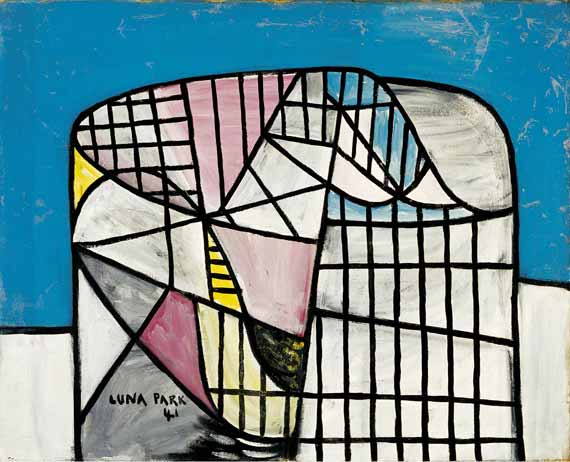 Sidney Nolan, Luna Park, 1941, ripolin enamel on canvas.
The exhibition brings together 117 pieces from all over the world, it is hung chronologically, and represents the different phases of his life. So we get more than the twin series of paintings of the Ned Kelly myth that supposedly created an idea of the entire continent of Australia. What was that idea? Tragedy?
 Sidney Nolan, Self portrait in youth, 1986, spray enamel on canvas,
The argument is that when Nolan began painting in 1932 there was no accepted pictorial language for rendering Australia and that Nolan forged the pictorial language of white Australian painting. Without Nolan there would have been no Fred Williams, no Brett Whiteley.
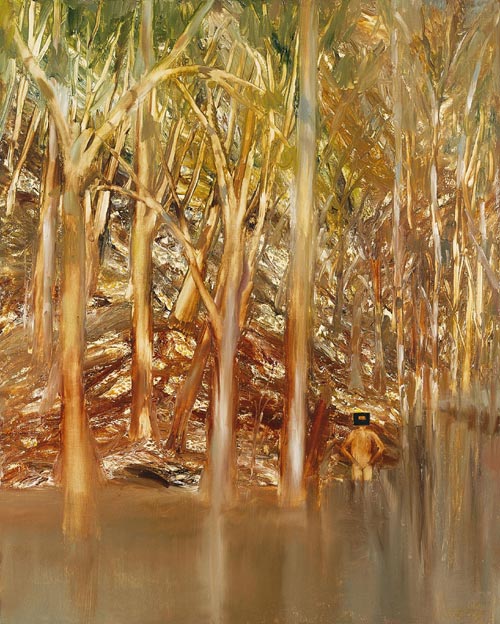 Sidney Nolan, Riverbend 11, 1965–1966, (one of nine panels), Oil on canvas
Riverbend was the first of several panoramic murals Nolan produced between 1964 and 1967, and it was drawn from the Goulburn Valley landscape he used to walk with his father. It proved to be pivotal in his career for integrating his Australian themes of the nineteenth-century outlaw Ned Kelly (now given overtones, among other things, of the explorers Burke and Wills), and the primeval Australian scene. The landscape-----the sunlight filtering through pendant leaves flickered disturbingly on the muddy flanks of the river---dwarfs the human action within it.
|


Gary
Nolan works with a concept of Australia as a primeval scene. The idea of
timelessness or all-time had been first expressed by Nolan in the 1948–1950 landscapes of Northern and Central Australia and it influenced the 1964 images of the frozen Antarctic as well as Riverbend.