|
May 20, 2009
I have been looking for Australian photographers who have worked within, or are reworking, the New Topographics tradition of altered landscapes. It is seen as primarily an American tradition --apart from Bernd & Hilla Becher ---even the idea of altered or manufactured landscapes applies to settler society's such as Australia. I'm curious as I'm trying to find Australian antecedents for my Port Adelaide project.
Then I remembered the work of the German–Australian photographer Wolfgang Sievers. He has been institutionalised under under modernism primarily because of his architectural photography. However, his aerial landscapes are intriguing and ambivalent images that offer other possibilities than a modernist celebration of industrial civilization:
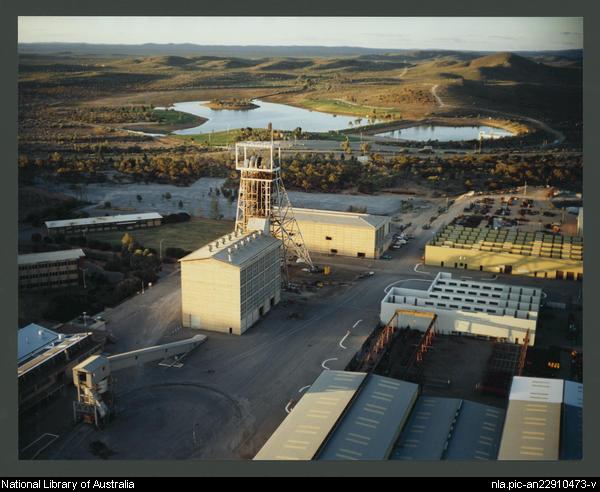 Wolfgang Sievers, Broken Hill, 1980, National Library of Australia
If Australia is a postcolonial nation whose history has been (and continues to be) dominated by social and cultural dependence on other countries, the definition of Australia as ‘provincial’ has been derived from observing local appropriations of other cultures--European or American visual traditions. However, the concern in Australian visual culture is to find a possibility of originality in Australian culture within this relationship of dependency.
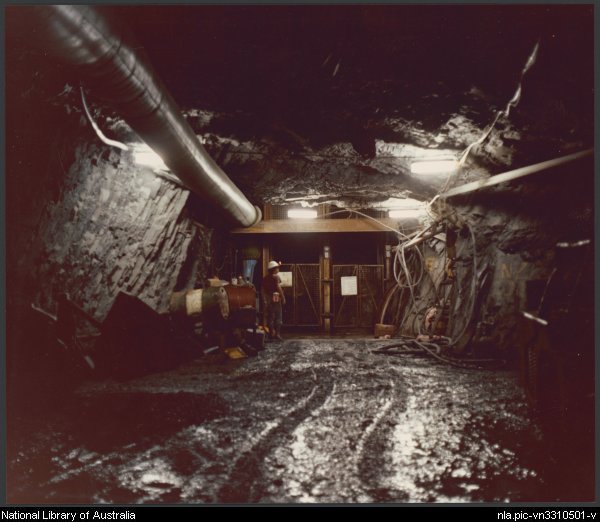 Wolfgang Sievers, Blue Spec gold mine, Nullagine, Western Australia, 1975, National Library of Australia
Sievers background is Berlin’s Contempora School of Applied Arts (an offshoot of the Bauhaus school), the New Photography and the modernist aesthetic integral to Bauhaus philosophy. However, Siever's work transgresses a formalist modernism as he primarily made his living through documentary commercial work for large corporations:
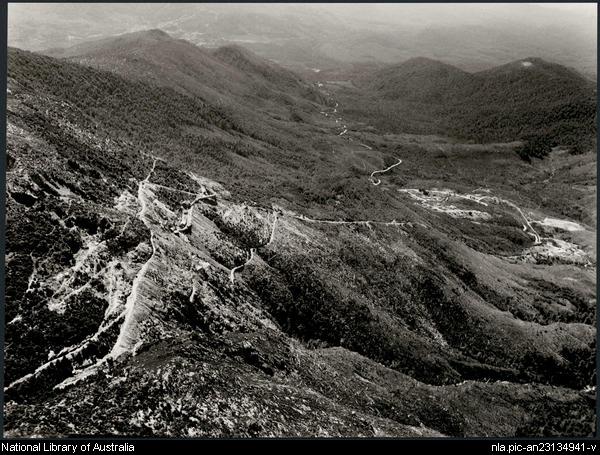 Wolfgang Sievers, BHAS mineral exploration in Western Tasmania near Zeehan, 1959, National Library of Australia
Sievers body of landscape photographic work also challenges the idea of Australia as an unspoiled wildernes since it focuses not on the pristine western landscape of national parks’ wilderness photography but on the “man-altered landscape” by then multinational mining companies. There are many places in outback Australia regardless how remote, where humans have marked nature or wilderness by their industrial presence
Wolfgang Sievers, BHAS mineral exploration in Western Tasmania near Zeehan, 1959, National Library of Australia
Sievers body of landscape photographic work also challenges the idea of Australia as an unspoiled wildernes since it focuses not on the pristine western landscape of national parks’ wilderness photography but on the “man-altered landscape” by then multinational mining companies. There are many places in outback Australia regardless how remote, where humans have marked nature or wilderness by their industrial presence
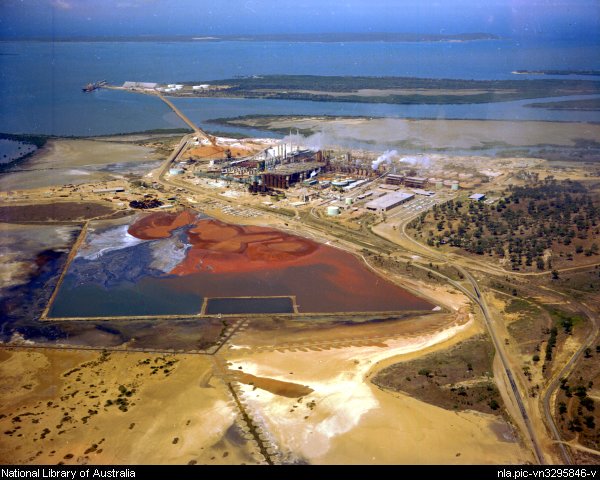 Wolfgang Sievers, Comalco bauxite mine and processing plant, Gladstone, Queensland, 1971, National Library of Australia
Is there an irony in this work of Sievers, as there was in the American Topographics movement; an ethical ambiguity about development and wilderness? Irony is a negative trope calculated to expose ideology as distorted representation of reality. Or is Siever's photography transparent documentary. Or is there a juxtapositions of human exploitation and the beauty of the constructed landscape?
|


