|
October 29, 2009
The exhibition New Topographics: Photographs of a Man-altered Landscape, held in 1975 at the International Museum of Photography George Eastman House, (Rochester, NY) and the show brought together nine photographers—Robert Adams, Lewis Baltz, Bernd and Hilla Becher, Joe Deal, Frank Gohlke, Nicholas Nixon, John Schott, Stephen Shore, and Henry Wessel, Jr.
 John Schott, John, El Nido Motel, 1973, gelatin silver print
This signaled the emergence of a new approach to landscape, effectively giving a name to a movement or style and has since come to be understood as marking a paradigm shift. The Exposure Project describes this shift as a rejection of the the photography of an Ansel Adams and Edward Weston who depicted the landscape as an entity of unscathed and organic beauty. It also rejected the gauzy theatrics and feel-good humanity of Alfred Stieglitz and Edward Steichen.
The photographers of the "New Topographics" movement strove to show the rapidly increasing imprint of human beings on the landscape by an industrial culture. They turned their cameras towards newly built tract houses, industrial parks, expansive highways and commercial strip malls as proof of man's impetuous development.
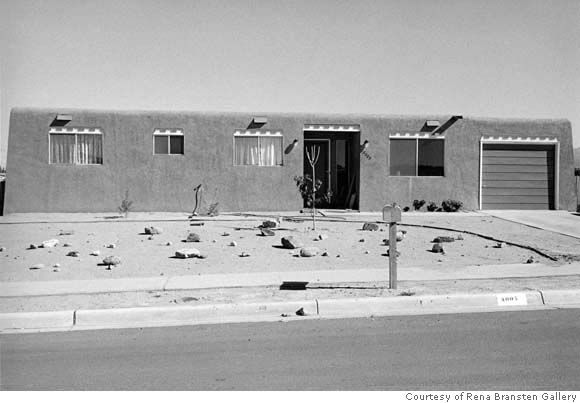 Henry Wessel, "New Mexico" 1969, silver gelatin print
The New Topographics focused on what everybody in America during the 1950s, 60s and 70s actually saw in front of their noses, through their windshields or across their backyard fences.These were run-of-the-mill subjects: highways, strip malls, used car lots and other seemingly nowhere places. They created a poetics of the American everyday life.
The exhibition has influenced a whole generation of photographers. In Australia and in Japan photographers worked by questioning the notion of wilderness and the celebration of an untouched nature. So we can talk about a New Topographics movement.
A new version, restaging or recreation of this exhibition has been organized by organized by the George Eastman House with the Center for Creative Photography at the University of Arizona. More than two-thirds of the photographs by the original ten participants—Robert Adams, Lewis Baltz, Bernd and Hilla Becher, Joe Deal, Frank Gohlke, Nicholas Nixon, John Schott, Stephen Shore, and Henry Wessel, Jr.—are displayed.
An accompanying presentation of works by influential photographers and thinkers offers historic context, including Timothy O’Sullivan, Walker Evans, Ed Ruscha, Robert Smithson, and Dan Graham, as well as architect team Robert Venturi and Denise Scott Brown, with their publication Learning from Las Vegas (1972).
The issues that contemporary photographers could explore to build on what the "New Topographics" artists started would be the effects of consumerism, the over-development of the landscape, the accelerated use of our natural resources and climate change.
|


