|
November 15, 2010
Jan Groover was mentioned in this post by Stephen B Smith in this interview.
Groover abandoned painting for photography and puts a painter’s sense of composition into her series of photographic Kitchen Still Lifes. These were done when black and white still ruled and colour had to establish itself as serious art photography.
 Jan Groover, Untitled, circa 1978, Chromogenic print, from the Kitchen Still Lives series
Groover is working with the classical still life tradition, where the artist arranges and composes the forms and then captures elements of this arrangement. Groover uses the reflection off the metals of her cutlery and steel bowls to give off painterly effects of light and dark, and shadow. The photos are cropped close-ups of a mix of utensils and produce, often larger than life. Groover sometimes incorporates mirrored elements to further increase the depth of the usually simple objects.
Kitchen Still Lifes were precisionist abstract color photography from the late 70s. As formalism feel out of favor and William Eggleston's lyrical documentary style has taken hold,. Groover's analytic studies in muted tones of kitchen utensils feels isolated from today's colour photography.
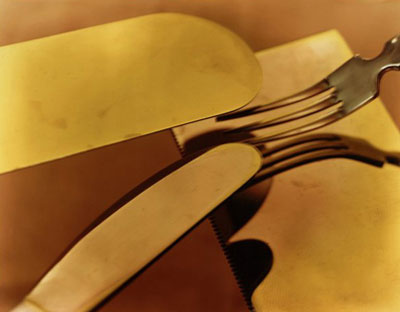 Jan Groover, Untitled, circa 1978, Chromogenic print, from the Kitchen Still Lives series
Groover is often included in discussions about the "new" color photographers of the early 1970s because of her preference and proficiency with emerging color technologies. Although readings of Groover's work have been largely formalist, her images also reveal a witty understanding and appreciation of the history of photography. With a subtle humor, she makes reference to such celebrated 20th-century artists as Edward Steichen, Alfred Stieglitz, Paul Strand, and Edward Weston and to the history of painting.
Groover's sophisticated formalism often features the leaves of several houseplants, two forks, and a mixing bowl. Although these objects are pedestrian, the artist coerces magical formal dialogues from their contrasting shapes, colors, and textures, and ultimately creates a Technicolor cubist collage.
|


