
Mandy Martin, Puritjarra 2, 2005. For further information on MANDY MARTIN, refer here: http://www.mandy-martin.com/
If there are diverse kinds of knowledge and ways of knowing place, then we need to learn to value the different ways each of us sees a single place that is significant, but differently so, for each perspective.
|
|
looking for something firm in a world of chaotic flux
|
|
|
American photography: Steven B. Smith
« Previous |
|Next »
|
|
|
November 14, 2010
Steven B. Smith's photography represents the transition of the American Western landscape into suburbia, and the work references back to Robert Adams, Lewis Baltz and Richard Misrach:
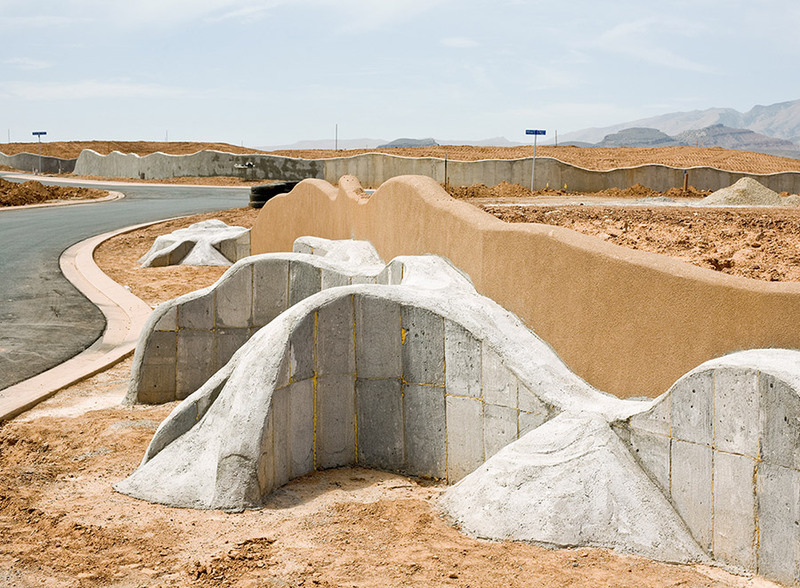 Steven B. Smith, Sculpted Fence # 6, Ivins, Utah, 2007, from the Close to Nature series
In this interview Smith, who teaches in the photography department at Rhode Island School of Desig, . says:
I trying to make a portrait of the culture, of the values of certain middle- and upper-middle-class people in the West. I wanted to do that by showing the process of how they changed the land, making it into something they thought was valuable. Specifically, these developments where the land is dramatically changed but in a way that supposedly takes the local environment into consideration—you know, the manmade reflecting and paying homage to the existing landscape. I was mostly interested in the systems that people use to restrain the land and route water, these elaborate systems of short-term control.
He adds that he started 1993 or ‘94, and he wanted to make black-and-white straight landscape photos.
I thought, why don’t you just kill yourself? Why do you insist on doing something that will never sell or be popular? And then the Germans started becoming popular. All of a sudden it was okay to do landscape, landscape was really hot. And then it was okay to do black and white. Photographers like Toshio Shibata were doing great. It was weird. I started out thinking that I was out in the wilderness, and then slowly it became okay to do what I was doing; I lucked into it.
One of his influences was Jan Groover’s work. She uses the large-format view camera to extend and play with the way the lens draws, as well as the way that film acts as a canvas. She used the view camera on tabletops, and Smith took some of the ideas, rules, or limitations of the tabletop and transferred them to landscape.
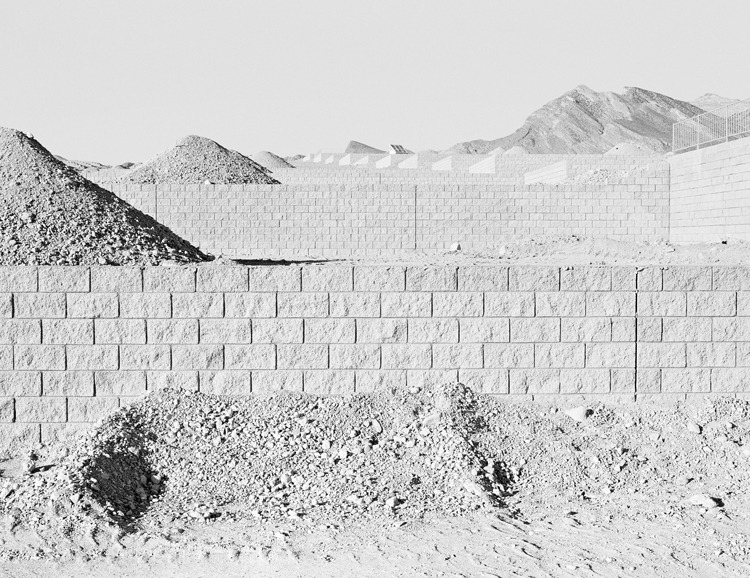 Steven B. Smith, Homesites, Las Vegas, Nevada, 1996, from the series The Weather and a Place to Live
Smith talks about his equipment, technique and work flow. He says that:
I shoot with 4x5 film and develop it myself. Occasionally I’ll make a few silver prints, to make sure that I’m processing things correctly. But I scan my images on an Imacon scanner, which is a high-quality film scanner or a drum scanner, and then I work on the files in Photoshop. I print the photographs digitally using quadtone ink on archival cotton-rag paper.
The printer is an Epson 7600, and he uses John Cohen’s Piezography quadtone inks, selenium color, printed on Hahnemühle photo rag and Roy Harrington’s quadtone RIP.
This kind of equipment is way beyond what I can afford. An Imacon scanner is around $15000. The scanning and printing would have to be outsourced.
|
|
|
| | Posted by Gary Sauer-Thompson at 8:38 PM | Permalink |
|
|
|
|
|
|
|


