|
September 11, 2010
The Ian Potter Gallery at the National Gallery of Victoria currently has an exhibition entitled Stormy Weather Contemporary Landscape Photography. The works shown are drawn entirely from the National Gallery of Victoria Collection, which has an extensive collection of Australian photographs.
This exhibition charts some contemporary approaches to the landscape featuring 24 photographs from the work of eleven Australian photographers including Rosemary Laing; Harry Nankin; David Stephenson; Richard Woldendorp; Nici Cumpston, Anne Ferran, Stephenie Valentin, Murray Fredericks, Jill Orr and Siri Hayes.
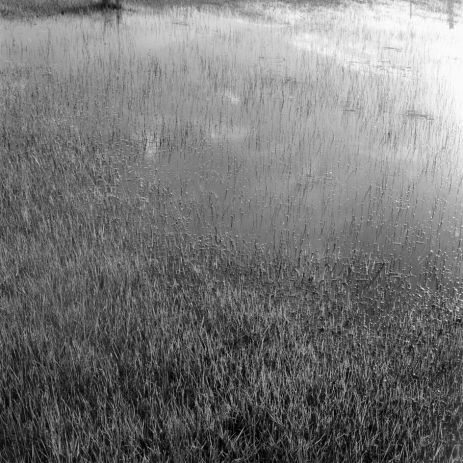 Anne Ferran, Untitled (Lost to Worlds 2 series) 2008-2009, Digital print on aluminium
The Potter Gallery's exhibition blurb, which is written by Dr Isobel Crombie, the Senior Curator, Photography, National Gallery of Victoria (NGV), Melbourne, says:
Photographers’ interest in the landscape has increased in the last few years. Perhaps as a result of heightened environmental awareness, or an evolution in our engagement with Australian history, practitioners are again turning to the natural world as a site for critical practice and inspiration...The artists displayed here reveal history in a landscape; provoke ecological concerns; use the landscape as a site of performance; or reveal the distinctive beauty of a place.
Crombie's catalogue of the exhibition, which explores the recent history of landscape photography, is not online. So I have no idea how Crombie, who has written extensively on Australian photography, interprets the Australian tradition of landscape photography from art historical perspective. I would assume that the tradition is divided into different stages--- starting from 19th photography in settler Australia --- that reflect the different styles and concerns in landscape photography.
I reckon that Jill Orr is the one who uses the landscape as a site of performance as I remember the site-specific works being staged on the banks of the Murray River and on the waterless salt-encrusted surface of Mitre Lake in Victoria’s arid Wimmera district in 2007. Here Orr addresses what psychoanalysts sometimes refer to as ‘trans-generational haunting’, that is the way in which repressed or unspoken secrets are passed, predominantly in the form of traumatic interactions, from one generation to the next.
The work of Siri Hayes is intriguing. The images of Lyric Theatre at Merri Creek shows an immense canopy of trees that dwarfs three tiny people standing on the banks of a creek in inner city Melbourne. On the one hand we have the beauty of nature--- of Merri Creek at the edge of the city of Melbourne:
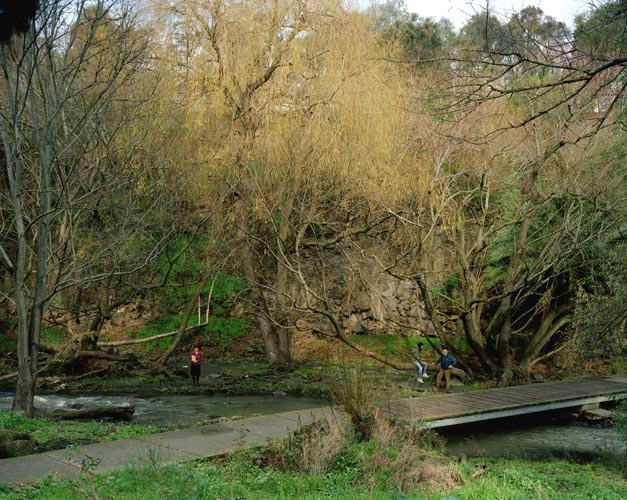 Siri Hayes, Untitled, Lyric Theatre at Merri Creek
On the other hand, the images in Hayes’ series also represent an ecosystem in a downward spiral, where the effluvia of modern life – the ubiquitous Coke cans, plastic bags and syringes – choke up waterways and spoil the picture-postcard view. People are then theatrically included in this damaged natural landscape in a seemingly unconnected way; there is a suggested narrative but we are unsure what the story is.
|


