|
November 19, 2010
Eric de Maré was a British architectural photographer who worked in the mid 20th century and specialised in the qualities of early and late industrial structures. De Mare was a pioneer in recovering architectural merit (of a kind that nobody now denies) in the then-overlooked industrial buildings of the past.
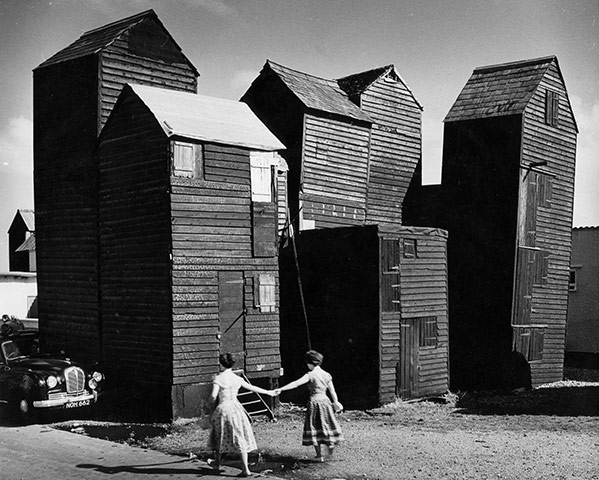 Eric de Maré, St Edward's, 'Skyscraper' fishermen's sheds, the Stade, Hastings, Sussex 1956 As well as exploring England's neglected industrial heritage de Maré became a champion of a humanised modernism, less austere than the machine aesthetic of such as Le Corbusier. In 1931, de Mare published The Functional Tradition. In this he urged admiration for the qualities of design arrived at in the early industrial period by high-quality but simple solutions to mechanical and manufacturing problems.
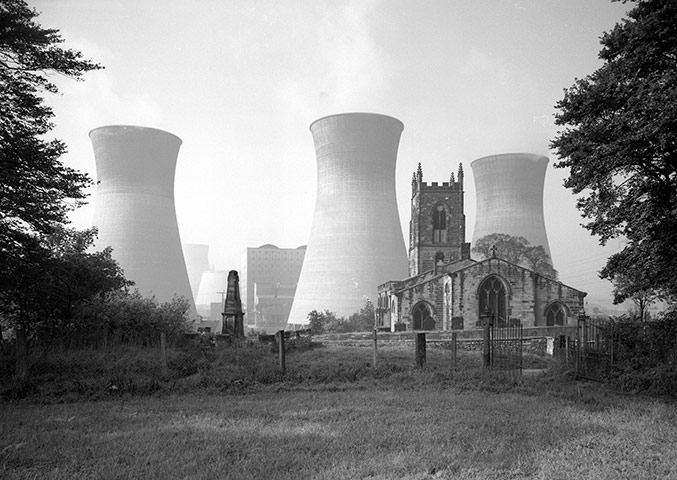 Eric de Maré, St Edward's, Brotherton, with Ferrybridge B power station behind, 1960s In the above image St Edwards church in Brotherton, North Yorkshire, stands before Ferrybridge power station. It is a surreal image which captures the odd juxtaposition of rural and urban architecture, of the church and factory, an image suggestive of the shifting tides of post-war British culture.
This kind of photography was influential: one can see a line that runs through the imagery of Fay Godwin and John Davies starting somewhere from here.
Update
I've just stumbled across a collection of de Maré's photographs of English heritage architecture:
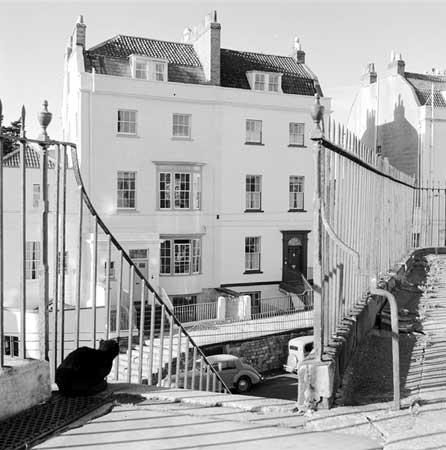 Eric de Maré, Prince's Buildings, Wellington Terrace, Clifton, Bristol This body of work, whose ostensible purpose was to document heritage architecture reminds me of the work of Eugene Atget. ed Maré, however, was also concerned to stress that the anonymous, vernacular industrial structures (eg. , the canals of England) with their simple, forthright and unadorned functional forms provided a casebook of precedents for Modernist architects to rebuild post-war Britain.
|


For me the curious and enjoyable of the second pic is that the gate is open. Does this say...that even in this new world we are still here and open for business or...does it say we are gone all hope is lost.