|
November 2, 2010
Michael Wolf’s Architecture of Density refers back to the work that emerged from the Düsseldorf school of Bernd and Hilla Becher and to the contemporary minimalist work of Andreas Gursky or Thomas Struth. Wolf is German born, grew up in the USA and studied at UC Berkley and at the University of Essen in Germany, and resides in Hong Kong.
His 'Architecture of Density' series, which is a portrait of Hong Kong with no people in it at all, was initially shot with a 6x7 cm Makina Plaubel, then a 4x5 view camera.
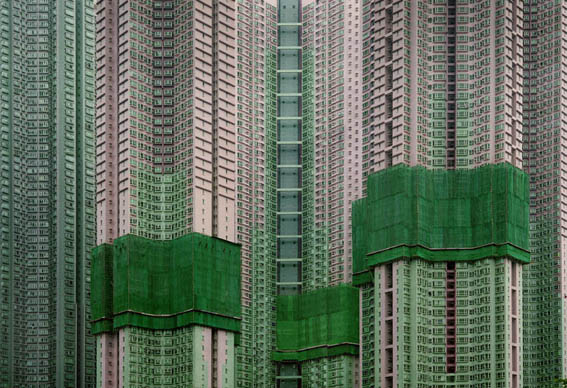 Michael Wolf, Architecture of Density #12, from Architecture of Density, 2003, Chromogenic Print
This is high rise urban living in Hong Kong is dense, and Wolf's camera represents the facades of monstrously tall and repetitive residential high- rise buildings, so as to give the impression that these high rise apartments appear as if they might extend indefinitely, upwards and down.
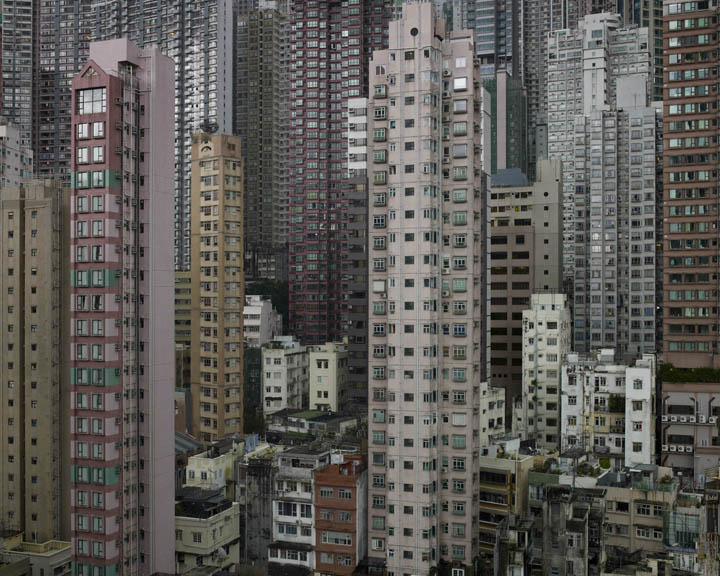 Michael Wolf, Architecture of Density #116, from Architecture of Density, 2008, Chromogenic Print
In these Hong Kong pictures, Wolf purges high-rise architecture of the romance and celebration of the 20th century modernists in New York and Chicago.
In his previous projects, Wolf described the vernacular culture of the street. His early vision of the region dwelt on personal aesthetic gestures left in back doors and alleyways, such as makeshift seating in the streets.In these photographs, small tokens of human presence took precedence over monumental architecture.
|


