|
July 28, 2005
I'm serious.
I was following links (mosaics of fragments) when cruising the postmodern Experience Music Project's Pop Conference. This is self-described as 'an annual gathering dedicated to music writing in all its limitless forms, with a mixture of academics, journalists, artists, and other aficionados'.
The conference on music writing is held in the participatory museum of music in America's rock temple:
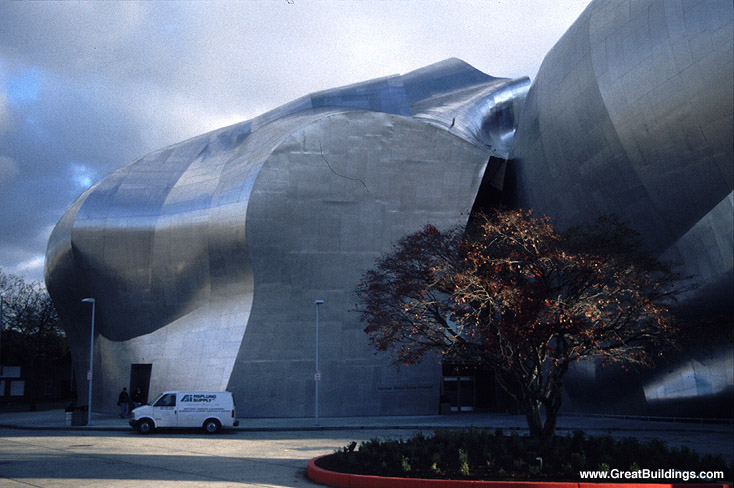
Frank Gehry Experience Music Project, 2000
I was surfing the web. I was intrigued by this found myself reading this; loved this; puzzled about this; wandered through this and with great interest; then, somehow, I came across an intriguing quote.
It was by Pope Benedict XVI when he was a cardinal: "Then there are two developments in music itself that have their origins primarily in the West but that for a long time have affected the whole of mankind in the world culture that is being formed. Modern so-called "classical" music has maneuvered itself, with some exceptions, into an elitist ghetto, which only specialists may enter -- and even they do so with what may sometimes be mixed feelings. The music of the masses has broken loose from this and treads a very different path.
On the one hand, there is pop music, which is certainly no longer supported by the people in the ancient sense (populus). It is aimed at the phenomenon of the masses, is industrially produced, and ultimately has to be described as a cult of the banal. "Rock", on the other hand, is the expression of elemental passions, and at rock festivals it assumes a cultic character, a form of worship, in fact, in opposition to Christian worship. People are, so to speak, released from themselves by the emotional shock of rhythm, noise, and special lighting effects. However, in the ecstasy of having all their defenses torn down, the participants sink, as it were, beneath the elemental force of the universe. The music of the Holy Spirit's sober inebriation seems to have little chance when self has become a prison, the mind is a shackle, and breaking out from both appears as a true promise of redemption that can be tasted at least for a few moments.
What is to be done? Theoretical solutions are perhaps even less helpful here. There has to be renewal from within."
The quote is from this text. It was delivered at Eighth International Church Music Congress in Rome in 1986. Here is my link.
This 'renewal from within' is going to be difficult to achieve, given his stark duality that dividing music into "high serious" and "low commercial" realms with their Appollarian and Dionysian undercurrents. It reminds me of this guy
Maybe it is Cardinal Ratzinger's stark duality is the problem. We can think in terms of an excess of meaning by looking at the excluded middle as unpacking possibilities within the tightly defined duality.
This is an example:
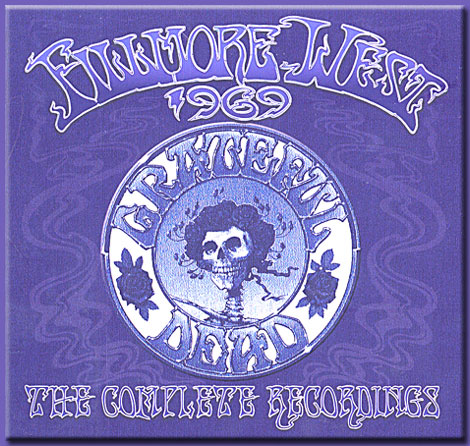
Grateful Dead
And so is this.
I guess the Pope needs to some Derrida when he was a moment.
|


