Thought-Factory.net Philosophical Conversations Public Opinion philosophy.com Junk for code

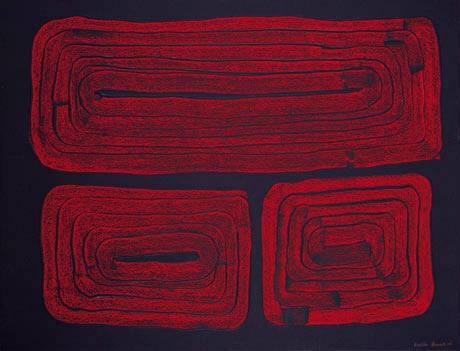
Mandy Martin, Puritjarra 2, 2005. For further information on MANDY MARTIN, refer here: http://www.mandy-martin.com/
If there are diverse kinds of knowledge and ways of knowing place, then we need to learn to value the different ways each of us sees a single place that is significant, but differently so, for each perspective.
RECENT ENTRIES
SEARCH
ARCHIVES
Library
Thinkers/Critics/etc
WEBLOGS
Australian Weblogs
Critical commentary
Visual blogs
CULTURE
ART
PHOTOGRAPHY
DESIGN/STREET ART
ARCHITECTURE/CITY
Film
MUSIC
Sexuality
FOOD & WiNE
Other
www.thought-factory.net
looking for something firm in a world of chaotic flux

Rosella Namok: breaking new ground? « Previous | |Next »
February 17, 2007

The three paintings below are from the online archive of the Queensland Art Gallery in Brisbane. I 've turned to the QAG after my visit to the National Gallery in Canberra and saw the paucity of their Indigenous art collection. It was a primitive footnote to the universal (European) avant garde art of the first half of the 20th century. The avant garde works all looked so conservative---it was like stepping back into a modernist time warp: that was how things were way back then.

'Primitivism' is a disgrace in terms of a collection policy. The NGA is still besotted by works, such as David Hockney's A Bigger Grand Canyon, and they are blind to the brilliant and innovative work being done by Indigenous artists in Australia over the last two decades to renew their visual language. It would appear that the NGA is still fighting the Blue Pole high modernist battles of the 1970s, instead of developing a tradition of Indigenous art from the colonial period to show the different strands of Indigneous art, how the artists rework their old visual language to express contemporary concerns, and how they break away from indigenous art being traditionally classified as magico-religious. Shouldn't that be one of the responsibilities of the NGA?

The exhibition at the Queensland Art Gallery is entitled Fortitude: New Art from Queensland 2000 It includes some work by an Indigenous artist Rosella Namok, from Lockhart River in Cape York.

NamokRBig House.jpg
Rosella Namok, Big house, 1999-2000, Acrylic on canvas

Lockhart River is a small community near the sea on the eastern side on the peninsula, and the work produced is often directly related to the isolated community's iconographic traditions and concerns. Namok has the ability to take the traditional visual language of Indigenous art and reshape the old signs to create some contemporary artworks.

Though Rosella Namok often paints with her fingers — a technique that relates to the tradition of sand drawing and body painting---she is not categorized as a primitive artist vis-a-vis the (international) avant garde; nor is she seen as just producing kitschy tourist art. The art institution holds Rosella Namok to be one of the most widely-acclaimed and best known of an emerging group of young Aboriginal artists in Cape York; a group commonly referred to as the Lockhart River Art Gang.
NamokRParraWay.jpg
Rosella Namok, Para Way, 2000, Synthetic polymer paint on canvas

To non-Aborigines, much contemporary Aboriginal art is read as abstraction. Even given the story, we never get it, because the magicoreligious bit eludes us. We could begin by accepting the fuzzy spaces of the art institution's old art history styles in a post-colonial society, the diversity of contemporary Indigenous art practice, and look at the way Indigenous artists are breaking new ground whilst working in their traditions.

NamokRUngkurn.jpg
Rosella Namok, Kaapay and Kuyan today, 1999, Synthetic polymer paint on canvas

The painting depicts the two halves, or moieties, into which Ungkum society is traditionally divided and which one you are . . . ‘kaapay’ or ‘kuyan’ .... depends on your father.

This approach by the QAG in the Fortitude and survey exhibitions is refreshing as it enable us to look at the works of Indigenous artists as contemporary art, rather than being obliged to put Indigenous works into the spiritual/religious/Dreamtime category--- interpreted as non-western magico-religious---because we don't get it. Why not accept that young Indigenous artists such as Rosella Namok are producing contemporary art, just like non-Indigenous artists. That is what the QAG is inviting us to do. in doing so it breaks new ground when compared to the NGA.


| Posted by Gary Sauer-Thompson at 10:15 AM | | Comments (24)
Comments

Comments

The thing that I have noticed about Indigenous art is that the line between Crap and Good is Blurred.
Seems that a lot is given a Free ticket on the bus because it is done by Aborigines. Yes a lot is great but, 2 of the pics above could be hanging in a primary school classroom.

Les,
yes the line between art and non-art is blurry and often so. Do you put the 1st two works into the primary school classroom category? Instead of primary school classroom maybe we should say body art.

I was interested in how the Art institution selects Indigenous works to be included into the category 'art', given the limited collection in the NGA in Canberra. I've been puzzling about the way the NGA views Indigneous art.

So I turned to a world I didn't know---the Cape York communities--- and dug around to see how the QAG did the sifting between art/non-art.

What we find is that Indigenous art is no longer accepted in terms of being hung on European Art pegs----still the tacit policy of the National Gallery of Australia judging from its Dada-Surrealist exhibition gallery--Indigneous art is a footnote to European art to be viewed through European eyes from the perspective of European art history.

QAG has broken away from that high modernist asesthetic. Indigneous works are a part of contemporary regional art. I selected then because they did an exhibition called Story Place: Indigenous Art of Cape York and the Rainforest’ ; a major survey exhibition of historical and contemporary indigenous art from Queensland’s Cape York Peninsula, which was held at the Queensland Art Gallery from July-November 2003.

The third Namok image--Kaapay and Kuyan today--is from that exhibition.

I was referring to the first and third....yes you are right about the body art.
I suppose the idea is to represent regions in aboriginal art and not look too closely at what is great and good.
A lot of indigenous kids are encouraged into art in communities. I think more so than what white kids are. So that is a factor in the end results. A lot of countries have an indigenous art culture like ours but are further along in their Art Evolution.

Les,
Aboriginal art has been inaccessible to non-Aboriginal people. Marca Langton puts it this way in Aboriginal Art and Film: The Politics of Representation in Rouge:

The intellectuality and abbreviation, two of the significant features of Aboriginal art, are disguised by the often cryptic explanations by Aboriginal artists and by the equally cryptic catalogue entries.

These are difficult waters to find our way through given the colonail history of assimilation and the the habit of iconicising the ‘primitive’. The primitive is one way to grapple with fear of the unknown and apparently known, the uncertain and the apparently certain, as a search for the perceived intrinsic value of the 'primitive'. It is from familiar stereotypes and the constant stereotyping, iconising and mythologising of Aboriginal people in films, video and television are that most Australians ‘know’ about Aboriginal people.

I guess this means we need to see how artists Rosella Namok take the language of their own culture--body art or sand painting---and refashion it to talk about the present.

She says that her art reflects a desire to reconnect her country and people with their past:

'My paintings and prints are not traditional style, they are my own modern style and are a contemporary response to the traditional culture and isolation of our community'.
The one you judge to be the best work --'para way'-- refers to reaffirms the distinctiveness of her community with respect to white Australian (para) society.

I'm not sure abouthe evolution bit---I see the experiments to integrate Indigenous and non-indigenous traditions--some work better than others as you can see from the link to Gallery Gondwana in Alice Spings and Sydney

What I meant by the art evolution statement is that a lot is still done using basic shapes....circles, ovals like kids when they first start to draw.
Yes, lots will queue up to say intellegently written things about aboriginal art but the fact remains as with all art that only a small percentage of what is done is great! and defer to my previous statement about free rides on the bus.

Les,

There is a big difference between regional Indigenous Australians in isolated places like Lochart working from their traditional shapes--continuity and change of forms---and urban Aborigines who have been to art school and an integral part of the art institution.

I'm not arguing against good and bad Indigenous art---I'm responding to it by pointing to the practices of the art institutions such as QAG that selects works in terms of an exhibition called 'new art'.

I've argued that they are breaking new ground in terms of shifting the ground of 'primitive' in relation to European modernism; primitive in relation to a past way of life.

We are now viewing new art work by Indigenous Australians alongside the new work of non-Idigenous Australians. And we are not viewing the former in terms of religion and magic. It's a big shift.

Yes...all things must move forward to continue to be Cool.
Art is after all a chair. It must be comfortable, well designed and a snappy colour to be sellable.

Les,
it seems to me that your concerns about the quality of Namok's artwork are more to do with the art institution in Queensland (the QAG) and its selection standards, than the individual Indigenous artists earning a living by producing art works for the private gallery system.

No...
I will tell you exactly the points I am trying to make.
1. the 2 paintings in this post that I described are only at best on par with good primary school aged artists in the age group of 9 plus.
2. Sometimes the purpose of this body art paintings is to hang near the better stuff to make the good stuff look Great.
3. Aboriginal art is sometimes over spiritualized.
4. My comments are general observations and not linked to Queensland alone.
5. Good luck to any artist that can sell anything.

Les,
re your point that 'the 2 paintings in this post that I described are only at best on par with good primary school aged artists in the age group of 9 plus'. Have you looked at these works in relation to the Fortitude exhibition they were a part of? It is very uneven in terms of quality for both white and Indigenous artists.

Your comments don't add up.

Firstly, you say that your critique has nothing to do with the art institution yet you say that 'Sometimes the purpose of this body art paintings is to hang near the better stuff to make the good stuff look Great.'That refers to the gallery practices of the art institution

Secondly, you say that 'Aboriginal art is sometimes over spiritualized' even though I been arguing that this work can be read as breaking away from that paradigm.


Thirdly, when you say 'Aboriginal art is sometimes over spiritualized' you are referring to the interpretations placed around it by the art institution's catalogues and books.

You seem to be taking an aggressive stance?

Les,
I've slipped into philosophical mode because you claim x but say y.

I think if you read my comments again and just read mine without reading yours.
And read them as statements and not as a discussion with your comments you will see that what I have said is very basic.
I think you may of drifted off the points that I was trying to make.

Les,
Maybe the argument is the post was not clear. What was obvious is that it was about the practices of the art institution (NGA +QAG) as well as the works of a particular Indigenous artist from Lockhart River. The argument was about the changing relationship between the two.

Your comments keep pointing the finger at the poor quality art work of a particular indigenous artist. They also highlight how Indigenous artists in general are getting a hand out from the art institution, even though they are producing work that a child in a primary school could do---(primitivism is the implied claim as well as poor quality).

I'm arguing that some of your criticism is misdirected----it should be directed at the art institution's selection procedures that construct what you claim to be an inferior painting into 'art' . Clearly there are major differences in aesthetic judgement between you and the QAG about Namok's art work. So we need to look at what the QAG is doing with its exhibitions.

The post argued that is not just a case of an individual Indigenous artist reworking traditional signs and symbols of her local culture to express concerns about her current mode of life. The way the art institutiion enframes these works is also crucial, given the past history exemplified by the way works were hung in the NGA's Dada/Surrealist gallery.

Though you keep ignoring the point about the role of the art institution in all of this, you then go on to make statements about the spiritual interpretations of Indigenous art by the art institution. These statements pay no attention to what I've written about how the QAG in its recent exhibitions is breaking away from your judgement about the classification of Indigenous art as religion of a past way of life.

So I've shifted into debate mode, linked back to aesthetics and connected art's problems with magic and rationality to highlight the differences in the way we approach Indigenous art works.

Yes ok I realise that the artist Has moved on from this mode of art and done some good stuff but the point I was trying to make that drawing shapes is a VERY BASIC art form remains.

Les,
I'm not contesting your claim----its the art institution that is by claiming it is art. I'm ever mindful that of the understanding of art implicit in Marcel Duchamp's famous gesture of presenting a urinal, the most banal of objects, as a work of art.

It's your other tacit claims about the art institution that I'm contesting.

As in life the art institution is filled with people with different opinions on what is good and what is not good.
So one cannot be the critic without occasionally criticizing them as I am sure that the do each other.
As you know there is a vast amount of styles in art. Most recently your Grifitti post is what I regard as a genuine art form (and I am definitely not implying that aboriginal art isn't a genuine art form)while others in and out of the "Art institution" would look at it with disgust.

Les,
I've reposted your comments on graffiti under the post, as graffiti warrants its own conversation.

Ha!!

I absolutely LOATHE that David Hockney at the NGA!! It embarasses me.
Now
I love Rosella Namok.
Whereas I agree that there are a lot of lesser-quality indigenous pieces in existence, most of these are created specifically for the tourist industry and are a means of generating income. Which is fair enough.
This generation of indigenous painters are disseminating aspects of their culture with a new vigour and life...and this does need to be taken into account, that there was a rupture in the process of cultural heritage, and that formalist qualities from non-indigenous sources have been assimilated in some artists work.
There are so many wonderful indigenous pieces, and I feel, like Kenneth Clarke said about western civilisation,
this culture has only survived by the skin of its teeth.


Hey, this is weird timing.
take a look at this, didnt see it in the aust. papers

http://www.timesonline.co.uk/tol/news/world/asia/article1442648.ece

Fiona,
yeah I couldn't see what all the fuss was about re Hockney's A Bigger Grand Canyon.

Maybe it is about the limitations of photography in relation to big spaces --hence the collage appearance vis-a-vis the multiple viewpoints of cubist painting.

The Queensland Art Gallery has selected these works by Rosella Namok as art, as distinct, from tourist works and, unlike Les, I'm happy to accept the judgment. I'm more interested in exploring the significance of these works in terms of the way indigenous art is represented in out flagship galleries.

Fiona,
thanks for the Bernard Lagan article in The Times about aboriginal art sweatshops. The Senate Inquiry shows that it's not just a case of art v kitschy tourist works.As Lagan says:

Australia’s lucrative Aboriginal art industry has exposed a shady network of art “factories” where painters are forced to churn out pictures in return for drugs, alcohol and scant financial reward...Promising and noted Aboriginal artists are lured from remote communities and herded into painting houses in the central Australian city of Alice Springs... There they are detained and forced to produce a flow of work in return for cash, alcohol, drugs or worn-out 4x4 vehicles.

What has been revealed is a network of questionable art dealers and galleries that are exploiting Aboriginal artists, many of whom are elderly and have little understanding of the true value of their art or the workings of the art market.

Thank you for your response.
Yes, the exploitative aspect has always disturbed me and have had heated discussions with some Sydney dealers about this. Knowing that the hundreds of thousands generated by the trade in these works is bypassing the communities saddens and angers me. Of course, there are many responsible and ethical dealers, but definitely an enormous flow of marketable goods, the aesthetic of which are determined by sales.
I was pleased to see the lovely Rosella Namok pieces on your site, I think they are significant and worthy of discussion.
thanks!

Fiona,
here is the link to the Senate inquiry into Indigenous art.The terms of reference are:
a particular reference to:

#the current size and scale of Australia's Indigenous visual arts and craft sector;
#the economic, social and cultural benefits of the sector;
#the overall financial, cultural and artistic sustainability of the sector;
#the current and likely future priority infrastructure needs of the sector;
#opportunities for strategies and mechanisms that the sector could adopt to improve its practices, capacity and sustainability, including to deal with unscrupulous or unethical conduct;
#opportunities for existing government support programs for Indigenous visual arts and crafts to be more effectively targeted to #improve the sector's capacity and future sustainability; and
#future opportunities for further growth of Australia's Indigenous visual arts and craft sector, including through further developing international markets.

It's fairly wide ranging.The submissions are here.

Michael Reid's submission. I couldn't find the submission from the NGA or the AGNSW. Peter Garrett did not have much to say.


Post a comment

(If you haven't left a comment here before, you may need to be approved by the site owner before your comment will appear. Until then, it won't appear on the entry. Thanks for waiting.)

Name:
Email Address:
URL:
Remember personal info?
Comments: (you may use HTML tags for style)