|
January 30, 2007
As I've been searching for images to construct the South Australian regional album in my gallery I found myself keep exploring the 19th century colonial painters. I couldn't help but notice the way these visual artists ignored Aborigines in their colonial landscapes of settler Australia.
When they painted Aborigines it was to place the indigenous people in a time before history: their colonial discourse says this is the timeless land: out there in the centre beyond the water it's the timeless land in the sense of the land of the dreamtime. So the Aborigines have no history, as theirs is a culture that was changeless and timeless. A new world order has arrived with settler Australia, a world of history and of change; one that can tame the strange and weird land to build a civilisation through farming and building dams.
I kept coming back to and to the romantic work of von Guerard: less the picturesque images and more those that refer back to Caspar David Friedrich. These are the sublime wilderness ones, with their trace of longing, or nostalgia, for the absent landscapes of Europe.
An example that links the two themes is this romantic painting in which a small group of Aborigines are camped by large, dark rocks in the red/gold glow of sunset:
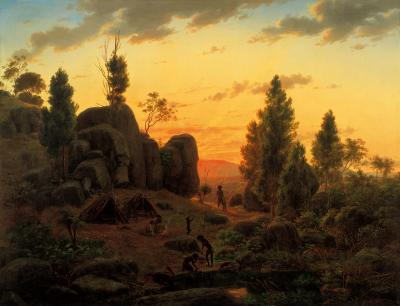
Eugene Von Guerard, Stoney Rises, Lake Corangamite, 1857.
It is strange, melancholy, foreboding, with a hint of terror. Though the aboriginal people are depicted as happily living their natural life in a timeless land, there are few of them. Do they represent a little pocket of survival. Is there a sense of doom? A sense that their world will be invaded and destroyed by the British?
The classic statement of the weird landscape is Marcus Clarke's:
"In Australia alone is to be found the grotesque, the weird, the strange scribblings of nature learning how to write. Some see no beauty in our trees without shade, our flowers without perfume, our birds who cannot fly. But the dweller in the wilderness acknowledges the subtle charm of this fantastic land of monstrosities. He becomes familiar with the beauty of loneliness, whispered to by the myriad tongues of the wilderness he learns the language of the barren and the uncouth."
An example of the weirdness is:
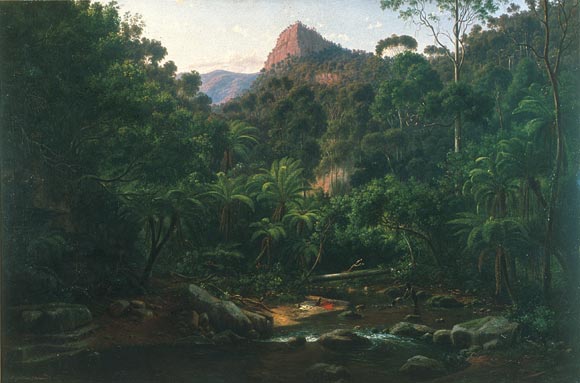
Eugene Von Guérard, Fern Tree Gully, Cape Otway Ranges, c 1879.
The weirdness and romantic melancholy turns to the wildness of the sublime, as expressed in this weather-beaten, desolate and bleak image:
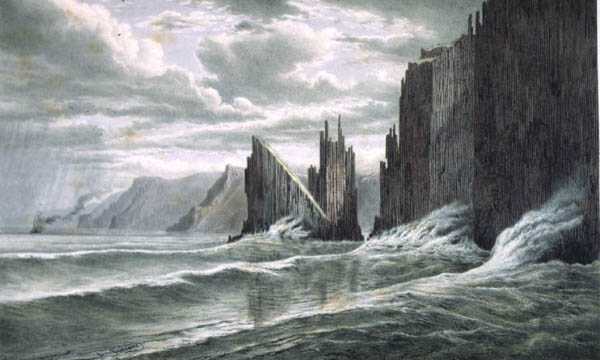
Eugene Von Guérard, South end of Tasman's Island, 1967, lithograph colour
What is oftern called 'that certain weird melancholy' is the awesomeness of the horrors: the sweeping, out of control bushfires, raging floods and apocalyptic dust storms which are a part of the untameable land that is Australia.
|


I come from between the Otways and the Stony Rises and I am intimately familiar with both. Von Guérard's visuals are nothing like the areas. At all.
When talented visual recorders can be so distorted in their inbuilt need to "see" things not as they are, but as they would be back in their land, it makes me wonder about the accuracy of those who used words to describe the country and it's inhabitants.
btw. When I was growing up there [and farming land on what I discovered later was Buckley's Swamp] it was the accepted wisdom that the area had not been populated to any extent by aboriginals. This despite the fact that any human standing on a hill or near an eel filled lake could easily think "this would make a good place to be", and despite Buckley's writing and despite the fact that even Von Guérard who couldn't get the vegetation even vaguely right, still had to include aboriginals because they were so bloody obvious.