|
January 31, 2007
I've often wondered how contemporary white artists respond to the innovative work of indigenous painters. An example of a response is this work by a South Australian painter we have come across before in considerations of regionalism in a global world,
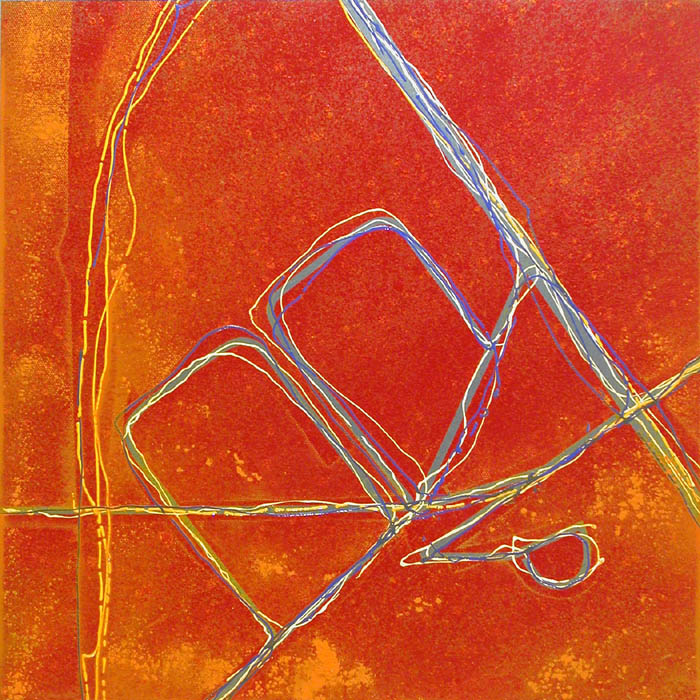
David Hume, Woomera #2, Acrylic on Galvanised Steel, 2005
The linkages and responses are a touchy subject because of the long tradition of white artists ripping off , and exploiting, black artists. But the way the latter paint the landscape in terms of maps of their country is an important innovation in the Australian landscape tradition; so innovative that it cannot but have an impact on other visual artists. What these contemporay indigenous works express is what Adorno calls riddles.
In Aesthetic Theory Adorno says:
What has irritated the theory of art on end is the fact that all art works are riddles; indeed, art as a whole is a riddle. Another way of putting this is to say that art expresses something while at the same time hiding it. The enigmatic quality grimaces like a clown...Trying to wrestle with the riddle of art is one thing. Understanding specific artistic products is quite another. Verstehen of particular art objects is the objective reproduction or re-enactment of a work by experience where experience operates on the inside of the work ....The enigmatic quality renders the very notion of Verstehen problematic...I am using the term 'enigma' not in a loose sense, denoting some general ambiguity, but in the precise sense of a riddle or puzzle...Now art works are puzzles in this sense...vexing the viewer whose defeat is a foregone conclusion.
Like myself, David Hume has visited Woomera on trips to Andamooka. I found Woomera a strange town, one deeply haunted by its past. Firstly, as a site for the Anglo-Australian Joint Project in the mid-twentieth century to test British rockets to carry nuclear warheads to counter the threat posed by the Soviet Union. Secondly, when I visited Woomera the town was known for it's detention centre for aslyum seekers and refugees. It was a hostile town to strangers. That time too has past. It's future may well be a nuclear dump site. Hauntology is everywhere in Woomera.
David Hume sees Woomera as a mythic place, rather than in terms of hauntology.
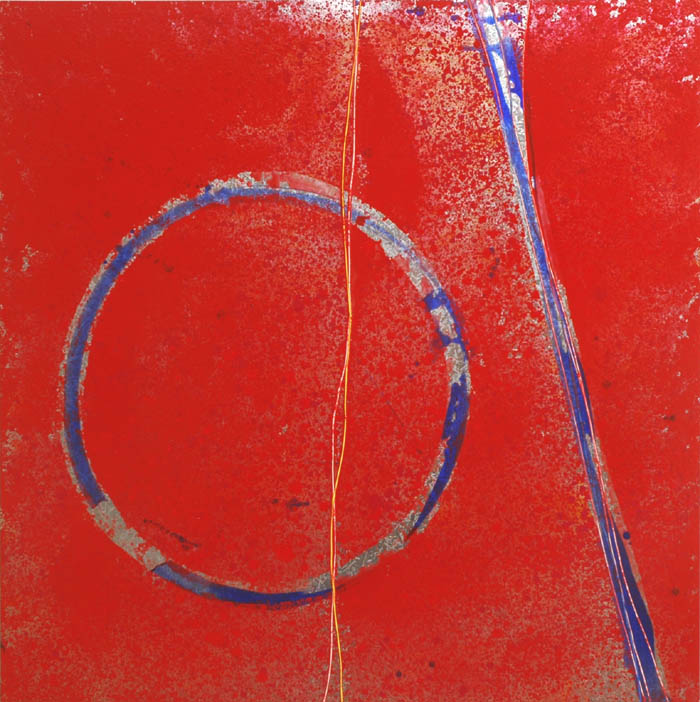
David Hume, Woomera #9, Acrylic on Galvanised Steel, 2005
Hume says thatmaps:
...are tremendously dense ways of storing and transmitting information, they not only show the land, but give tantalising vignettes of the stories that go with it. Dog Fence, for example, is a prosaic term, but I’m sure there are whole lives bound up in it; and the Prohibited Area – an exclusion zone for rocket testing – is particularly rich in history.
He's right about the cultural meanings. The Prohibited Area, for instance, was the site of the Maralinga nuclear tests by the British around 1957. Despite a cleanup it is still a contaminated wasteland.The spectre that haunts this space is the deaths of indigenous Australia from the tests conducted by a declining imperial power.
Hume, to his credit, goes on to confront the key issue---the relationship to indiigenous Australians. He says:
The journeys I seek to mark in this work belong to indigenous Australians as well as non-indigenous. Because similarities between my work and Aboriginal work have been remarked, I have been particular in explaining, in a very Western way, the origins of what I have done. Perhaps because I grew up in the time of the Papunya Tula paintings of the 1980s and 1990s, I felt it important to be sure that my work did not misappropriate items that should be the exclusive domain of Aboriginal culture. I think that now we should be able to advance, with caution, beyond that time.
Woomera is where indigenous and white history overlap and are overlaid in a complex way.
|


That is a nice painting.