|
March 4, 2007
The recurring theme of Luchello Visconti's period films was the decadence and decline of upper class milieus in the face of historical upheaval: thus the last months of the Austrian occupation in Senso (1954), the unification of Italy in The Leopard (1963) and of Germany in Ludwig (1972), the rise of the Third Reich in The Damned (1969).
I'm a Visconti fan as I love his aesthetics (framing and colour) his political astuteness and sense of history and tradition, the way that the personal is intersected by the political, and the big canvas to convey the sense of history.
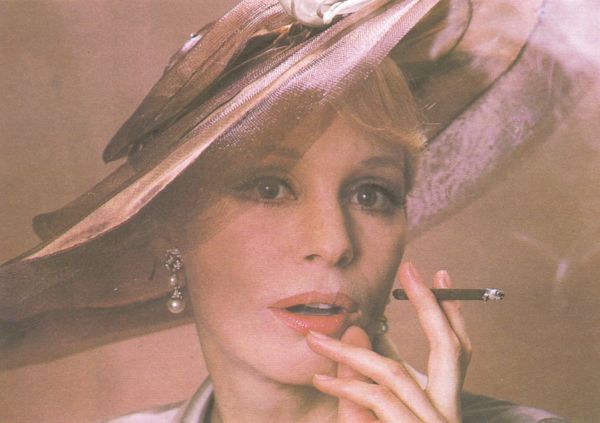
Ingrid Thulin, Visconti, The Damned, 1969
The Damned opens and closes with shots of fire, more precisely shots of the furnace in the von Essenbeck family steel mills, and has the burning of the Reichstag as a pivotal event. This forceful denunciation of the political helllfire of Nazism sweeping through the lives of a powerful industrialist's family (based on the Krupps) boldly embraces the kitsch side of Nazi popular culture. The shots of the furnace suggest a Dante-esque inferno, whilst the film is constructed from a Hammer-horror pop color palette emphasizing the intense contrast between shadow and light (good vs. evil), blues, browns and reds.
What is represented is a series of horrors, including murder, rape, child abuse and incest, as the bourgeois family falls into the clutches of neurotic grandson Helmut Berger who uses his Nazism to play out his monster size Oedipus complex. This is not a world order fading as with the landed aristocracy in Visconti's The Leopard. It is a bourgeois world exploding.
Visconti shows the massive shift in the power-base internal to the Nazi's once in power they were in power . He shows the way its populist Brown-shirt elements who often relied upon anti-capitalist rhetoric were de-decapitated as a political force within Nazism with the infamous ‘Night of the Long Knives’ (June 30th 1934) in which the Black shirted SS loyal only to Hitler massacred the Brown-shirt leadership. Hitler then became Fuhrer after the death of Hindenberg.
In 'Visconti's Cinema of Twilight' in Senses of Cinema Maximilian Le Cain highlights the camera technique. He says that:
The disorientating violence of the zooms in The Damned literally pulls the space out from around the characters, enveloping them in a panicky state of alienation from their surroundings which are changing too fast. This constant spatial disintegration reflects the insecurity of the often ruthless characters' scrabble for power in the crucible of a new and very dangerous society.
On the one hand, we have the bourgeois family struggling to maintain its influence and prosperity in the face of fascism's relentless and brutal ascent, and on the other hand, the way the Nazi's divided the family to control them. The consequence is that blackmail, double-dealing, cynical sexual manipulation and murder become the accepted currency of family members attempting to purchase power and prestige.
I'm unclear to what extent Visconti engages with fascist aesthetics --I presume it was there in the aesthetics of physical perfection in depicting the nude SA as akin to pictures in physique magazines: pinups which are both sanctimoniously asexual and pornographic; and in the transformation of sexual energy into a "spiritual" force, for the benefit of the community.
Is there an an unresolved tension in Visconti's work between his social Marxist perspective and the commitment to sheer cinematic aesthetics and the beauty of the image as a legitimate value in its own right; one that is further complicated by his growing awareness of his homosexuality and its impact on his films? I would have thought that the political and aesthetic import of the film is shown to be a direct consequence of its ability to restructure perception and to revitalize thought, even at the expense of traditional modes of cinematic enunciation.
|


