Thought-Factory.net Philosophical Conversations Public Opinion philosophy.com Junk for code

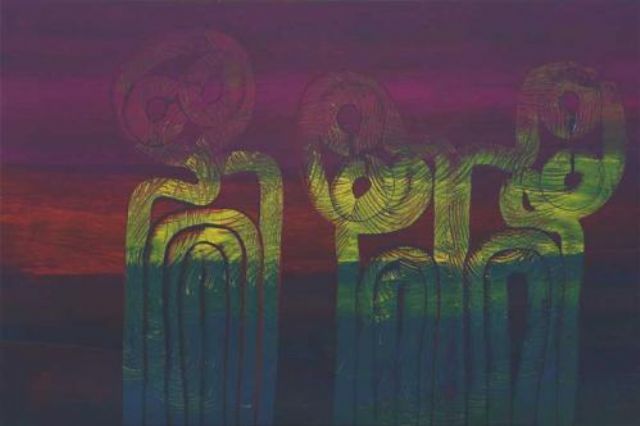
Mandy Martin, Puritjarra 2, 2005. For further information on MANDY MARTIN, refer here: http://www.mandy-martin.com/
If there are diverse kinds of knowledge and ways of knowing place, then we need to learn to value the different ways each of us sees a single place that is significant, but differently so, for each perspective.
RECENT ENTRIES
SEARCH
ARCHIVES
Library
Thinkers/Critics/etc
WEBLOGS
Australian Weblogs
Critical commentary
Visual blogs
CULTURE
ART
PHOTOGRAPHY
DESIGN/STREET ART
ARCHITECTURE/CITY
Film
MUSIC
Sexuality
FOOD & WiNE
Other
www.thought-factory.net
looking for something firm in a world of chaotic flux

Fiona Omeenyo, Hauntology, Derrida « Previous | |Next »
March 22, 2007

Fiona Omeenyo is part of the Lockhart River Gang, and her work explores family relationships – those who are alive and those who are dead. Is there a haunting by ghosts and a politics of memory in play here in these paintings?

My interpretation of some of Fiona Omeenyo recent paintings is that we have the ghostly echo (or traces) of an ancient "nomadic mode of life 'drifting' through an violent economic flows of modernity. The images can be interpreted as a hauntology that remembers the suffering of the Indigenous people though their stories that are passed down.

This isn't about the return of the past, it is about us living in a time when the past is present, and the present is saturated with the past; and the past shapes future possibilities.
OmeenyoMyPainting.jpg
Fiona Omeenyo, My painting, 2001, synthetic polymer paint on canvas

Fiona Omeenyo says:

My works are about country and stories passed onto me by my family. i like to paint about those stories ... good to understand ... so I can tell my kids about those story places and why they are important to our family. Sometimes when I'm bored ... I do my best paintings .. the feeling inside of me ... I don't know how to explain it ... i just let that painting take a hold of my hand ... just put the paintbrush on the canvas and start painting away. And when I'm painting I feel happy ... just like someone's standing next to me watching what I'm doing ... makes me feel strong.

The image speak to a history of Australia beneath the surface, away from the standard 'end of history' narrative we've learned on our mothers knees; speaks to another, alternative history that we struggle to articulate intelligibly how this spectre is haunting Australia.

Omeenyo's 'My painting' is not spooky, but we are not made comfortable either. We sense the presence of spectres on the edges on the art institutions, and we become aware that the image offers an alternative to modernism's linear history, or postmodernism's permanent revival of past styles. This history is about the time being out of joint; there is some temporal disjunction here that we cannot quite put our finger on; we suspect that it is a space where the precondition for our being is the killing, abduction, and rape of your ancestors; or their forcible removal from their own lands? The ghosts always return. In hauntology, we engage with the ghosts, resurrect them, commit ourselves to a response to the many voices of the past.

previous

UIpdate: 24 March
I forgot to mention that hauntology, as K-Punk points out has its roots in Jacques Derrida's Specters of Marx. This update is cross posted from philosophical conversations. The ghosts dealt with in this text pertain to, at the very least, those ghosts of Marx that haunt us (as in chapter 3, “Wears and Tears”), and those that haunted Marx (those he confronted, was obsessed with, and afraid of, as in chapter 4, “In the Name of the Revolution, the Double Barricade”).

In dealing with these different levels of ghosts and hauntings Derrida treats two fundamental questions: 1) whither Marxism?, that is, where is it going? and is it dying?, and 2) how is time out of joint and what kind of response does this call for? These questions come together in an affirmation of a certain type of “learning to live” as seen in the
exordium (xii-xx). Derrida urges the reader to learn to live together-with, together with ghosts, and together with others rather than repress history. In recognizing a debt–a debt to Marx and his specters–Derrida signals a “politics of memory” and the necessity to reckon with, and work with our past, our ghosts, and our inheritance.

| Posted by Gary Sauer-Thompson at 8:47 AM | | Comments (11)
Comments

Comments

This will and always remain a great painting regardless of your Stupid words that introduced it.

Les,
stupid words? I suggest you read Robyn Davidson's Quarterly essay No Fixed Address: Nomads and the Fate of the Planet, which explores the paradoxes and strengths of nomadism, in both its traditional and modern forms. Davidson argues that nomadism is not so much a political organisation or world-view as a strategy that permits access to resources. It is a resilient, rational response to circumstances.

For the record nomadism was destroyed by pastoralism and the economic flows of empire in Queensland.

Yeah its a nice coulour.

Les,
Form is sedimentated content.

I left Perth in 1985 and travelled Oz for 6 years with just one bag. I didn't think of myself at the time as a Nomad but I guess that I was.

Your Past of past of past rant is what I was referring to in earlier comments.
Made me feel like a Pastie!
Perhaps "Stupid" was a bit harsh.

Les,
that postmodern account of nomadic is very different to nomadism in the anthropologial sense of a pre-modern way of life not based on agriculture.Conflating the two indicates that you have not read Davidson's Quarterly essay.

The missions in Cape York were the outcome of the destruction of nomdism by pastoralism. I quote:

From the latter part of the nineteenth century, many Aboriginal people moved to missions, with some of them moving hundreds of kilometres from their homelands and subsequently living on land belonging to other clan groups who spoke different languages. These moves were at variance with Aboriginal custom and caused hitherto unknown conflict over land use. While some of this migration was voluntary as a direct consequence of European occupation, in many cases it was at the orders of "Protectors of Aboriginals" - orders that were not subject to redress.

And:
The most recent relocation occurred in 1963 when the Aboriginal residents of Mapoon on the west coast were forcibly moved to a new place near Bamaga, which was called New Mapoon. Also in the mid 1960s, an opportunity was given to the people resident at Lockhart River Mission to move to the Northern Peninsula Area and a small number of people voluntarily established the new community of Umagico.

In 1970 the Queensland Government built a new village adjacent to Iron Range aerodrome, and the people of Lockhart River moved from the old mission site.

No I havent read it and probably wouldn't unless it fell off the shelf and hit me on the head.
I have lived the no fixed address life so I dont need someone to tell me their version of it.

Les,
If you are nomadic in the postmodern sense you still live in the flows of history. On your account do you continue to live in linear historical time? Or do you embrace the Quadrant conservatives declinist understanding of history.

Seems to me that you are trying to prove that you are not Stupid

Les
that word 'stupid' surfaces once again from your political unconscious. I read you as a cultural conservative with a hostility to aesthetics; one who desires to repress the Indigneous interpretation of Australian history.

Outcast
by Herman Spector

I am the bastard in the ragged suit
who spits, with bitterness and malice to all.

needing the stimulus of crowds,
hatred engendered of coney-island faces,
pimps in a pressedwell parade,

I, looking into faces
(some say nothing; or with a leer-
see what the years have done to me,
and be confused,
unbroadway heel!)

at times the timid christ,
longing to speak . . .
women pass hurriedly, disdainfully by.
men, pigsnouted, puff
and puke at the stars . . .

recalling the verses of sensitive men
who have felt these things . . .
who have reacted, to all things on earth,
I am dissolved in unemotion.
won by a quiet content,
the philosophy of social man . . .
The high hat gods go down the aisles.
I am at one with life.