|
March 01, 2007
I've been thinking about the work of the Lockhart River artists and the effect this regional form of Indigenous art has on us living in a wholly commodified, spectacular culture of a modern consumer culture with its street signs, neon lights, shopping centres, the seductive, super-intense colour of advertising and desire as pleasure.
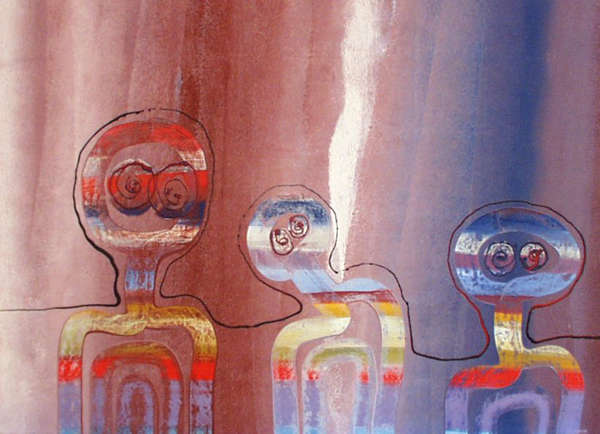
Fiona Omeenyo, Wedding Ceremony, 2001, Acrylic on canvas
I remembered this paragraph from Guy Debord's The Society of the Spectacle, which was published in the late 1960s.
When art becomes independent and paints its world in dazzling colors, a moment of life has grown old. Such a moment cannot be rejuvenated by dazzling colors, it can only be evoked in memory. The greatness of art only emerges at the dusk of life.(para 188)
Debord's remarks are a reworking of Hegel for sure, but they captures a key point--the dazzling colours of a vibrant art emerges at the dusk of the form of traditional Indigenous (hunting and gathering) life grown old.
Of course, Debord, as a good European, was not thinking of a postcolonial Australia. He was thinking of Europe in the 1930s and he had Dada and Surrealism in mind.The National Gallery of Australia incorporates Indigenous works into Dada and Surrealism on stylistic grounds, which I find rather dubious.
In a latter paragraph in the Society of the Spectacle Debord says:
Dadaism and surrealism were the two currents that marked the end of modern art. Though they were only partially conscious of it, they were contemporaries of the last great offensive of the revolutionary proletarian movement, and the defeat of that movement, which left them trapped within the very artistic sphere whose decrepitude they had denounced, was the fundamental reason for their immobilization. Dadaism and surrealism were historically linked yet also opposed to each other. This opposition involved the most important and radical contributions of the two movements, but it also revealed the internal inadequacy of their one-sided critiques. Dadaism sought to abolish art without realizing it; surrealism sought to realize art without abolishing it. The critical position since developed by the situationists has shown that the abolition and realization of art are inseparable aspects of a single transcendence of art.(para 191)
What rose was a spectacular society that buries history in culture and restructures society without community.
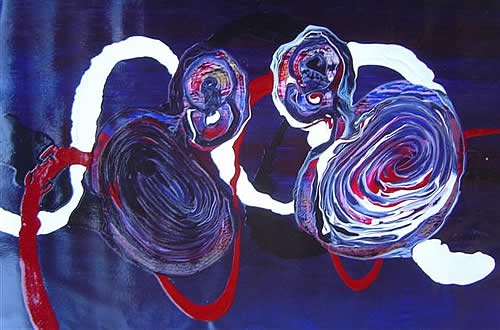
Fiona Omeenyo, Untitled, 2005, Acrylic on canvas
Can Indigenous art be interpreted as having a critical position in relation to modernist art and the spectacular society?
|


A critical position...in relation to modernist art and the spectacular society...
Sort of amazing that he was writing in the 30's, isnt it...
We have to stop ourselves at every point, I think, in terms of reminding ourselves not to expect the spectacular. Its almost impossible.
I was given ticketes to a U2 concert and thought, I must be the only weirdo here, marvelling at the scope and scale of this particular spectacle, and those carried along by it. Astonishing!
Indigenous art such as Omeenyo's is interesting, i that it evades any real categorisation, it doesnt site itself within recognisable stylistic canons, and therefore occupies an interesting position.
It is "modern" in the sense that all current indigenous art is, really, in that the motifs and narratives have departed the traditional sites of earth, rock , body and bark. They use modern materials , participate within a market and exist specifically within their medium.
Fiona Omeenyo seems to stand outside of something, though. Her colours sing about wandjina figures, rather than confirming their "anthropological" status as earth pigments might. Her work does tread a precarious balance between the "junior school artroom genre" as referred to by a previous reader, in that she is situated outside of recognisable style.
But the notion of the spectacle is definitely present in my mind when I look at them. In this visual culture, we expect so much of an artwork, or any image really. And of course, dollars intrude as they always do.
Looking at Omeenyos work, I like to think that this is a new way of seeing, perhaps not a critical way, but an access point to indigenous culture.
well, that doesnt make too much sense...
I was interested actually in the quote about colours....
"When art becomes independent and paints its world in dazzling colors, a moment of life has grown old. Such a moment cannot be rejuvenated by..."
Could you give an example? or comment further, it is intriguing.
I wont get started on the dada/surreal debate... I havent seen the new guinea etc works you mention, in the context of being exhibited as Surreal and dada. What are they, and what are they with?