|
March 19, 2007
The photo below depicts traditional throwup graffiti executed in spraycan enamel. The block letters style is very popular in Adelaide. While many people associate graffiti with tasteless vandalism, the term traditionally refers to writing on walls (eg., in Roman times ). Whilst the term is more loosely used today graffiti still generally denotes artistic writing or drawing--usually with spray paint--on walls, trains, cars or pavements.
Traditional styled graffiti forms a key thread in the street culture of Adelaide that I'm just beginning to discover that responds to the urban decay and poverty around them with a burst of creative self-expression. The graffiti artists generally avoid explicit political statements in their work, which has little connection to the leftist, generational or racial politics of the 60s.
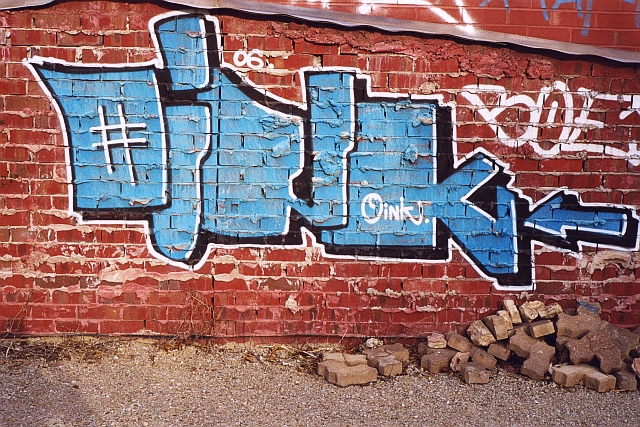
Gary Sauer-Thompson, traditional graffiti, South Terrace Adelaide, 2007
Others have been there before me. The interesting work of some Adelaide street photographers grouped under Church on Fire shows more of Adelaide's alternative street culture that is not recognized as public art by the Adelaide City Council.Yet the former changes the grimy urban wasteland spaces into a gallery of graffiti.
This creating poetic images on walls is an innovative transformation in graffiti and introduces a division between taggers interested in quantity and muralists concerned with developing style. It is unclear whether the latter have a base of support in Adelaide's art gallery world. I presume the indifference of the art scene is the norm. How much work is motivated by an individuals' knowledge of American hip hop culture---or is very regionally based? Can the work understood to be visual expression of hip-hop youth culture.
In Australia, art historians have judged some local graffiti of sufficient creative merit to rank them firmly within visual art. Oxford University Press's art history text Australian Painting 1788-2000 concludes with a long discussion of graffiti's key place within contemporary visual culture, including the work of several Australian practitioners. Discovering Graffiti by Christopher Heathcote in Art Monthly (Australia, September 2000) is good on Melbourne and Sydney graffiti.
start previous
|


