|
March 26, 2007
I watched Ridley Scott's Black Hawk Down last night- about the first Battle of Mogadishu in the early 1990s fought under the UN charter. It represented a turning point in the Clinton Administration's use of military intervention in Third World conflicts. The film focuses on the 18 Americans killed and 73 wounded in the 18-hour battle, even though an estimated 500 to 2,000 Somalis were also killed. The ghosts of Somalia continue to haunt U.S. policy.
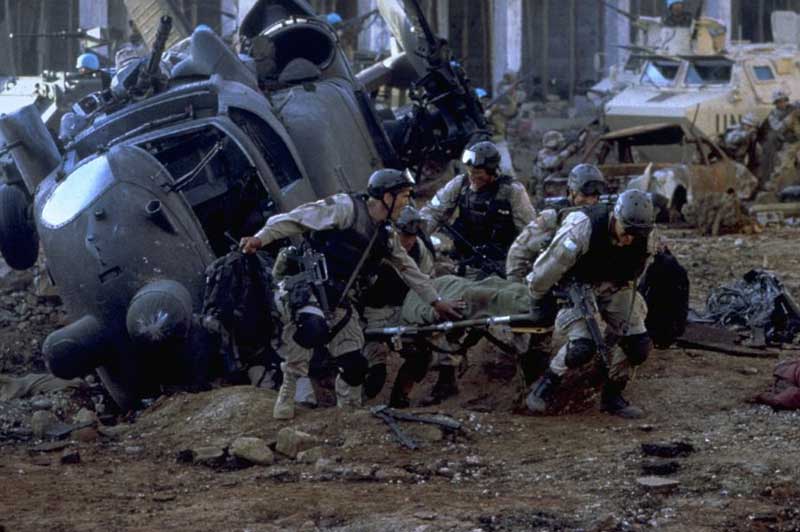
I was curious because I thought that Ridley Scott's visually innovative and provocative sci-fi Blade Runner was an excellent movie in the genre. Black Hawk Down links back to the Vietnam movies. It looks great, is emotionally charged, but I got bored with its account of American heroics under fire. The image that made them front page news -- the bloodied bodies of American soldiers being dragged through the streets of Mogadishu is not included in the film. This caused President Clinton to pull Americans out of the country.
The film glorified American actions in the precision mission gone wrong---a deadly ambush---but it does not critically analyze the US government's view of internationalism. Putting the incident into a global context is done by the History Channel presentation on the Deluxe Edition of the DVD. Why are the Americans intervening in a civil war? What began as a successful effort to halt bloodshed and feed starving people somehow evolved into a series of seek-and-destroy missions against the powerful warlords who ran different parts of the country.
What we are offered is a polished, photogenic vision of battle that gets across the blood and guts of it and captures the mood of the soldiers -- abject frustration, dedication to duty, dismay and fear, grief, a desire for retribution, and above all, heroism in the face of impossible odds. What is down played are the military blunders. So it is anti-war but pro-military with sound effects galore. The flow of events is fluid in terms of an unfolding of anarchy.
Watching the film I kept on thinking forward to Iraq and the Americans in Baghdad and postmodern spaces in Representations of post-modern spaces in Ridley Scott’s Black Hawk Down
Scott’s film explores in minute detail how the State’s military is undone when it attempts to use its mobile technological might to penetrate Mogadishu. It is undone because it is unprepared to deal with the spaces of Mogadishu which are neither the space of modernity, the space of nations, nor the tribal spaces the colonialists encountered in their first occupation of Africa. Scott recontextualizes the notion of post-modern war imagined in terms of the U.S.’s advanced technology and information control.
The text states that:
Postmodernity in the Mogadishu represented in Black Hawk Down has its own measure, one whose trajectory is heavily inflected both by its tribal heritage and its influences from Europe, but which is other than both. This Mogadishu is anything but “primitive,” undeveloped, or unordered as the Americans tend to think. The Somalis’ access to technology, markets, and media all tend to level out many of the disparities that once characterized their relationship with the European powers.
Even though the Americans eventually extricate themselves they have lost not just the battle but the “war” because the very measure of what’s winning and what’s losing has shifted into a new modality--one represented by Iraq.
|


The History Channel has been doing good stuff the last few years. Digital CGI has made creating/recreating history easier, but also for whatever reason their productions have professionalised as well.
The only reason I went and saw 300 was because a watched a two hour History Channel special on it.