|
December 13, 2009
William Christenberry's poetic documentation of the vernacular landscape of the American South is an ongoing series that blends the descriptive with the mythic. It parallels the work of Bernd and Hilla Becher.
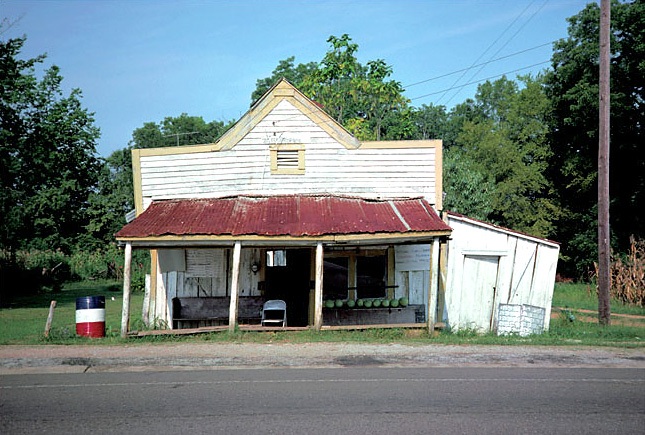 William Christenberry, T.B. Hick’s Store, Newbern, Alabama’, 1976
This kind of work links text and image since the artist’s memories of the Deep South are stepped in rich literary and photographic tradition.
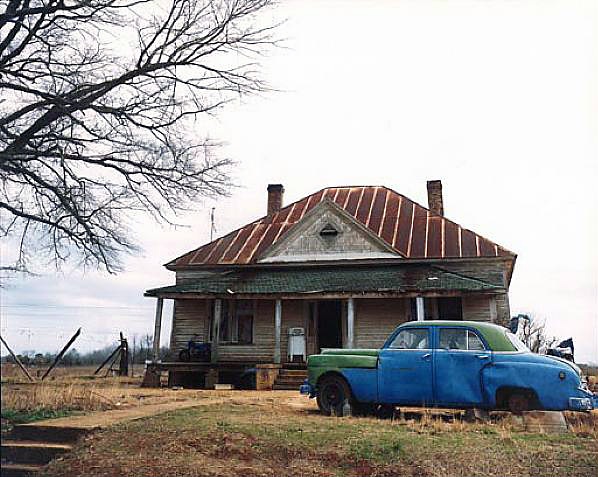 William Christenberry, House and Car, near Akron, Alabama’, 1981
This work is about place, time and memory.In this interview in Afterimage (November 2005) he says:
I don't want my work thought about in terms of nostalgia. It is about place and sense of place. I only make pictures when I go home. I am not looking back longing for the past, but at the beauty of time and the passage of time....I can't wait to get out into that landscape and to go back and see those same places. Sometimes they are still there and sometimes they are completely gone...Returning to the sites allows me to record both the traces of passing time and represent how a subject is transformed by time.
He adds that Walker kept his distance emotionally. His view was objective. My stance is very subjective.
The place is so much a part of me. I can't escape it and have no desire to escape it. I continue to come to grips with it. I don't want my work to be thought of as maudlinor overly sentimental. It's not. It's a love affair--a lifetime of involvement with a place.
He adds that although his work is largely celebratory there is this dark side that permeates the South--eg., the issues of the civil rights period and the terrible evil that manifests itself in the Ku Klux Klan's terrorism and racism.
|


have you seen artblart--it's very good.