
Mandy Martin, Puritjarra 2, 2005. For further information on MANDY MARTIN, refer here: http://www.mandy-martin.com/
If there are diverse kinds of knowledge and ways of knowing place, then we need to learn to value the different ways each of us sees a single place that is significant, but differently so, for each perspective.
|
|
looking for something firm in a world of chaotic flux
|
|
|
Grosz, Deleuze, indigenous art
« Previous |
|Next »
|
|
|
January 28, 2009
Liz Grosz's Chaos, Territory, Art: Deleuze and the Framing of the Earth tackles contemporary Aborigiinal art in its last last chapter, Sensation.The Earth, a People, Art. Grosz does so by using Gilles Deleuze's ideas about how the artworks created by Kathleen Petyarre and Clifford Possum Tjapaltjarri affect us.
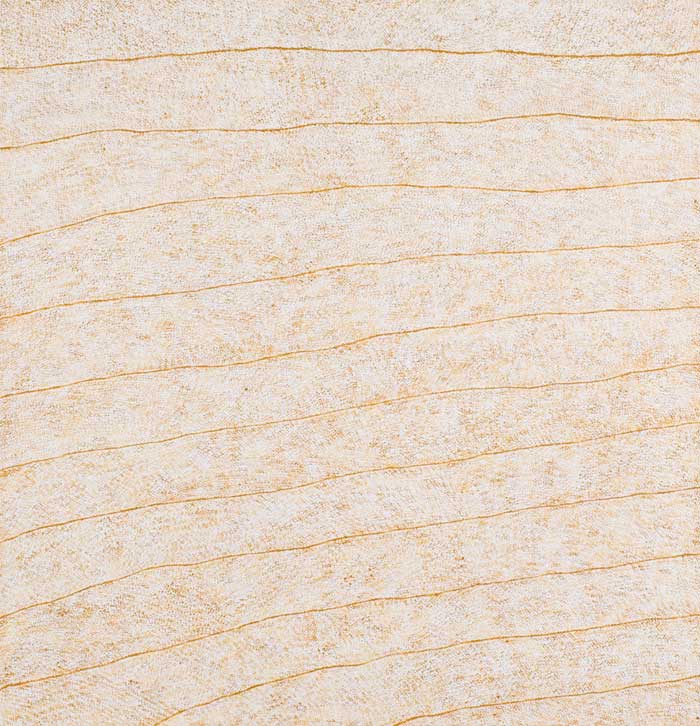 Kathleen Petyarre, Mountain Devil Lizard Dreaming, sandhill country (after hailstorm) 2004, Acrylic on linen,
Art, Grosz argues, is not primarily conceptual. Instead, it is positioned as the intensification and materialisation of sensation. Concepts are “by-products or effects rather than the very material of art” sensations might inspire a concept or thought, but art does not produce these concepts directly. Art intensifies sensation, and generates new sensation, new excesses. The creation of material forms facilitates our processing of the sensations and stimulations we receive from the world, ordering them into new forms.
Grosz says:
I don't want to deny that artworks have meaning but it may be that in our century-long fascination with language, and with the reduction of all artworks to their linguistic representations, has blunted us to something extra-linguistic that I think even language has: a force or affective resonance that we feel when we experience art directly but that we often or sometimes lose when we over-interpret it. Every work of art, every text, can be interpreted. The question really is: What does that interpretation do to the text or work of art? What does it contain of their force?
She argues, rightly, that contemporary Aboriginal art has come to exist not just on a plane of religious ritual and anthropological knowledge (as many want to suggest), but as art sensations that are now a part of the history of 20th-century art (and beyond), as techniques, forms, images that others can address, incorporate, complicate and transform.However, Aboriginal art Grosz says defies western art history categorisation. Instead of falling into the stylistic schools of either abstraction or expressionism or the 'middle' position of the figural, much of western desert art, seems to occupy all three positions simultaneously.
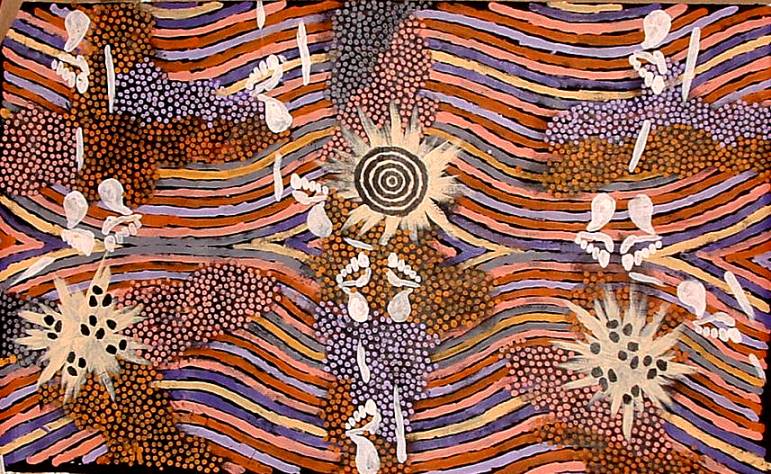 Clifford Possum Tjapaltjarri, Napperby Lakes, 1994, acrylic on canvas
Contemporarry Aboriginal Art has produced an entire field of art and it has changed what art is and how we view it. Grosz adds that:
Art is not about representation. Art is of the body, for it is only art that draws the body into sensations never experienced before, perhaps not capable of being experienced in any other way, the sunflower-sensations that only van Gogh's work conjures, the 'appleyness of the apple' in Cezanne, the Rembrandt-universe of affects or the meat-sensation that underlies the flesh in Bacon.Sensation draws us, living beings of all kinds, into the artwork in a strange becoming, in which the living being empties itself of its interior to be filled with the sensation of that work alone.
Art is less the s the representation of sensation and more the making material of sensation--and the extraction and transformation of intensities.
|
|
|
|
|
|
|
|
|
|
|


This review by Peta Mitchell in Politics and Culture is good. Mitchell says:
Grosz maintains an entirely ahistorical distinction between art and science in that she follow is Deleuze and Guattari, in distinguishes between the two planes upon which art and science operate. Where ‘art is the opening up of the universe to becoming-other, […] science is the opening up of the universe to practical action, to becoming useful’ Art and science, she continues ‘are not alternatives to each other: art ‘competes’ and ‘cooperates’ only with other art practices, as science, specific scientific doctrines, techniques, and principles, ‘compete’ and ‘cooperate’ only with each other’.