|
January 12, 2009
Dieter Appelt is one of Germany's most influential photographers and videographers. Since 1982, the artist has taught photography, film and video at the Hochschule der Kunst in Berlin. In the late 1970's and 1980's, the artist's work was centered on performance art, and his photography developed out of the documentation of his performance.
Often, the performances took place within constructed nature-based sculptures or sets and dealt with issues related to primal endurance and decay. This was in part because of the experience of returning home from World War II to find the decomposing bodies of soldiers in neighboring fields
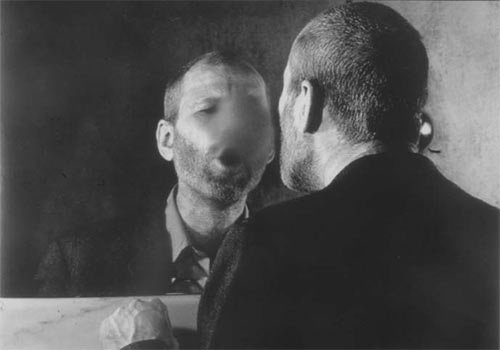 Dieter Appelt, ”Der Fleck auf dem Spiegel,den der Atemhauch schafft”,1977, photography
A latter work is Forth Bridge — Cinema. Metric Space, an exhibition at the Canadian Centre for Architecture; a work informed by, and referring to, the late nineteenth-century Forth Rail Bridge near Edinburgh in Scotland.
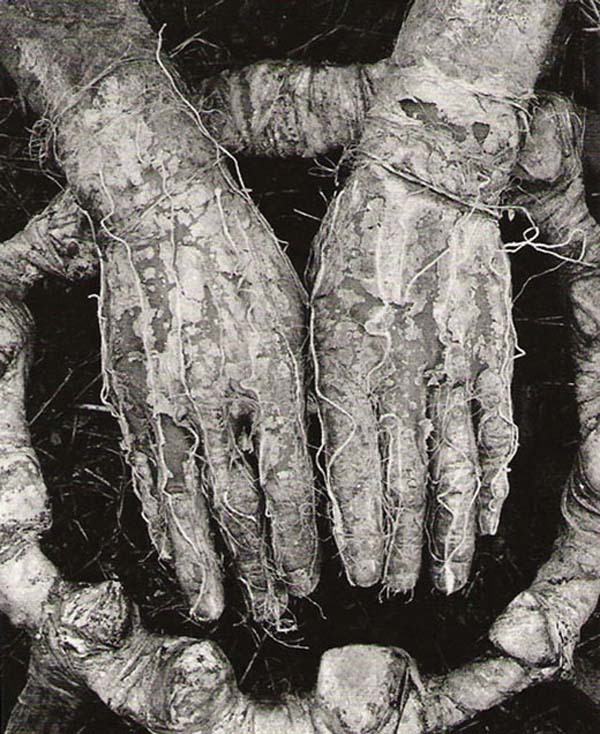 Dieter Appelt, "aus Erinnerungsspur (vergraste Hände), (Weed growth of the hands), 1978-79.
The images is a record of Appelt's performances, the best known documented by "Liberation of the Fingers." In the attempt to purge himself of wartime childhood memories of decaying bodies, Appelt set out to become one himself: he whitened his body with marble dust and wrapped his hands and legs in linen, as if preparing for burial. The artist was not only burying himself alive, as it were, but resurrecting himself, that is, functioning as his own Christ--or shaman, in the tradition of his contemporary Joseph Beuys.
|


Dieter Appelt's performance work belongs in the German postwar culture of mourning and melancholy. The artist is processing his own unhappy experience. As photographs, the images demonstrate the medium's expressive potential. In Art Forum Donald Kuspit says:
its a big switch from this work to the architectural one--from expressionism to abstraction.