|
January 19, 2009
Thomas Demand began as a sculptor and took up photography to record his ephemeral paper constructions. In 1993 he began making constructions for the sole purpose of photographing them. Demand begins with a preexisting image culled from the media, usually of a political event, which he translates into a life-size model made of colored paper and cardboard.
His handcrafted facsimiles of architectural spaces and natural environments are built in the image of other images. Once they have been photographed, the models are destroyed.
 Thomas Demand, Poll, 2001
Each of Demand’s photographs is one or more steps removed from reality, creating tension between the fabricated and the real. Demand knowingly uses the traditional role of photography as a faithful transcriber of the world to throw his subject’s artificiality into doubt. This confounding of references is such that the very idea of an original recedes completely.
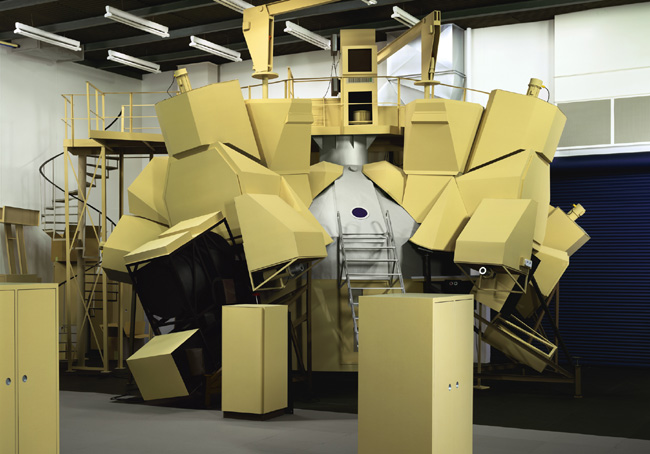 Thomas Demand, Space Simulator, 2003
At first sight, the subjects represented in Demand’s photographs seem commonplace and familiar, but often they relate to scenes of cultural or political relevance, which have come to our attention through the mass media. They range from the archives of German filmmaker and National Socialist propagandist Leni Riefenstahl, Saddam Hussein’s attempt to purchase a concentrated form of uranium called ‘yellowcake’ from Africa and the kitchen in Saddam Hussein’s hideaway in Tikrit, Iraq.
Art curators and critics interpret Demand's work as reconsidering the traditional notion of photography as a faithful record of reality, highlighting the evasiveness of the medium in a world that is saturated with manipulated or mediated images.
|


