|
January 11, 2009
I never really connected with the work of Victor Burgin when I was at photography school in Melbourne --it was miles away from straight photography and it was embedded in theory, which I was told by the instructors/lecturers had little to do with photography proper. Anyway photography was about creating original pictures not reworking the pictures of others.
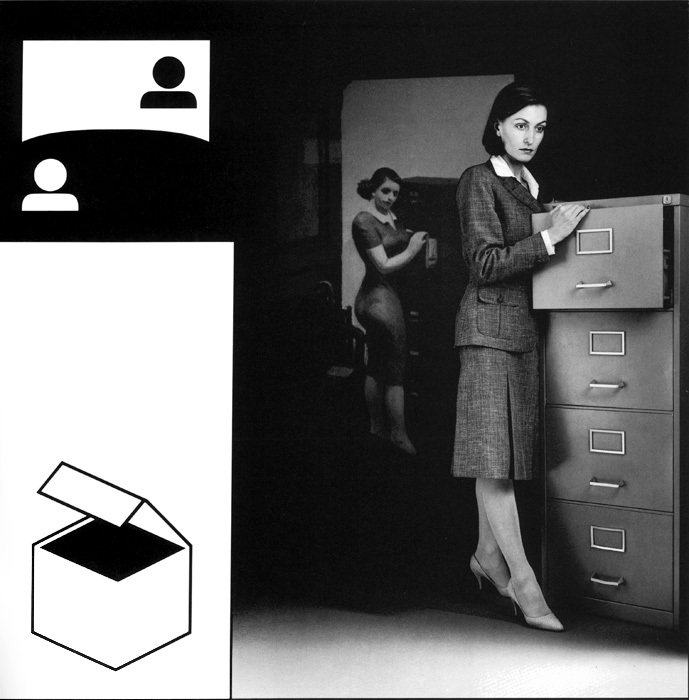 Victor Burgin, Office at Night, 1986
I sensed that Burgin had a knowledge of the art world way in advance of my meagre grasp of 20th century art. In this case Burgin's work is a re-reading of Edward Hopper’s 1940 painting Office at Night; a re-reading was from the perspective of the organization of desire within the law, and the organization of sexuality within a patriarchal capitalism.
 Edward Hopper, Office at Night, 1940
Burgin's Office at Night, which was first shown at the ICA, London, in 1986, was a seven-part photographic installation. Burgin says:
Patriarchy has traditionally consigned women to supportive roles in the running of the economy, subject to the authority of men. The ‘secretary/boss’ couple in Hopper’s painting is at once a picture of a particular, albeit fictional, couple and an emblem, ‘iconogram’, serving to metonymically represent all such couples – all such links in the chains of organization of the (re)production of wealth. Such coupling for reproduction must of course contain its sexual imperative. The family functions to contain, restrain, this imperative in so far as it is directed towards the reproduction of subjects for the workplace. The erotic supplement to the biological imperative cannot however be contained in the family. It spills into the place of work, where it threatens to subvert the orders of rationalized production. [Hopper’s] painting, clearly, may represent such a moment of potential erotic disruption in appealing to such preconstructed meanings, items of the popular pre-conscious, as are filed under, for example, ‘working late at the office’.
Postmodernism was not on the horizon of the photography school in the 1980s. Even if they knew about it the response would have formed part of the strong resistance against a theoretically active art-making process coupled to a gleeful celebration of naivete in photography.
|


The art world work works in terms of the division of labor: between artists, who are supposed to be relatively inarticulate and badly read, and critics, who are supposedly more articulate and can explain what the artist does.
Aspiring art photographers don't read books on theory--critics do. Photographers then spurn the critics and become hostile to theory.