|
January 21, 2009
Sugimoto Hiroshi's work ---his series include “Dioramas” (1976-); “Theaters” (1978-); and “Seascapes” (1980-)---- centres on the idea that photography is a time machine, a method of preserving and picturing memory and time.
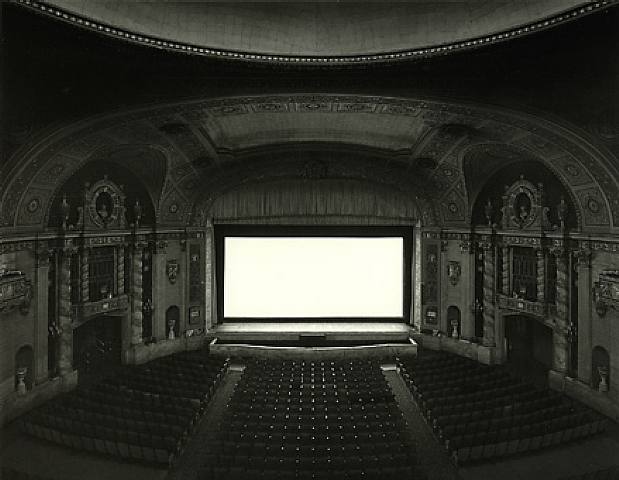 Sugimoto Hiroshi,series
Since the 1970s, Sugimoto has worked on his photo-series entitled «Theaters» in which he photographs auditoriums of American movie theaters, and drive-in movies, during showings. He says:
The question-and-answer session that led up to this vision went something like this: Suppose you shoot a whole movie in a single frame? And the answer: You get a shining screen. Immediately I sprang into action, experimenting toward realizing this vision. Dressed up as a tourist, I walked into a cheap cinema in the East Village with a large-format camera. As soon as the movie started, I fixed the shutter at a wide-open aperture, and two hours later when the movie finished, I clicked the shutter closed. That evening, I developed the film, and the vision exploded behind my eyes.
In most of the theater photographs there is a darkened proscenium arch and decorative architectural details enclose a rectangle of dense, milky light. Often, rows of empty seats are visible in the foreground, just below the glowing movie screen. Except for the viewer, the auditorium is unoccupied.
The Theaters series allude to the camera, to the perceiving spectator or viewer and to time.The work provides a way to think time in the photographic image that is different from the tradition in the history of modern photography in which the photograph has been seen as a static object, a frozen moment of time. A photograph that has been taken in the past, is a brief and short moment of time that is necessarily regarded as one of its decisive characteristics. Film is a series of movement whilst photography is a cut into time.
|


