|
October 29, 2007
I caught Kathy Drayton 's Girl in a Mirror: A portrait of Carol Jerrems (2005) by chance on ABC last night. The 55-minute documentary, which is available as a DVD, is constructed from seventy-three of Jerrems' original prints; 166 new prints made from the extensive collection of negatives stored in the gas rooms of the NGA; together with thirty portraits of Jerrems sourced from the archives of contemporaries, Rennie Ellis, Robert Ashton and her teacher and mentor, filmmaker Paul Cox.

Carol Jerrems, Vale Street, 1975
Vale St, St Kilda, has become the iconic image of Australia in the seventies. It is a portrait of Melbourne model Catriona Brown flanked by two sharpie teenagers, the boys standing just behind in the shadows.
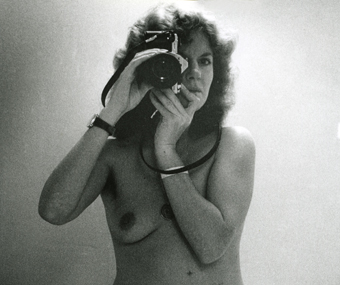 Jerrems aimed to capture the raw edges of the world she saw around her: sharpie subculture, street life and urban indigenous people. Jerrems aimed to capture the raw edges of the world she saw around her: sharpie subculture, street life and urban indigenous people.
She was part of the counterculture of the 1970s - and photographed the music, the cars, the fashions, the social tensions and the sexual experimentation.
Jerrems was diagnosed with polycythemia, a rare blood-related cancer when in Hobart. She underwent months of invasive and painful procedures, but came to a realisation she was dying.
Jerrems photographed and wrote about her physical decline. She photographed doctors hovering, the scars on her stomach, and her mother, with whom she had a difficult relationship, visiting. Jerrems had moved from observer and recorder of the historical moment, to a very personal open style: collaborating with her subjects in their representation, and often including herself in reflections in the frame.
|


