|
January 15, 2009
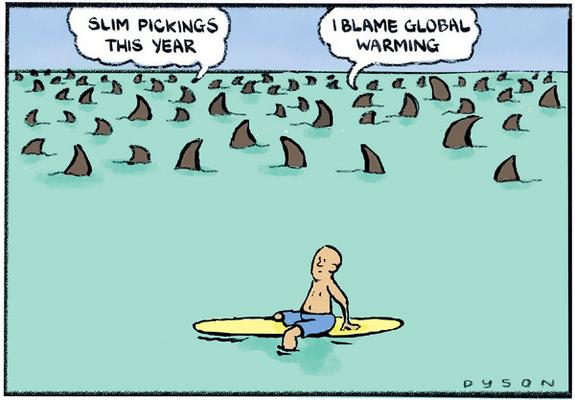
A light moment that refers to the media's current and ongoing anxiety about shark attacks on Australian beaches during the high summer. Reading the media on shark attacks this summer gives me the impression that the media assumes sharks should make way for humans. It's as if sharks have no right to be in the water as predators.
The water around our shorelines belongs to us humans not sharks. Sharks must give way to humans. If they persist in cruising the shore where human have fun, then they ought to be shot. The whole of nature is subservient to human interest and desires.
 Dyson
Dyson
It's only a cartoon but it does ‘overcome a purely formalistic approach to aesthetics and opens the way for a more dynamic interpretation of the relationship between art and life. One way of exploring this is through the notions of decay, the ruin and fragment that engender creativity. That which has succumbed to the ordeals of time also embodies an awareness of the process of time.
These terms suggest the postmodern which is commonly considered to be a period of decay in that in this period (postmodernity) there is a lack of originality, a ‘‘fractured’’ narratives typical of seriality, a corruption of meaning, which it is inferred pose a ‘‘danger to civilization’. The current transformations in narrative form are interpreted as symptoms of a state of cultural degeneration with contemporary media (art and cinema) is viewed as resisting legibility and interpretative depth.
The ruin is a fragment, which is a state of being. The ruin-fragment as it were. Fragment suggests broken off, detached or an incomplete part. Ruins evoke wholes that have passed away and are an historical object. Considered as fragment ruins become detached from their original contexts and are in some sense isolated from the present. Whilst a fragment can refer back to a whole that has passed away it also has a forward looking aspect, as it can be a figure coming into being.
The ruin fragment--a deserted, ruined building in the bush--- is a way of framing history, the past and the nation an suggest decline, decay and disorder, even when they evoke conservative nostalgia. The aesthetics of the sublime is in part an effort to name the confusion that comes over us when faced with the catastrophes of human history.
|


The tabloid media is suggesting that the current spate of shark attacks were due to the king tide, which in turn was caused by global warming!