|
January 6, 2008
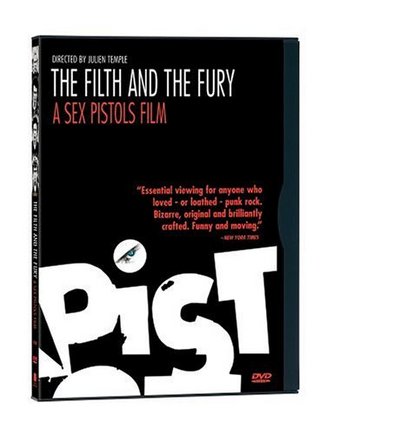
I watch DVD of the Six Pistols Filth and Fury by Julien Temple last night. It was their own story told in opposition to that of Malcolm McLaren in The Great Rock and Roll Swindle, which was also directed by Temple.
It is predominantly John Lydon's side of the story---I was ripped off by McLaren--- woven into a narrative about the bad boys who are too hot to handle.So there is lots of trouble. McLaren, who was not interviewed for the film, is represented by a disembodied bondage mask which speaks excerpts from previous interviews.
It was a very visual film. It situated the Sex Pistols in terms of images of the working class under a Labour Government (Wilson), the strikes under the Heath and Thatcher Government, a variety of English television comedy shows, and an odd 1950s film of Richard III.
The ugly Sex Pistols were a stand up comedy act, whilst punk was doing your own thing. The cultural context for punk (conflated throughout with the Sex Pistols) is British pop culture, and particularly British mainstream media culture.
The Sex Pistols's intrusion into an otherwise banal media culture is presented as a clash of styles, which sits at odds with the class politics outlined in the opening of the film. Rotten implies that the real story of punk is that of a genuine social movement struggling to create a truly participatory oppositional culture.
What suprised me was the failure to connect punk to the European avante garde of the 1930s---Dada , Lettrists, surrealists and situationists. There was a brief mention of New York Dolls; no mention of Iggy Pop and the Stooges or the Ramones. The Sex Pistols did it all of their own is the claim; a denial of the Greil Markus view of punk as making a new culture out of old chords. In this interview Temple says:
One of the things that The Filth and the Fury does is to challenge that theoretical take on the Sex Pistols as the whole story—that this was a manipulated series of events, and ideas from European art and political movements were somehow injected into these kids. These kids actually came pretty well formed, with their own versions of anarchy and anger and outrage. They didn’t need to have middle-class art school students telling them how to express those things. I think that’s an important consideration to put alongside all the Greil Marcus and Jon Savage theories, to see the actual people involved and what made them write the lyrics that they wrote and make the music that they made.
The freedoms that were opened up by the Sex Pistols, such as the freedom to make a movie when you’re young in England, the freedom to wear whatever you liked, have become industries like the London fashion business where they Hoover up any new idea as soon as it appears on the street and corporatize it and sell it back to you before it’s able to do anything on its own.
|


Gary,
the standard account or reading of punk's politics is as that of the smug, insular British establishment that saw a bunch of black-leather-clad working class kids with spiked hair and safety-pin earrings and thought them a genuine menace.
Punk, just like Dada, was never going to destroy the established institutions.