|
January 24, 2009
W.J.T. Mitchell has long argued that there has been a visual turn, or what he calls a “pictorial turn,” in contemporary culture and theory in which images, pictures and the realm of the visual have been recognized as being as important and worthy of intense scrutiny as the realm of language.
While the “linguistic turn” (Richard Rorty ) in the 1960s called attention to the role of language in culture, theory, and everyday life the notion of a “pictorial turn” signals the importance of pictures and images, and challenges us to be observant and informed critics of visual culture.
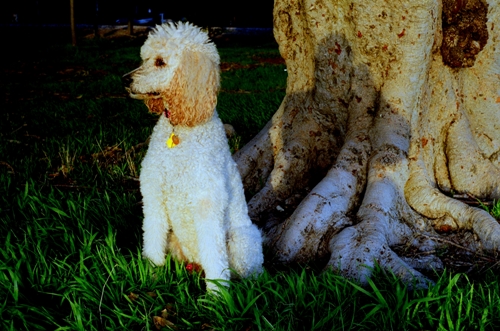 Gary Sauer-Thompson, Ari, Adelaide Parklands, 2008
The title of Mitchell's book, What do Pictures Want?, strikes me as odd. Pictures don't have desires. They are objects that convey meaning not animated beings with desires, needs, appetites, demands, and drives of their own like dogs. Pictured are not alive like dogs. They do not act in the world like dogs. Images are not living creatures.
Mitchell's response is to reformulate this initial question into another set of questions:
'Why is that people have strange attitudes towards images, objects and media? Why do they behave as if pictures were alive, as if works of art had minds of their own, as if images had a power to influence human beings, demanding things from us, persuading seducing, and leading us astray. Even more puzzling, why is it that the very people who express these attitudes and engage in this behaviour will, when questioned, assure us that they know very well that pictures are not alive, that works of art do not have minds of their own, and that images are really quite powerless to do anything without he cooperation of their beholders? How is that, in other words, that people are able to maintain a "double consciousness " towards images, picture, and representations in a variety of media, vacillating between magical beliefs and skeptical doubts, naive animism and hard headed materialism, mystical and critical attitudes
The usual response to this contradiction is to say that they--someone else-- is naive and superstitious whilst we are hardheaded critical and skeptical. Someone else is generally the Other.
|


