|
November 24, 2008
There is an exhibition of the work of Andreas Gursky at the National Gallery of Victoria in Melbourne. I hoping to see it when I'm in Melbourne next weekend. This style of art photography has its roots in Bernd and Hilla Becher's style of documentary photography that gained a place in the art world through the serial character of their photography allowing a minimalist or conceptual reading. I want to judge how far this colourist, digital photography has moved towards emulating late 20th century American modernist painting.
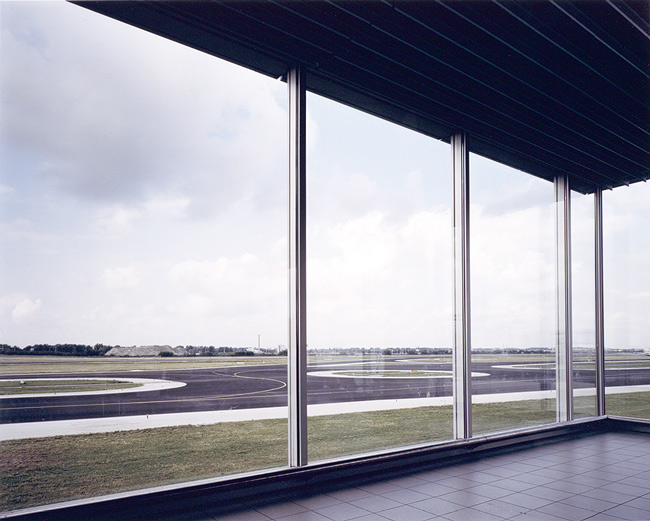 Andreas Gursky, Schiphol, 1994, Chromogenic print.
At one level we have a straightforward style of photography that works within the austere aesthetics of modernism---technically impeccable architectural photography without the documentary status of the "given". This de-romanticized" vision that gestures to a postmodern version of the sublime. His work of large-format color photographs depicts vast panoramic scenes: entire cityscapes, endless horizons, multi-floored office buildings, huge factory corridors and crowded public spaces usually taken from a distance that have the appearance of a bird's eye perspective.
However, all is not as it appears as Stefan Beyst points out. Gursky's representation of reality is frequently constructed from the combination of distinct shots in one image, and then digitally manipulated within a rigid geometric nature. This gives up the traditional Renaissance perspective that wanted to overlook the world from one single vantage point--the God's eye view.
 Andre Gursky, Kamiokande, 2007
As Beyst says Gursky does not penetrate into the essence of things behind the appearances, nor does he provide a 'global' or God's eye view of them. Rather, like an old fashioned modernist, we have a basic abstract geometric macrostructure, within which the micro-elements are subordinated. There is lots of detail, for sure, and it is often highly repetitive. But content appears to be downplayed in terms of mattering as content; only downplayed though since if Gursky's images were really abstract -they would be just coloured squares or circles. The detail matters.
|


Gursky? A modernist, now there's a thought.