|
December 9, 2008
I've been considering building two of my embryonic photography projects---on the River Murray and Port Adelaide ---- into electronic books with text and photographs. That requires special software. What sort?
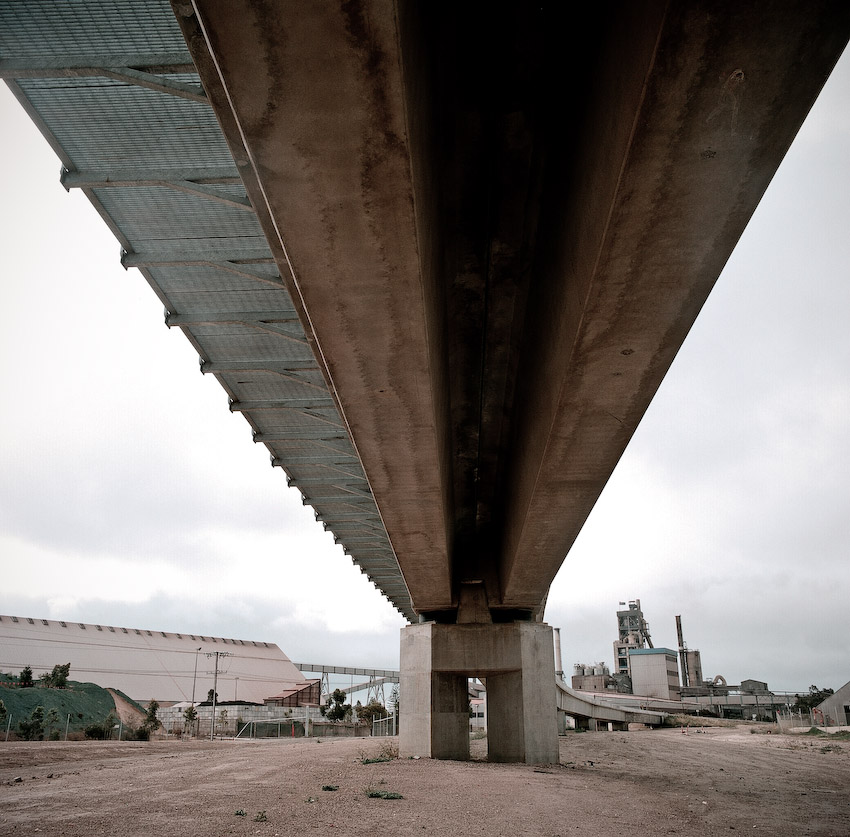 Gary Sauer-Thompson, Port Adelaide, South Australia, 2008
I'm not sure how to go about creating an e-photobook with text. But it is the next step, as I have some text and pictures that explore image-text relations viewed as a site of conflict. It is the conflict that is crucial given the development versus the environment struggle that has been played out in these two projects. So the nexus is where political, institutional, and social antagonisms play themselves out in the materiality of representation.
Theorists, such as W. J. T. Mitchell in Picture Theory: Essays on Visual and Verbal Representation, argue that the postmodern mode of representation is one which represses language and absorbs it into image. According to Mitchell we live in a culture dominated by pictorial image, yet we remain unable to understand the power of the picture, even though the pictures themselves form a point or site of friction and discomfort.
Consequently, we need to avoid the tacit binary theories of the Image/text" relation: the photographers and visual artists who reduce every to image and make the text empty and those in the literary world who see the image as an illustration of the text. Each is a black hole for the other. Thus photographs were once seen to just look like the world: we can see what a picture is of without having to learn any codes---a naïve mimesis, copy or correspondence theories of representation, or a renewed metaphysics of pictorial ‘presence’ in which the picture has the capacity to transport a viewer to a state of being that both precedes and elides language.
If the dominant theory in our culture is a too linguistic interpretation of images that hinders "visual literacy", then we need to begin from the tensions and paradoxes that exist between visual and verbal representations in the mass-circulated global corporate culture in which we now find ourselves.
|


Mitchell is interesting. He thinks in terms of a visual culture and the "pictorial turn" in which the long domination of the printed book is giving way to cinema, video, and other forms of multimedia as the determining influences in our culture.
Mitchell works in terms of the domain of images across the media, including literature and language as well as scientific discourse and the visual arts. By ‘image’ he means works of art, products of mass culture, or ordinary functional images such as the images of sexual identity on lavatories or the icons on a computer desktop. Iconology addresses the entire field of visual (and verbal) images, of which the realm of artistic images is a small and distinct subfield.