|
August 8, 2012
American photographic modernists--eg., Edward Weston and John Szarkowski--- held that sharp focus was a part of the ontology of a photograph. It was a core characteristic of the medium specificity of photography, rather than an aspect of a certain kind or style of photograph.
This medium specificity approach was part of a strategy to define the photographic medium's ontology differently from painting and other visual media. By outlining the medium specific characteristics of their field they assumed that they could define the ontology of photography.
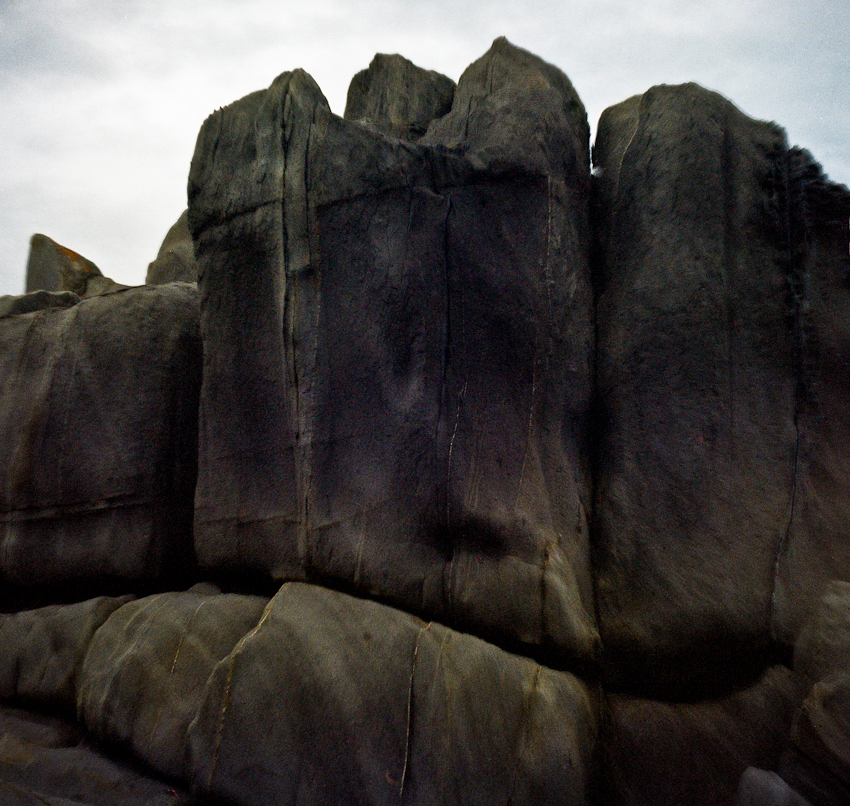 Gary Sauer-Thompson, rockface, Kings Beach, Victor Harbor, 2011
Why not think otherwise---why can't photography not share or exchange characteristics with painting? Why cannot we have blurred photographs in which the indexical quality of the photograph is weakened? If we can, then the identity of photography is one of flux and mutability as it changes over time.
In their Representation in Photography The Competition with Painting chapter in Photography Theory Historical Perspective text Hilde Van Gelder and Helen W. Westgeest say that:
The debate in the nineteenth century among photographers and theorists on whether a photograph should be as sharply focused as possible or be partly blurred was strongly related to the discussion about the relationship between photography and painting. The late pictorialist photographers, such as Peter Henry Emerson, preferred a painterly blurredness in photographs. As argued in the first section of this chapter, these photographers were accused of being pseudo-painters. The blurred photographs looked like impressionist paintings, which were perceived as unfinished paintings that had to be completed by the spectator in the very act of observation and interpretation.
The American modernists, as we have noted, were at pains to differentiate photography from painting in order to establish the autonomy of photography as a fine art.
Today, after postmodernism, we have the ncreasing popularity of blurred photographs in contemporary art.
|


In contrast to the pictorialist style, the American modernists rejected any kind of manipulation in the photographic process (e.g. soft lens, special developing or printing methods) and tried to use the advantages of the camera as a unique medium for capturing reality. Their motifs were supposed to look as "objective" as possible.