September 28, 2012
American photography: Jonathan Smith
Jonathan Smith is a British photographer living and working in New York for ten year. His intriguing Night and the City series highlights the importance of night photography
September 25, 2012
American photography: James Welling
James Welling The Mind on Fire at the MK Gallery looks back to Welling's work in' the Pictures Generation', a group of artists working in New York in the 1980s.
 James Welling, Summation, 1981(detail). Inkjet print.
This period of experimentation generated numerous collages, paintings, notes and ephemera before culminating in a number of iconic series: minutely crumpled aluminium foil evoking starry skies or lunar landscapes; luxurious drapes sprinkled with dough suggesting snow-capped mountain ridges; and abstract colourfields appearing as sun-drenched horizons.
September 23, 2012
Brighton Photo Biennial: urban exploration
The Brighton Photo Biennial explores the theme Agents of Change: Photography and the Politics of Space. One theme of the Biennial is urban exploration: photographers picturing closed and hidden spaces of abandoned buildings, construction sites and underground tunnels.
In his Assaying history: creating temporal junctions through urban exploration paper Garrett says that the practice of urban exploration can be roughly defined as the discovery and exploration of unseen parts of the built environment, usually with a focus on derelict places. He adds:
Urban explorers are fascinated primarily in the flotsam of capital. They engage in a practice intensely interested in locating sites of haunted memory, seeking interaction with the ghosts of lives lived... These moments of encounter between the present and the past, experienced through physically exploring abandoned architecture, create flashes of confrontation with unexpected material traces that lead to emotionally charged discoveries through an embodied practice which mirrors the role of the archaeologist assaying surface material without deep excavation to analyse the character of places---a surface survey of affectation.
Urban exploration gives agency to places with an appreciation for the life of an
architectural feature or system that continues after abandonment, with an acknowl- edgement that, though the capitalist use-life of all places will inevitably end, places do not `die'.
He argues that there is a place, a need, and a desire for embodied experiences of the past, dreams of alternative pasts, for localised historical interpretation and for unregulated decay because a ruin can point much more powerfully than a restored building to its historical and social genesis and because unregulated experiences in ruins tell us as much about ourselves as about the places we explore.
Ruins may be decaying, but they are not dead: they are places filled with possibilities for wondrous adventure, inspiring visions, quiet moments, peripatetic playfulness, and artistic potential.
September 17, 2012
The 'Innocence of Muslims'
The US-made Innocence of Muslims was produced and directed by an Egyptian-American Coptic Christian, Nakoula Basseley Nakoula who lives outside Los Angeles under the pseudonym Sam Bacile. The producers of the film, intent on enraging Muslims, hired actors without informing them exactly what they were participating in.
Islam represents an existential threat and the film denigrates Islam and the Prophet Muhammad.
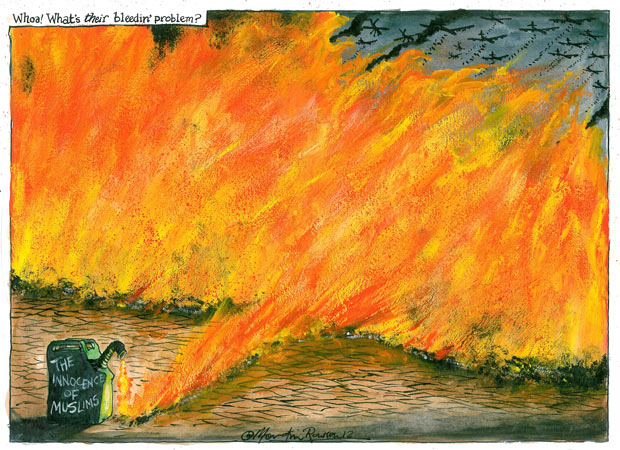
The film is designed to stir the flames of the civilization wars. It has succeeded.
September 16, 2012
From Flâneur to Driveur
In Morphings and Ur-Forms: From Flâneur to Driveur in Scan (2005) Sherman Young argues that in the instance of Sydney, the romantic figure of the flâneur is arguably impossible, and has instead morphed into variously the bohemian or tourist-flâneur.
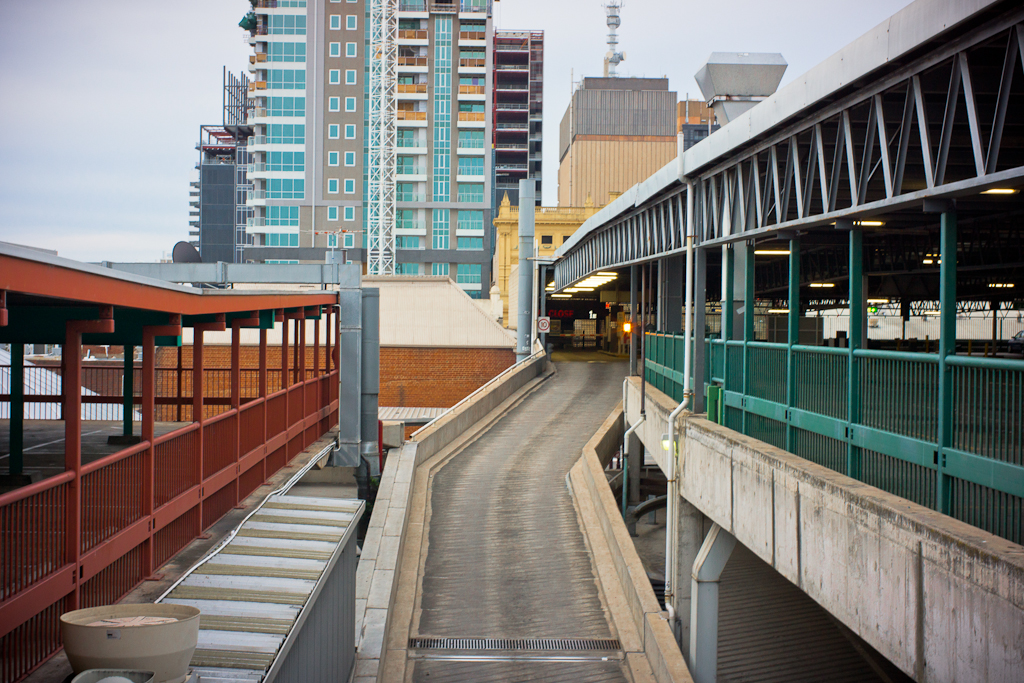 Gary Sauer-Thompson, Central Market carpark, Adelaide
When people do walk in the city, flanerie has been displaced by the precise itinerary of the three day tourist, the three minute dash from train platform to bus stop, the insistent battle between jaywalker and bicycle courier.
Young, however, goes further than this:
this paper suggests that the most appropriate becoming is the more focussed approach of the driveur, whereby Sydney represents and is represented by a directed flan Erie, located in the driver's seat of the automobile, in which the urban environment is largely aesthetic distraction. Just as the flâneur's natural environment was 19th Century Paris, contemporary Sydney epitomises the driveur's city as a tableau upon which information flows, mostly oblivious to its environment. Nowhere is this shift more apparent than in new media representations, which having glanced towards ideas of flanerie, now appear to exist primarily for the driveur.
The reality for many of the city's inhabitants is the driveur--the dominant actor in the twenty first century metropolis. Their Sydney is experienced as a cacophony of road rage, billboards advertising escape, talkback radio and traffic reports. The Sydney of the driveur is represented by traffic jams, bus lanes and fellow drivers in the wrong toll lane.
Though the aimless wandering of the flâneur with his serendipitous discoveries is not the domain of those who actually work and live there, it can be the domain of photographers exploring the city by walking.
September 12, 2012
Ed Douglas-- Family Tree: An Exploration
The Light Gallery at the Centre for Creative Photography in Adelaide has an exhibition of Ed Douglas' latest body of work. These are close up pictures of evocative pieces of trees on Douglas' property in the Adelaide Hills that were selected before they become firewood.
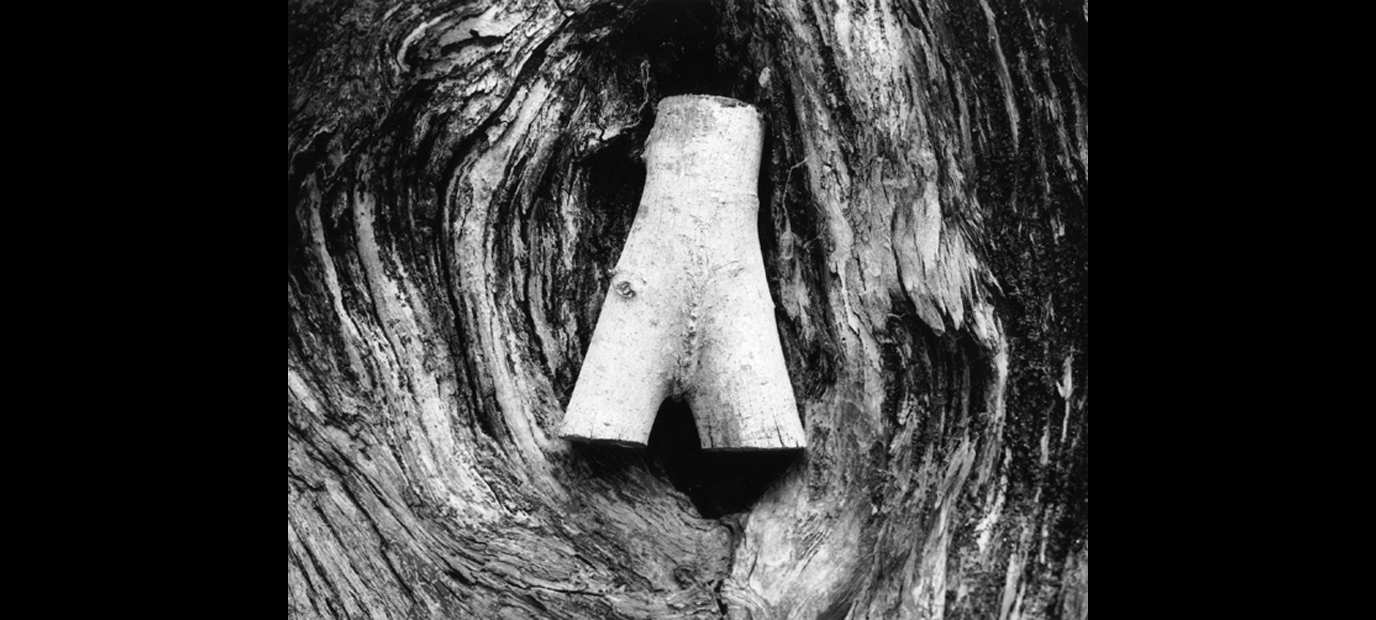 Ed Douglas, It's a Girl, 2012
They are studio based and shot on a 5x4 Cambo monorail on Efke 25 film using natural light mostly. The smaller gelatin-silver prints were traditional darkroom prints printed by Douglas; the much larger digital prints were from scans of the 5x4 negatives.
This body of work stands proudly in the tradition of American modernism--Edward Weston, Paul Caponigro and Frederick Sommer--the roots of Douglas' photographic practice. More specifically it is Californian modernism.
A central strand of Douglas work is anthropomorphising the tree through associations and projections.
September 10, 2012
Look: Contemporary Australian Photography since 1980
I've started to look through Anne Marsh's recent (2010) book Look: Contemporary Australian Photography since 1980.
As a survey of recent Australian photographic art it is the largest and most comprehensive of its kind providing both visual dialogues and critical theory. It represents over 190 artists, has a collection of over 400 photographs and a series of critical essays written by Anne analysing key themes and issues. The photography on Australian cities is thin.

Les Walkling, The site of his last embrace, 1986, Toned silver gelatin print
Marsh describes the time from the 1980’s to now as one of the most dynamic times in the history of art photography as, for the first time, it is taking centre stage in the art world. She says that previously, photography had to fight for recognition in the museums and galleries, but with the advent of post-modernism photography became seen as a valuable medium for creating visual dialogues.
September 7, 2012
the indexical nature of photography
Bernd Stigler in Practice post on FotoMuseum's Still Searching blog says that in talking about photographic realism, one should not talk about the images but about photographic practices. Ultimately, he adds, it is the way that photography is used that affirms or negates its realism.
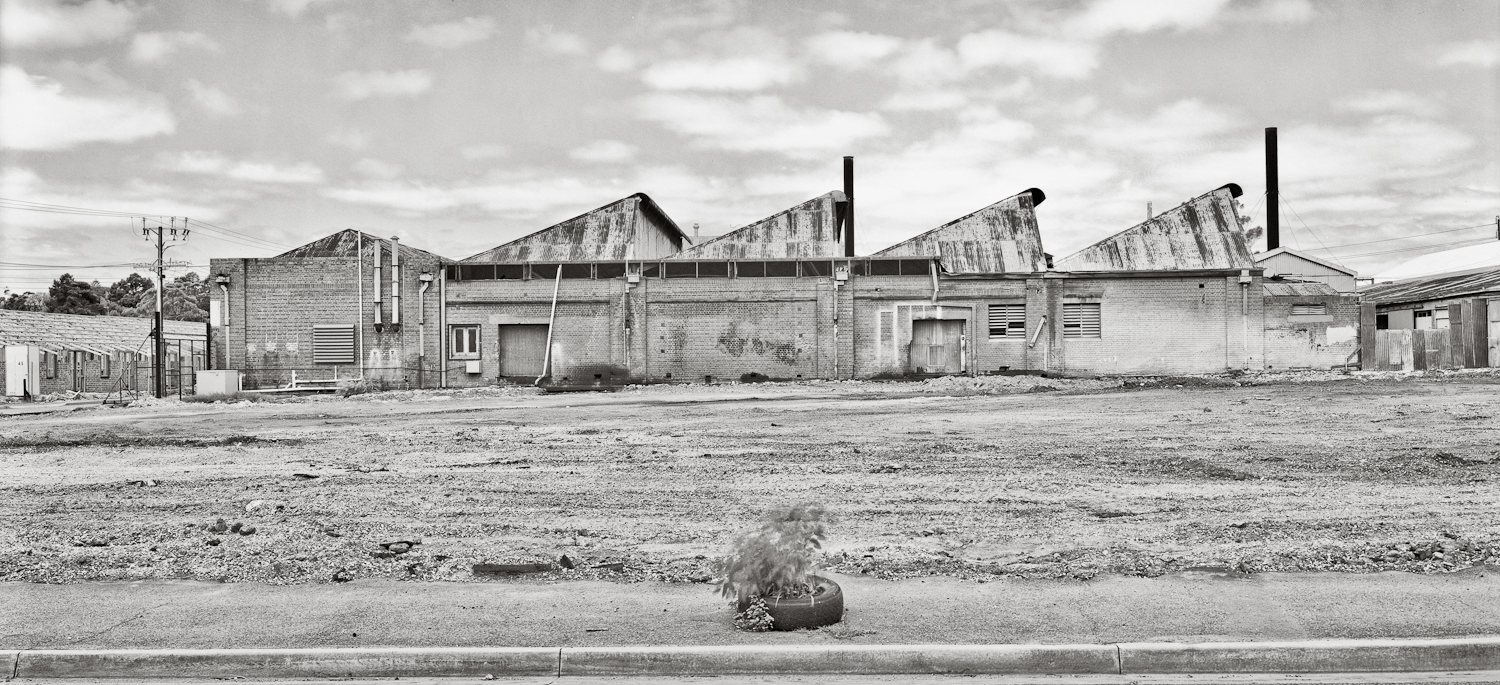 Gary Sauer-Thompson, Gibson St, Bowden, Adelaide
Stigler says:
Practical application decides the function of photography and defines its epistemic fields of reference. It decides about good and evil, conviction and rejection, images and their meaning.To name just one example of many: when with the emergence of digitalization the ontological status of photography became more fragile and often claims were made concerning and epistemic break in the history of the medium or even the end of the photographic age, shifts in practice began to take place that initially seemed inconsequential but then perhaps become much more important and sustained.p until now photography has perhaps been conceived too much in terms of images, and its social function has been neglected. But ultimately it is the way photography is used that affirms or negates its realism.
He adds that the fact that images are now much more readily available and circulate unimpeded, without regard for their source of origin—this is the real revolution that has led to the mass production and use of photographic images that one readily perceives as “fiction” and not as the “pencil of nature”.
The indexical nature of photography plays as little a role here as its relationship to reality via a logic of representation.
September 3, 2012
Adelaide + high rise development
Stop the DPA is the website of a group of residents in the South West corner of the CBD who are opposed to high rise development in this area.The SW corner, which consists of old worker’s cottages and welfare housing – has been singled out in the DPA’s aim to raise the city’s population to 48,000.
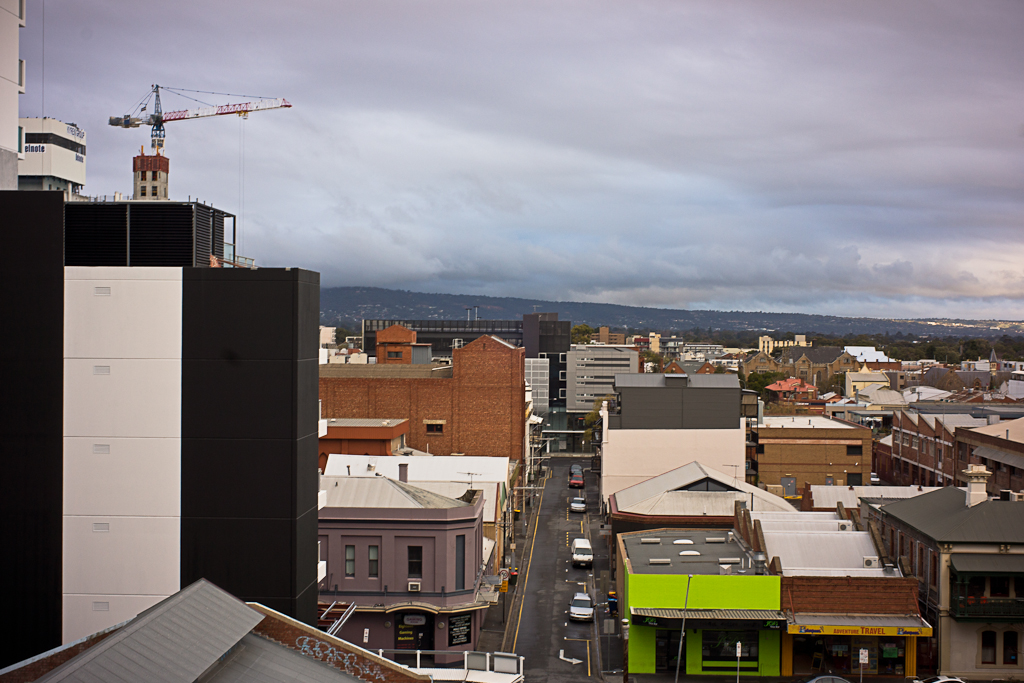 Gary Sauer-Thompson, South West Adelaide
The opposition is to high residential development in the form of the Mayfield development at 43-69 Sturt St, which consists of three blocks of 10, 12 and 14 storeys that include 400 flats, shops and offices. Currently the site consists of run down warehouses, a car park for spray-painted hire vans, and an old electrical substation. There is nothing there that is 'heritage' or aesthetically appealing.
This is a mixed use part of the CBD-- a CBD is synonomous with high-rise buildings and apartment blocks--and it is changing albeit slowly. The light industry is moving out being replaced by residents (in cottages and townhouses) and offices. The opposition is to high density living Their argument is that high-rise buildings - will destroy the character and sense of community in the area, even though a large section is saved from high rise development.
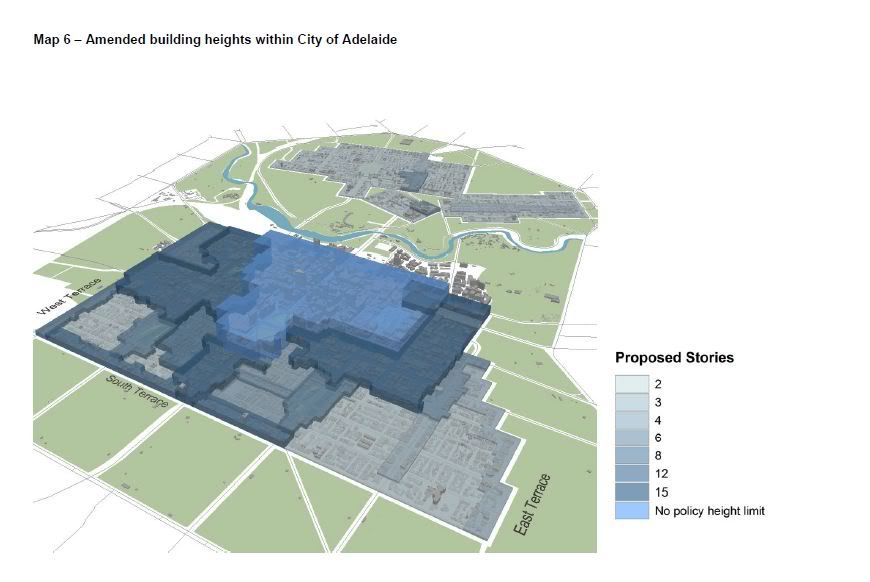
The new Development Plan for Adelaide is premised on tall buildings bringing more people, more people bringing more businesses, more businesses bringing more activity, more activity bringing more vibrancy.
photographic realism
Bernd Stigler explores photographic realism in his Reflection post on FotoMuseum's Still Searching blog.
Reflection is a particularly loaded term in relation to photography, what with all those mirror metaphors. Documentary photography is one of the most important forms of a “photographic realism”. One kind of reflection---naive realism---appears to deny a self-reflexive stance i.e. one capable of, or designed to reflect upon its own conventions and conditions.
In his post Stigler says that:
Photography constitutes the real and constitutes it as a medium. Photographs lay claim to being not merely an interpretation but a medial representation of the real—or at least they are perceived as such. Photography is the technical medium of realism. This legacy is unique to photography and still continues to shape our notion of photography. Even now it has not managed to free itself of this idea.
He adds that the meaning of photography in a dual sense of the word: the meaning that is culturally, historically, epistemologically and also aesthetically assigned to photography and the meaning these images have
September 1, 2012
Australian photography: Andrew Chapman
Andrew Chapman: Nearly A Retrospective at the Burrinja Gallery features photojournalism and documentary work spanning over 40 years. It offers an insight into Australian social and political life through the lens of one of Australia’s most-prominent documentary photographers.
Andrew Chapman worked as a newspaper and freelance photographer for over 20 years on numerous assignments for Time, Business Review Weekly and The Bulletin.
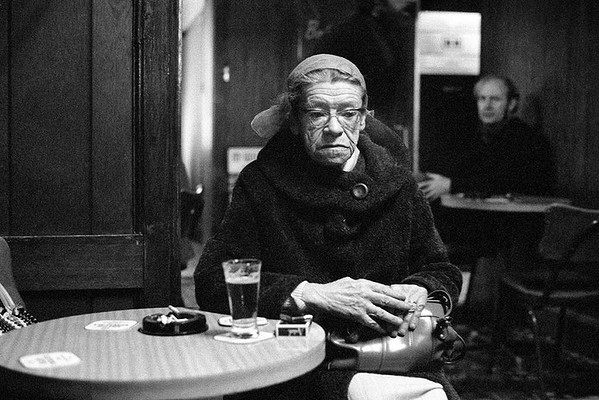 Andrew Chapman, Prahan Pub, 1974
He was a press photographer until the 1980s then started a full time career as a commercial photographer
in 1986. One of his personal projects was shearers in outback New South Wales, Queensland, Victoria and South Australia. This body of work became a book in 2006. Another project was Australian woolsheds.
Refractions: Contemporary urban photography
Refractions: Contemporary Urban Photography is an magazine on, and of, the urban environment, which is published in Melbourne. It can be viewed here. (It's a slow download). The pictures have been selected from the archives of the Flickr group--Urban Photo Publishing. There is an associated blog.
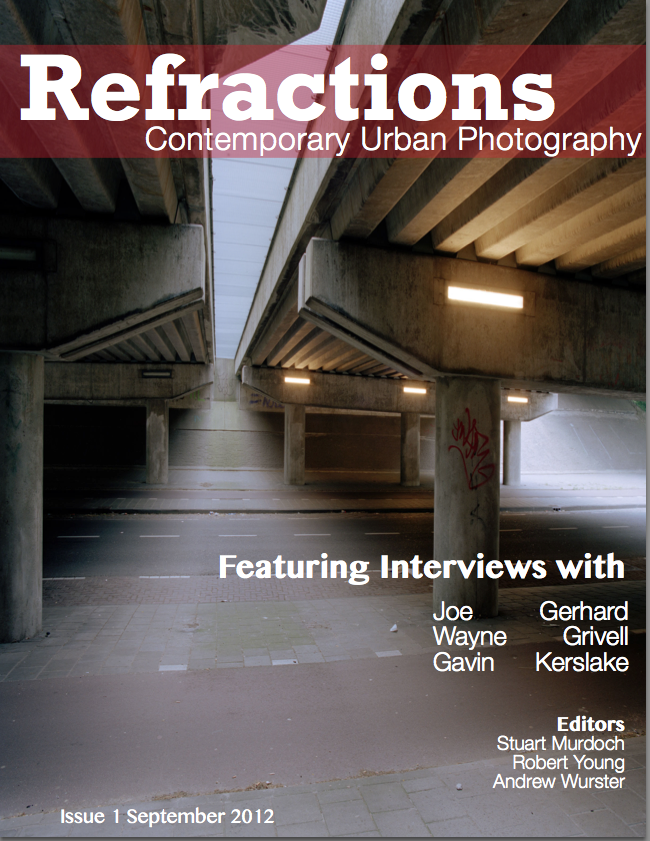
In the editorial Stuart Murdoch rejects the traditional modernist emphasis on the single image in favour of viewing photographs in the context of a body of work. He says that:
Historically in the art world, context was usually a printed exhibition, sometimes a book, or a photo essay, today an advertising campaign would be the commercial aspect of context.The internet and digital media has blown some parts this idea out of the water. The idea of context is lost on many people on the web, in fact the web changes this context extensively. To make interesting engaging work in the space that is cyber space, is at best difficult, at worst impossible to do, and to keep doing for any established amount of time unknown of... yet?
Murdoch asks, 'Is scrolling or swiping on a screen as an engaging experience as walking along a row of walls painted white, where the distance between images for some artists needs to be measured in millimeters?'
His response is that this question is still unanswered, but he refers us to Marvin Heiferman (ed.) Photography Changes Everything and Codex magazine. The latter is a collaborative graphic and textual website that employs a group of editors from across the globe, who post work and respond to each other’s posts, using primarily photographic fodder with minimal text, as well as graphic images, memes, gifs etc.
This collaborative approach to photography exemplified by Refractions is part of the commons in the public sphere. It stands in opposition to the corporate control of images through establishing various tollgates to the electronic reproduction rights on the information superhighway, and it provides a way for urban photographers to create a different history outside of the global supermarket of digital images.
This opens up a different set of concerns to those around the potential and actual impact of computing on the practice of photography, which many academics consider to be a turning point in photography's history.