|
August 28, 2011
I watched a DVD of Super Size Me last night. It is a documentary by Morgan Spurlock of a 30-day period from February 1 to March 2, 2003 during which he eats only McDonald's food and becomes very sick. It's a docudrama in the form of Michael Moore's Bowling For Columbine (2002) in which the political candidness and accessibility to a wide readership allows the independent features to enter the commercial market, rather than being sidelined as art house productions that receive minimal public exposure.
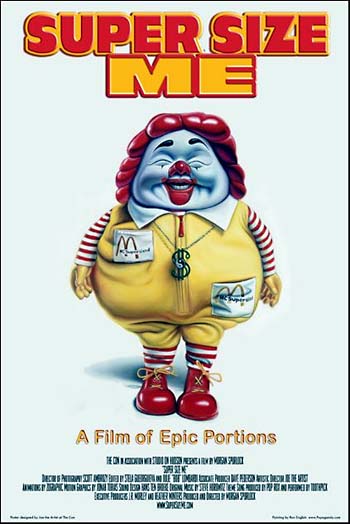
Spurlock claimed he was trying to imitate what an average diet for a regular eater at McDonald's—a person who would get little to no exercise—would do to them. The film's raison d'être resides in why the demand for such fast food outlets continues despite the well known health warnings about fast food high in fat content, and the associations between fast food intake and increased body mass index (BMI) and weight gain.
The result of eating unhealthy foods--those that are high in fat, high in sugar and high in salt--- is grossly protruding stomachs, saddle-bag thighs and an elevated risk for diabetes. Obesity is the second leading cause of preventable death in the US. Hence the discourse around the obesity epidemic, the governing of bodies, moral panic and public health campaigns to educate us about risk, lifestyles and individual responsibility and instruct us about how we should live.
The film suggested that overeating might not be a simple matter of self-control. Lovers of burgers, fries, fizzy drinks and sugary snacks could be addicted to fast food. The feeling is famiar: you pop a candy in your mouth and you’re off and running on a binge. You can’t have just one chip or a serving of ice cream. One taste and you eat a mountain of it. You just keep on coming back for more refined sugars, high fats as well as processed foods that result in feelings of shame and guilt.
|


