|
September 4, 2011
As is well known, Lee Friedlander's photographs broke with the dominant formal canons of the visual arts and those of photography, such as transparency and breaking our experience of the moment photographed.
Transparency or literalness of the photo is very strong in a positivist culture. Though Friedlander uses the techniques and images of naive photography his formalist modernism utilizes the strategies of juxtaposition and collage of the various elements whilst alluding to the document.
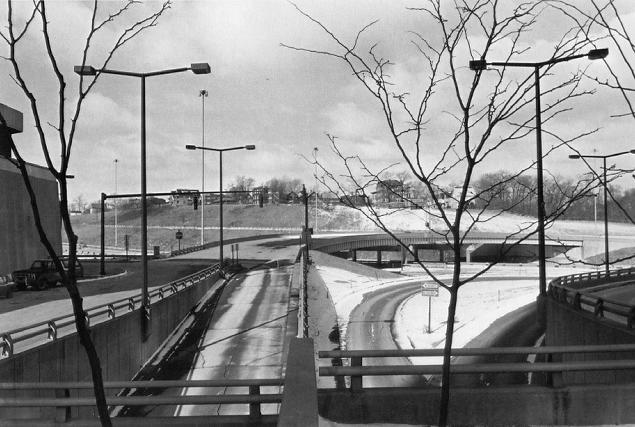 Lee Friedlander, Akron, OH, Plate 13 from "Factory Valleys", 1980
Friedlander is a formalist, concerned with how he divides the rectangle of the photograph, how light and shadow divide space, and how foreground and background relate and merge. Many of his landscapes have strong verticals, horizontals, and diagonals, which Friedlander uses to create additional frames for smaller stories within the frame of the photograph.
In her "Lee Friedlander's Guarded Strategies" essay (originally published in Artforum, April 1975) ---in her Decoys and disruptions: selected writings, 1975-2001 Martha Rosler says that:
The compression of foreground and background is fairly common in Lee Friedlander's photos. It violates the tacit rule that a representational photo should suggest space as we perceive it in the world, with any deformations being easily decodable. Friedlander's deformations are rarely result from the optics of lenses, which we have learned to cope with. Rather, he arrays the pictorial elements so that they may connect as conceptual units, against our learned habit of decoding the flat image into rationalized space.
Though spatial compression is a possibility peculiarly inherent to photography, where such junctures can happen accidentally, Friedlander makes it a conscious technique.
Rosler adds that:
Once you accept that photography need not rest on the history of painting (where, before the heavy influx of photographic influence, at least, there had been no concept of chance imagery, only accident and or better or worse decisions about intentional juxtaposition), you can accept as the outcome of conscious and artistic control photos that have the look of utter accident.
Friedlander’s work may make us think of naive photos that incorporate unwanted elements until we inspect a body of his work, when his habitual choice becomes evident, and chance and accident can be seen to diverge.
|


