|
September 29, 2011
The reading of the Australian land as a vast and empty space is a settler reading of this landscape has been the traditional one. Even after discarding the notion of terra nullius (with its undertones of tabula rasa) as an official characteristic of this land, the fact that we still live around the edges of the country continues to determine how we read the ontology of our dwelling here. The settler reading of the landscape as ‘vast and empty’, waiting for the settler ‘imprint’, has been a constant in Australian history.
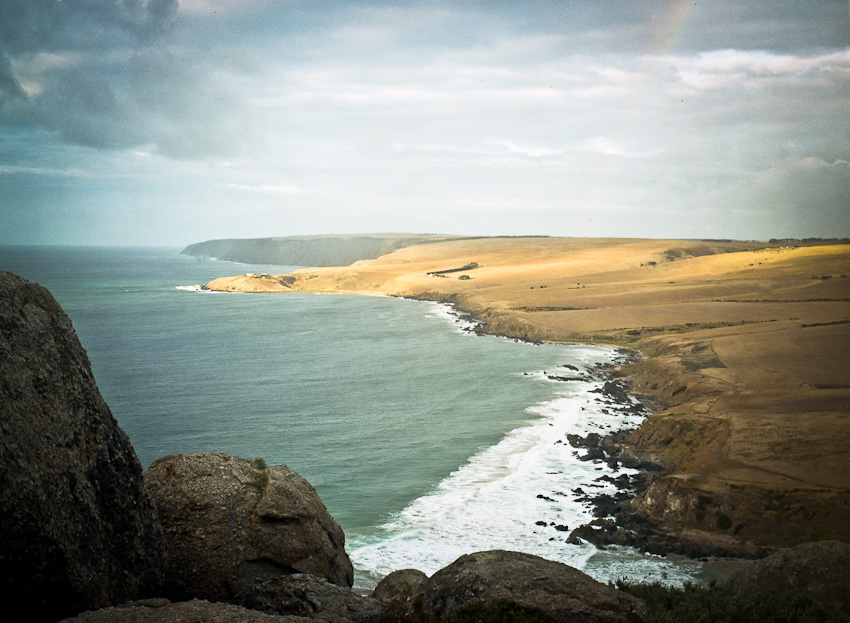 Gary Sauer-Thompson, Petrel Cove: morning, 2002
According to Helen Ennis, the quintessential ‘Australian landscapes’ are those of the bush and the beach: strong light features prominently in this tradition as a marker of ‘man’s’ subordination to nature and a means of illuminating the real and perpetual struggle between the European inhabitant and the rugged landscape.
The implication is that our buildings are situated in the vast, open space giving the impression that they have been constructed elsewhere and placed, almost at random, in this otherwise empty terrain. These buildings seem to have neither a context that grounds them nor the infrastructure or history to justify their presence.
Hence the idea of Australia as lacking----it lacks a visible ‘culture’; an absence that is interpreted as a failure on the part of Australia, as the new locality, to establish itself as a distinct cultural entity. It is seen as provincial. The model is one of centre versus periphery and it functions to marginalise the periphery. The colonial settler heritage that generated in settler artists’ sense of subordinated status, unoriginality and an underlying inadequacy. This constructed Australian art history within a framework of dependency on English, European and American art.
The reaction to this centre/periphery model is the post modern conception of Australia as palimpsest--there is no ‘real’ Australia, just images and representations. Australia is uniquely unoriginal and inauthentic because of the circumstances of its definition by others. Australia is a a simulacrum of the Great Southern Land---less a construct from of geography and origins, and more a construct of texts and textuality.
This was a theoretical framework that supported an art practice in a postmodern, globalised art world that absorbed and processed existing images, producing new but unoriginal works. This is to say, in a fashion, that appropriation artists ate images, in particular those of the North Atlantic canon. The argument that Australian art was uniquely unoriginal was predicated around a centre/periphery model that was marginalized by globalization and swept aside by the meta-culture of globalising biennales.
|


