|
December 26, 2006
I watched Alexander Sokurov's interesting Rusian Ark (2002) last night. We return to the 18th century to explore the corridors and salons of the Baroque Winter Palace (now the Russian State Hermitage Museum) in St. Petersburg (Russia's window to Europe) with a French Marquis diplomat from the 19th century and a modern filmmaker.
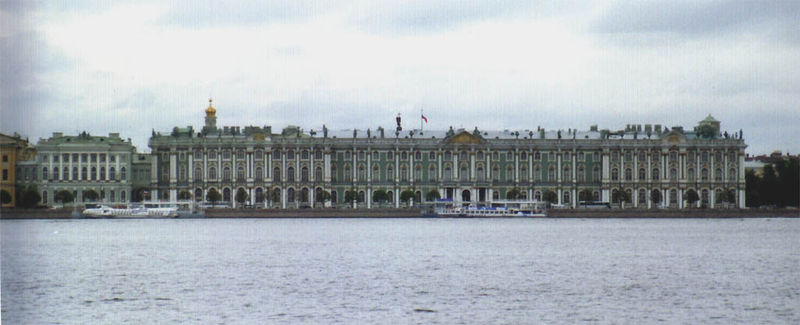
Winter Palace Neva River side, designed by Francesco Bartolomeo Rastre in 1754-62
The Hermitage Museum is the largest art gallery in Russia and is among the largest and most respected art museums in the world. It's collection has been digitalized.
The form of Russian Ark is Russia as a theater and its people are actors. We, as spectators, witness scenes from the Tsarist Empire: Peter the Great thrashes his general with a whip; during rehearsals of her own play, Catherine the Great rushes around looking for a place to relieve herself; the family of the last Tsar dine together, oblivious to the impending revolution; and hundreds of dancers waltz at the last Great Royal Ball of 1913 with Valery Gergiev conducting. The camera moves in and out of different time periods, assessing canvases and sculptures, glimpsing small vignettes and vast scenes.
This voyage through time unfolds in a single, uncut steadicam shot ---- a 96-minute-long, continuous tracking one---whilst the Marquis and the filmmaker as the camera engage in a passionate and ironic dispute criticisms against and defences for the narrator's native Russian culture. The Marquis clearly has a Western love-hate relationship with Russia. He mocks Russian civilization as a thin veneer of Europe on an Asiatic soul. The modern filmmaker questions his country’s uneasy connection to its past and to Europe today.
Henry Sheehan says that Russian Ark is interlinked with V.I. Pudovkin's 1927 Bolshevik classic The End of St. Petersburg, a story of the communist revolution:
As dedicated to expressive editing as Sokurov is to long, long takes, Pudovkin ended his film on the same grand staircase as does Sokurov. But Pudovkin used montage to ascend the stairs and focused on an individual, a revolutionary woman searching for her husband. Sokurov’s long, unbroken shot with a huge group of aristocrats is a riposte to Pudovkin’s. Additionally, Sokurov’s movie ends the same year Pudovkin’s begins.
I'm going to have the Russain Ark again--so I can move beyond the overpowering strangeness of its one-take structure and begin assess artistic implications. Matt Zoller Seit, writing in the New York Press, says that the super-long takes purely is esthetically significant:
It represents one extreme of an old, still-unresolved argument in film theory, namely: Does the essence of cinema lie in camera movement, composition and the arrangement of objects before the lens, or in the editing room? Thanks to the technical limitations of film cameras and the academic triumph of montage theory---exemplified by D.W. Griffith, Sergei Eisenstein and other editing room pioneers---the long take never had much chance at winning the argument. Editing allows one to expand, contract and otherwise manipulate and master time. The long take makes one more aware of time---the immutability of time, the continuous, merciless flow of time. Editing, by its very nature, chases immortality and omniscience; the unbroken long take acknowledges mortality; it also suggests a limited, subjective experience. There are no cuts in real life; ergo, when a movie scene unfolds without cutting, even when the onscreen action is absurd, it still feels more urgent, more real somehow, than a scene that’s edited---almost tactile.
Russian Ark is a meditation on how the past (history) continues to affect (even inhabit) and shape the present from the perspective of our subjective, continuous experience being guided through Russian history.
:
|


