|
December 14, 2006
I was in Melbourne on the weekend for work, and I stayed at the Radisson on Flagstaff, which had one broadband connection in the one desk business centre. The hotels continue to charge exorbitant rates for internet access. It was far too hot to walk around the city taking photos as I had planned, but I was able to take a tram to St Kilda on Saturday night, and I did a quick explore of the Docklands----Australia's largest urban renewal project---as the taxi took me to the airport to catch a flight to Canberra early Monday morning.
What initially struck me was the high rise apartment architecture. This great photo by Dutch photographer Frank van der Salm, courtesy of Conscientious, represents what I saw:
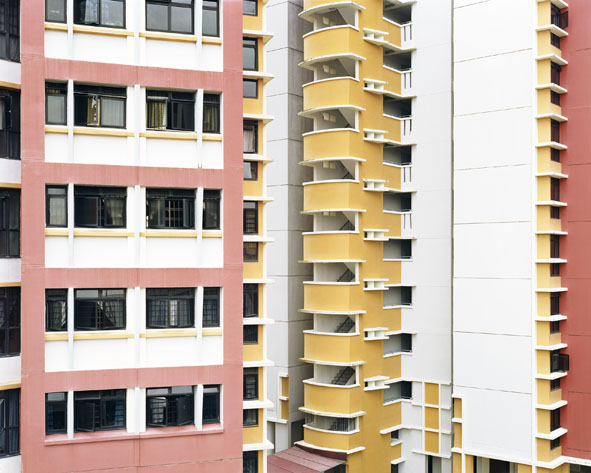
Frank van der Salm, Regime , 2005
The Melbourne Docklands stands for urban renewal of Melbourne's derelict waterfront. What I saw from the city end were high modernist apartment towers with splashes of colour. The towers were standing in wind swept public spaces that did not appear to be very people friendly. Does it give the city a heart? Does it enable the shift from doughnut city to cafe society?
Some say Docklands lacks 'soul'. The section I saw certainly hasn't put Melbourne in the vanguard of urban renewal and design. Was this part of the Docklands, or is it something adjoining?
The 15 year Docklands urban renewal project (progressive completion until 2015) is adding a total of 200 hectares to the western edge of Melbourne's central city area. It is is marketed as luxury waterfront living, cafes, restaurants, a state of the art stadium, a high technology park etc. It is to be a showpiece of design and renewal as indicated in this project vision:
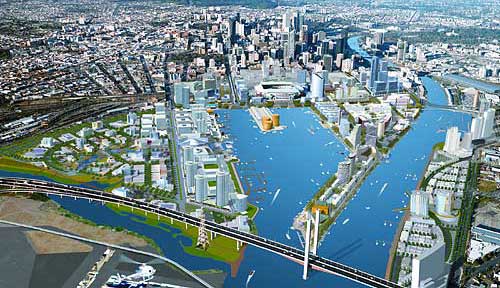
Docklands, Melbourne
Presumably, the urban development around the water edge is more attractive, visual and people friendly than the back end or the Spencer Street end. So we have piecemeal development and variable architecture in 7 different precincts with different developers.
Telstra Dome looked brutal. A 20th century A monster. Where were the flowing organic lines and the post modern shapes?

It is an urban transformation that goes way beyond anything in Adelaide. It is one firmly within increasing global integration, the shift from a manufacturing to a services economy, and the agglomeration of key functions into an area adjoining the central business district (CBD) of Melbourne. It says that Melbourne is part of the new international economy. Adelaide is not. In Adelaide the concerns of the urban policy debate still revolve around the 1980s consolidation--urban sprawl question with the policy outcomes falling on the side of urban consolidation--- eg. the local policy frameworks of Adelaide 21.
|


One of the most colourful waterfronts I have seen was Cape May, NJ. The houses were pretty old but they had been painted up in blues, purples, salmons, yellows, etc etc.