Thought-Factory.net Philosophical Conversations Public Opinion philosophy.com Junk for code

Mandy Martin, Puritjarra 2, 2005. For further information on MANDY MARTIN, refer here: http://www.mandy-martin.com/
If there are diverse kinds of knowledge and ways of knowing place, then we need to learn to value the different ways each of us sees a single place that is significant, but differently so, for each perspective.
RECENT ENTRIES
SEARCH
ARCHIVES
Library
Thinkers/Critics/etc
WEBLOGS
Australian Weblogs
Critical commentary
Visual blogs
CULTURE
ART
PHOTOGRAPHY
DESIGN/STREET ART
ARCHITECTURE/CITY
Film
MUSIC
Sexuality
FOOD & WiNE
Other
www.thought-factory.net
looking for something firm in a world of chaotic flux

Queenie McKenzie « Previous | |Next »
November 26, 2006

I mentioned Queenie McKenzie in this post. She had a relatively short artistic career as she did not begin to paint until the late 1980's after encouragement from her friend, Rover Thomas
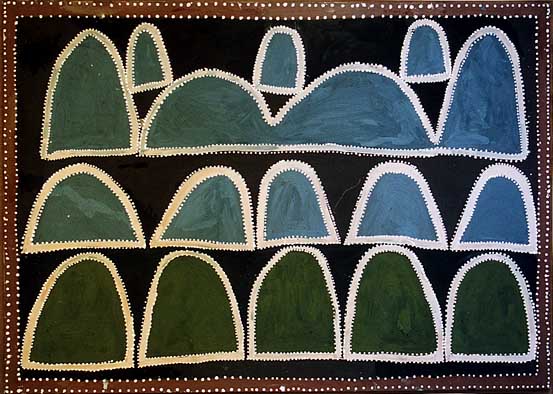
McKenzieQLudanFishhole.jpg
Queenie McKenzie,Turkey Creek, Ludan - Fish Hole, 1998

Her painting followed Rover Thomas' style, mapping country in natural ochers, blending landscape with witnessed or remembered events, family anecdotes and mythological information. Her landscapes are very distinctive, particularly her rendition of the Kimberleys. She used dots to delineate her simple forms and as a link to the traditional work of the Turkey Creek movement.

In her compositions, she usually placed images of geographic features in rows against monochrome grounds:
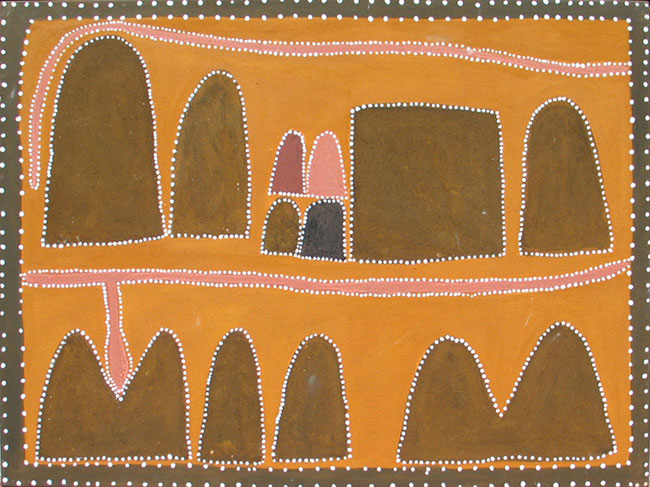
MckenzieQBalinjiTabletop.jpg
Queenie McKenzie, Balinji Tabletop, 1997, 120x91 cm ochre on canvas

Queenie McKenzie is now dead. She was a devout Catholic who, as an artist, tried to preserve both the style of Kimberley art and the traditional stories.

This kind of work takes us beyond the culture Wars, which suggests that there are two sides implacably opposed to one another, and that their goal is total victory by whatever means. To speak of culture wars, too, ennobles the warrior, and suggests aparity between the representatives of different positions. Culture wars are about power, and not about truth, as it suggests pit bulls that can intimidate and maul your enemies.

Culture, in contrast, suggests a pattern of relationships that include sharp differences about goals and about ways to live. These differences are best resolved in conversation, based on reasoned and appropriately complex argument about the issues at stake. This conversation has its standards, and you are entitled to a hearing only if you meet those standards.

| Posted by Gary Sauer-Thompson at 11:33 AM | | Comments (18)
Comments

Comments

While working in Alice a few years ago I saw a painting that was a Campbells soup can done in aboriginal dot style. It was quite humourous I thought.

Shamyus,
when Rover Thomas went to MOMA in New York and saw the high modernist abstractions on the walls he asked: who is that guy who paints like me?

Well, of the rover thomas painting I can only say that it looks like his dog has a brain tumor...I like it!!!

Shaymus,
I attended an art history lecture on landscape painting in the Fleurieu Peninsula Biennale that started from Claude Lorraine in the 17th century and traced his influence and reworking through Australian painters from colonial painters up to Fred Williams.

I kept on thinking of the aboriginal artists in the Western desert and the Kimberleys during the lecture --the lecture had nothing to say about them in terms of Claude Lorraine. They were utterly left of field--but they cannot be classified as primitive in opposition to sophisticated European.

The argument of the lecture was that we see the landscape through the schemata of landscape painting--eg; seeing the landscape a la Fred Williams when in an airplane.

If so, then we white Australians do not see the country through the eyes of Rover Thomas, Queenie McKenzie or Rusty Peters.

Primitive is perhaps a rude art word...depends I suppose if you wish to see exactly what is there in art....a lot of this aboriginal stuff includes how the artist feels about the place they are painting..to me that is what sets it apart...yes it does get skipped over I am sure in other countries, well unless there is an interesting black person with a colourful hat standing next to it....Native art is a bit like that. At least now it is regarded unlike say 50 years ago when it really didnt even exist

Shaymus
in the lecture on the landscape I mentioned above the first slide was of a colonial landscape--HT Johnston Evening Shadows, backwater of the Murray, SA in which the figures of Aboriginal people formed a significant presence. This very popular image was linked back to the huge influence of Claude Lorraine.

What was not mentioned in this lecture by the chap from the SA Art Gallery was the way this image of Aboriginal people in the bush was used to signify the primordial 'difference' of the antipodean landscape.

In this painting--and many others-- Aboriginality emerged as a motif of Australia's precolonial past: a timeless, Arcadian realm that preceded European colonisation, and in which Aboriginal people enjoyed uncontested possession of the Australian landscape. This uncolonised landscape represented the antithesis of white settler colonial civilisation represented in the Heidleberg School.

In this art history schemata aboriginal art is primitive. This "primitiveness" in Rover Thomas et el can alternatively be read as a part of the movement of Australian postwar modernist abstract painting that initially emerged in Sydney and linked to New York.

That standard kind of art history narrative is flawed, as abstract painting also emerged in the indigenous communities in the regions in the 1970s.

Yes it is a very nice painting...you can almost hear the bird go dewwwwoop.

Shaymus,
The pastoral landscape of the Australian bush (not countryside)is now interpreted as what we have lost---an unsullied wilderness. Pastoralism and irrigation made this arcadia history.

We desire to make contact with nature as harmonious, serene, and majestic. The tourist shots of beautiful Tasmania appeal to that desire.


yes I suppose that is what I tried to say in my painting "First came the Land then came the fence"

I met a man in tassy who made marvelous ash trays out of huon pine. he didn't smoke.

Shaymus,
very Rousseauian.

where do I find the above painting?---"First came the Land then came the fence" I could not see it on your blog.

picture

can you see the fence?

Shaymus,
pretty good. Looks to be very much in the style of abstract indigenous art

eg. Kathleen Petyarre from Utopia, Northern Territory

all my stuff is abstract...I think I was well and truly Corroboreed when I did that one so I was pleased with the result...
The petyarre painting would hang nicely...doesn't really command to be looked at but interesting if you choose to...initially I would say that it is about land cultivation but.......

Shaymus

people in Australia don't make the connection, but I reckon some indigenous work can be interpreted from the perspective of abstract expressionism, especially the slabs of colour in Mark Rothko or Willem De Kooning.

I realize the content is different---eg., mapping the country versus expressing personal emotions. But the slabs of colour can be some indigenous works--especially in the latter work of Emily Kame Kngwarreye

Yes I agree with your first statement..though the link isnt working at present...

As for the slabs of colour...well they have a place in drab suroundings. but at some point they need to relate to whats there or what the artist percieves to be there....otherwise they may as well been painted by 13 year old asian art students and sold at kmart.

The first link is now working.Scroll down.

I liked the Motherwell painting....

The guy on the left says...G'day Joe do you want to come to the cricket?

No thanks Bob....I'm off to the Races.

Shamyus,
yes I'm partial to Motherwell as well.

It's a move to a pop culture but also links to the imagery of Queenie Mckenzie.