Thought-Factory.net Philosophical Conversations Public Opinion philosophy.com Junk for code

Mandy Martin, Puritjarra 2, 2005. For further information on MANDY MARTIN, refer here: http://www.mandy-martin.com/
If there are diverse kinds of knowledge and ways of knowing place, then we need to learn to value the different ways each of us sees a single place that is significant, but differently so, for each perspective.
RECENT ENTRIES
SEARCH
ARCHIVES
Library
Thinkers/Critics/etc
WEBLOGS
Australian Weblogs
Critical commentary
Visual blogs
CULTURE
ART
PHOTOGRAPHY
DESIGN/STREET ART
ARCHITECTURE/CITY
Film
MUSIC
Sexuality
FOOD & WiNE
Other
www.thought-factory.net
looking for something firm in a world of chaotic flux

The falling man « Previous | |Next »
September 01, 2006

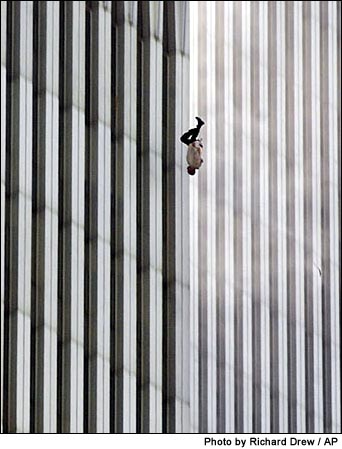
The photo below depicts a man falling from Manhattan's World Trade Center during the September 11, 2001 attacks in New York City. The unknown subject was one of the people (dubbed "jumpers" by the press) trapped on the upper floors of the building who apparently chose to jump to certain death, rather than die from the heat, fire and smoke. They did so until the tower collapsed.
DrewR.jpg
Richard Drew, The Falling Man, 2001

The image is controversial, especially in the US. The media's self-censorsed the photograph, preferring instead to print photos of acts of heroism and sacrifice. The picture appeared all over newspapers on September 12, but never appeared again. The image was deemed to be too confronting and it was derided as disrespectful, voyeuristic and exploitative of the tragedy that tore at the heart of the US.
WorldtradecentreBestS.jpg
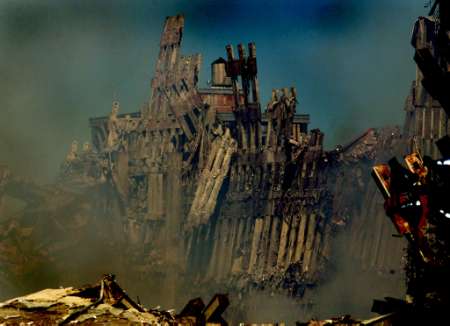
Shaun Best, 2001

The media were seen by the American public as being irresponsible and immoral. They exposed children to a brutal and honest truth? What truth is that? What is being exposed?

Update: 5 September
Kim Huynh provides an answer in an op ed. in the Canbera Times. He says that the violent reaction is in part explained by the falling man's defiance of two of the great narratives of our times:

The story of the modern forward-looking individual tells us that we must strive until the very end, if only because this is as good as it gets. From this perspective, each of us exists at the centre of the universe and, with enough will, can overcome any obstacle.The Christian story also urges us to carry on in the face of hardship because you never know when God will bestow his miracles. Even more compelling is the knowledge that there is only one sin that the Almighty cannot forgive - suicide. These grand stories are woven together to form the very core of what it means to be American today.

That makes sense.

| Posted by Gary Sauer-Thompson at 12:33 AM | | Comments (4) | TrackBacks (1)
TrackBack

Listed below are links to weblogs that reference The falling man:

» 9/11: 5th anniversary from Public Opinion
There is a lot of rewriting of history going on in the media commentary around the anniversary of 9/11. A lot of the commentary centres on the disconnect around the planes crashing into the World Trade Centre and the invasion of Iraq. The disconnect ja... [Read More]

 
Comments

Comments

Little bit raw too at the time.

Cam,
so it would seem. The image strikes at the heart of things American. They wanted affirming images to help them cope with the awfulness of what happened.

I was in DC when it all occurred. The top image is a bit raw for me even now. A bloke I work with up in NJ used to work for the Port Authority. He lost his brother in law and several old workmates. Sept 11th anniversaries are pretty rough on him.

Cam
I remember seeing the event unfold on late night TV in Adelaide and not really comphrending what was actually happening, even though I watched the live feed for hours.

I still have difficulty trying to understand the emotionality of the American reaction to 9/11 in the context of say the Lebanese suffering caused by the Israeli bombing. I now that 9/11 has had an enormous impact but the suffering of the Lebanese strikes me as far more tragic. I guess I dont understand the deep religiousity of the US.

Some of the American cartoons I see on the Cagle Cartoon Index about the Middle East--especiaally Iran--shock me. I find them so extreme. Thuey are more about the American unconscious than actual events, and they are pretty raw.

What the image says to me is: would I jump in a similar situation?