|
September 15, 2006
I picked up a couple of remastered old Fairport Convention CD's in Canberra ---Leige and Leif (1969) and Full House (1970) the other day. This music is prior to the disconnect between good music and the corporate music industry becoming a chasm, and the rise of the independent, or "indy" scene. The latter is where good music is now happening, as the corporate major labels are now releasing bad, overpriced music that has little appeal. Openness to new music by the corporate music industry is at an all time low.
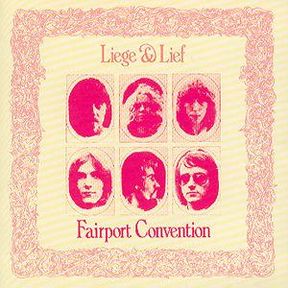 This a landmark CD as it marks the English version of fusing traditional and electric music: from Fairport Convention being a rock band that used folk music as an influence on their sound----transforming from a Byrds-style folk-rock band into a electrified band that specialised in reinterpreting traditional English music. This was the period that saw the band forging new music by drawing on a rich British heritage in much the same way that the Band (and the Bryds, Gram Parsons and Grateful Dead) were doing in America. This a landmark CD as it marks the English version of fusing traditional and electric music: from Fairport Convention being a rock band that used folk music as an influence on their sound----transforming from a Byrds-style folk-rock band into a electrified band that specialised in reinterpreting traditional English music. This was the period that saw the band forging new music by drawing on a rich British heritage in much the same way that the Band (and the Bryds, Gram Parsons and Grateful Dead) were doing in America.
Both the Byrds and Fairport Convention started their careers by covering modern folk artists (Bob Dylan, Joni Mitchell) and proceeded to extend and refine the folk genre bringing in a beat to move the music along. Both also eventually fell back on older forms as they explored the edges of folk-rock: The Byrds to country and Fairport to the jigs/reels/etc.
Leige and Lief is traditional English folk ballads with electric instruments (eg., the tracks Matty Groves and Tam Lin). Undeniably it's a great folk album, but a poor rock album. Moreover, there were only two original number on Leige and Leif--- the soaring 'Come All Ye', and 'Crazy Man Michael.'
The rest were adaptations of old English folk songs. Sandy Denny and Ashley Hutchings then left to begin independent careers (Fotheringay and Steeleye Span) . Hutchings carried on the most traditional face of British folk-rock with Steeleye Span, the Albion Band, and the Etchingham Steam Band.
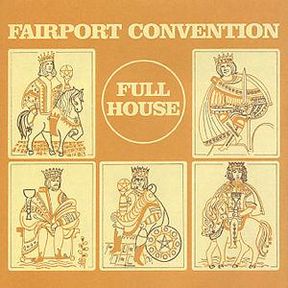 Full House places a greater emphasis on writing their own music and so breaks new ground and so is similar to the way that Gram Parsons broke new ground in the US. Full House places a greater emphasis on writing their own music and so breaks new ground and so is similar to the way that Gram Parsons broke new ground in the US.
Full House emphases the rock side of folk rock. It is centred around the contributions of, and the duelling between, Dave Swarbrick the fiddler and Richard Thompson the guitarist in particular. There is much more punch and energy in the music, but it lacks diversity and it does sound a bit monotonous at times.
Thompson left to pursue a solo career after 'Full House' as the material Thompson was writing at the time was not suitable for the band. The sound of Fairport Convention today is the electrified British folk style that had been mapped out on Liege and Lief---in the form of a English pub band playing pub music. It was Thompson who was the most innovative of this group of musicians ---the classic 'I Want to See the Bright Lights Tonight' (1974) and 'Shoot Out the Lights' (1982) with Linda Thompson realized Fairport Convention's rock/folk fusion promise of good original popular music with its roots in British folk music.
I'm not sure about Richard Thompson's work in the 1980s and 1990s. He shifted to Los Angeles and the production became more 'Americanized. ' I have only listened to bits of the music of this period.
|


I'm a big fan of Richard Thompson but yet to hear his work with Fairport. They are now on my list of CDs I need to get.