|
September 7, 2006
Sight is a privileged epistemological tool and our way of seeing and thinking about the world around us has been informed by the camera. These machines define the position of the interiorized observer to the outside world and they have been influential in representing our travelling experiences.
Travel has always served as a material basis for landscape aesthetics in art. Recall Claude Lorrain's sketches in Italy which inspired his classical landscape manner and artists for centuries; Edmund Burke's concept of the sublime was deeply associated with the sea and the Alps; Gilpin defined the picturesque on the basis of walking tours of England; and excursions in Italy underlay the Neoclassicism and historical landscapes of Valenciennes and his followers who established the tradition of plein-air painting. The three most valued aesthetic norms were often nationalised: Italy (the beautiful, associated with classicism); Switzerland (the sublime); and England (the picturesque).
The visual picturesque distinguished true travelers from mere tourists, the former experiencing authentic culture and the latter simply reproducing the false representations scripted by guidebooks The physical experience of moving through a sequence of prospects into a cultural experience, an experience that would enhance one's understanding of human life and human history.
The traveller of yesterday is the tourist of today. In romanticism aesthetics the travelling through a landscape is changed, as the emphasis is placed on the subjectivity of the gazing (middle class) traveller:
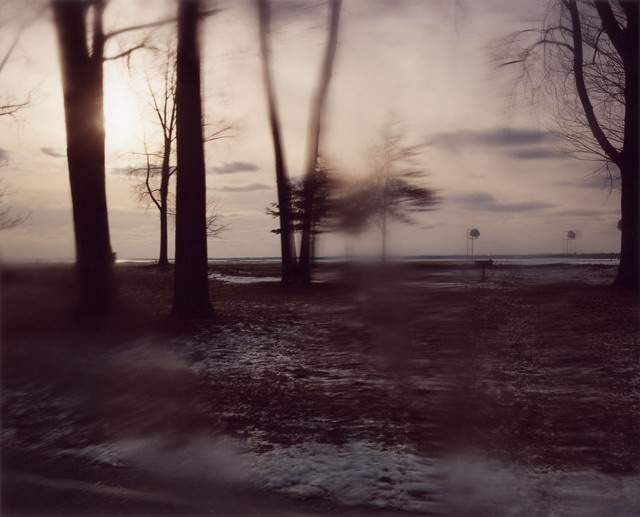
Todd Hiddo
With romanticism the landscape becomes a hybrid of the place, history, myth and illusion. Romantic art is generally characterized by a highly imaginative and subjective approach, emotional intensity, and a dream-like or visionary quality. Romantic art characteristically strives to express by suggestion states of feeling too intense, mystical, or elusive to be clearly defined.
Another part of romantic aesthetics is disclosed by the notion of the romantic sublime in that strand of Romantic European landscape painting that emphasised vast panoramic scenes, depict light breaking through storm laden clouds, endless skies and mist shrouded lakes.
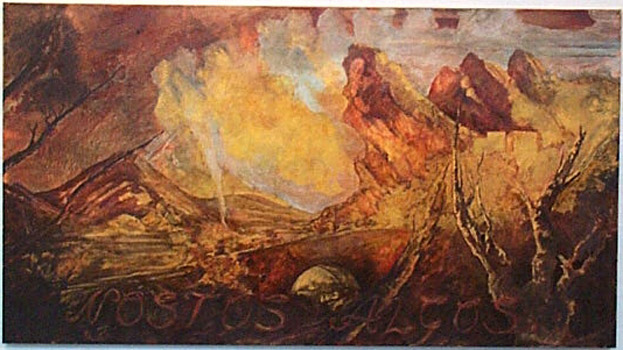
Mandy Martin, Nostos Algos, 2003, Oil, ochre, pigment on linen
The Romantic sublime is often nterpreted in Australia as the moment of inspiration when someone sees beauty in what many see as a hostile landscape. This tamed understanding of the sublime is more akin to a conception of the picturesque, which is what is transgressed in this kind of work:
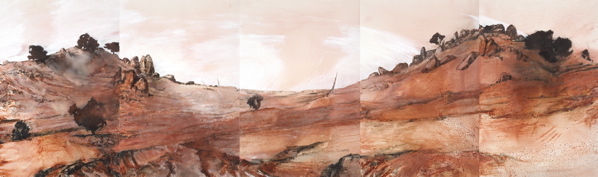
Mandy Martin, Haunted 3, 2005, Oil, ochre, pigment on linen,
I would want to return to Edmund Burke's understanding of the sublime, where 'terror is... the ruling principle of the sublime". He equated the sublime with astonishment, fear, pain, roughness, and obscurity. The sublime horrors appeal to our desires for self-preservation.
|


