|
August 2, 2009
The old mining infrastructure dominates the city of Broken Hill, and it is increasingly becoming disused as the mining winds down due the mines being mined out. The question then arises: --what do you do with the outmoded mining infrastructure that dominates the cityscape?
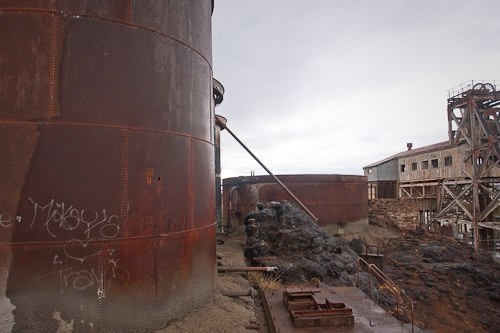 Gary Sauer-Thompson, Junction Mine, Broken Hill, 2009
This is a pressing question for the silver city since it is, by necessity, in the process of reinventing itself as a heritage/tourist destination for domestic tourists. As this submission to the Productivity Commission Inquiry into the Conservation of Australia’s Historic Heritage Places says:
Heritage and cultural tourism have become an integral part of Broken Hill’s future. The fixed life of the mining industry has led the city to focus on sustainable cultural tourism as an important area of growth with heritage as its major selling point.
How do you, for instance, turn the Junction Mine space or site into a new kind of public recreation space?
Should you turn a discarded industrial wasteland into a civic amenity? Martin Filler in Up in the Park in the New York Review of Books offers some insight. He says, in reference to the US, that:
Many architectural preservationists were slow to concede the historical merit of utilitarian landmarks until the 1960s and 1970s. An unusual reclamation project from that period looms larger in hindsight: the land-scape architect Richard Haag's Gas Works Park of 1970–1975 in Seattle, which recycled a defunct gasification plant into a new kind of public recreation space. Haag perceived the raw beauty of the lakeside site's abandoned mechanical components—monolithic tanks, totemic gauges, Mondrianesque pipelines—and incorporated them into his scheme as found objects. Haag's novel idea outraged traditionalists (not least the park's principal benefactors, who refused to have it named after them), but to others the concept seemed reasonable at a time when artists like Mark di Suvero and Alexander Liberman were appropriating I-beams and drainage culverts for their monumental outdoor sculptures.
Another example mentioned by Filler is in New York City: a linear park superimposed on the eponymous long- defunct cargo railroad trestle that wends through nearly a mile and a half of Manhattan's West Side from midtown to Greenwich Village ---known as the High Line.
Though there are a couple of heritage trails or walks in Broken Hill, at the moment Junction Mine is an old industrial infrastructure with a wire fence around it for safety. There is a space for cars and the site favoured by locals for a quite moment sitting in their cars. They just dump their junk food (MacDonalds etc) litter on the ground and drive off. It's all rather sad and derelict.
|


